

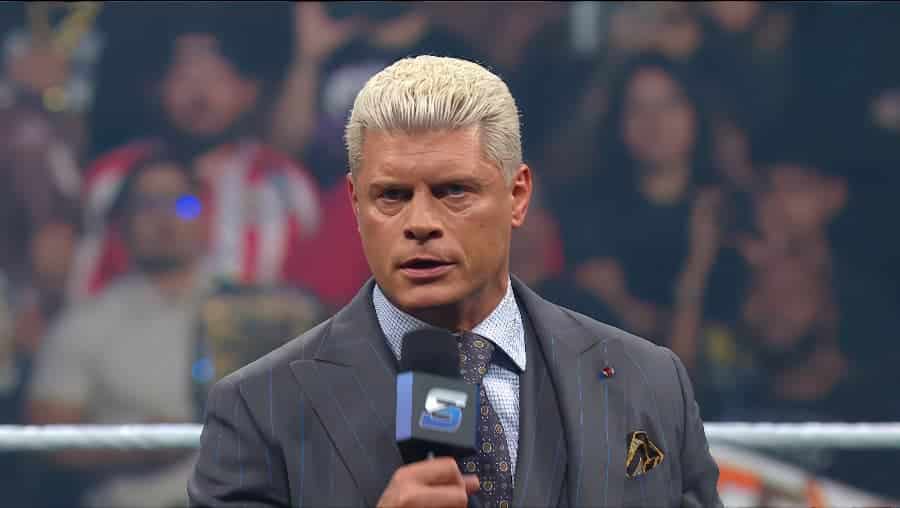
In a remarkably candid and lengthy interview on The Bill Simmons Podcast, “The American Nightmare” Cody Rhodes provided a deep dive into his career, detailing the financial risks of his first WWE departure, the intense physical and emotional struggle of his legendary Hell in a Cell match with a torn pectoral muscle, and the feeling of being “disrespected” that spurred his exit from All Elite Wrestling.
Betting on Himself
Rhodes began by reflecting on the “bet on yourself” moment when he left WWE while in his early 30s. He admitted that while he projected an image of financial security, the reality was far more uncertain. “I would always tell people, ‘Hey, I’m the one Rhodes who saved his money’… But that wasn’t entirely true,” he admitted. “It became, at one point a little bit more we are going check to check. I just bought a house in Denton, Texas… and that’s when I decided to see ya bye.” This financial pressure underscored the risk he was taking as he set out to reinvent himself on the independent circuit, in Japan, and ultimately with the group that would form AEW. It was on this journey that he felt an “underground rumbling” of fan support that culminated in the successful “All In” event, which proved a non-WWE entity could draw 10,000 fans in America.
The Torn Pec and the Hell in a Cell
Perhaps the most defining moment of his return to WWE was competing in a Hell in a Cell match against Seth Rollins with a pectoral tendon torn completely off the bone. Rhodes revealed the intense shame he felt after getting injured immediately after being positioned in his first main event back with the company. “I was really ashamed. I had never been hurt,” he said. “And then I finally got to the spot, and I got hurt… I felt like I’d blown it. So I wasn’t gonna leave that spot that night without at least leaving a very large mark on hopefully, the fans.”
This shame drove him to push through the injury, and he admitted to being less than forthcoming about the pain to ensure the match would happen. “So many lies went into making it so that I could get in that ring that night,” he recalled. “The information was true. WWE doctors looked at me and said he can’t hurt it any worse. That was true. Couldn’t hurt any worse. But also, it didn’t mean it didn’t hurt… I was like, ‘Oh, I’m good. I’m good.'” The pain was immediate and excruciating. “It’s probably two minutes in… it detaches here by my armpit, the other part is connected to your collarbone. So when the detach here, it just falls… However, it would cramp up into the collarbone spot. So anytime you did anything, it would cramp up… when that happened, it hurt more than anything.”
Leaving AEW
For the first time in such detail, Rhodes explained his mindset when leaving AEW, the company he helped found as an Executive Vice President. He stated that while feeling like a number at an established institution like WWE is one thing, feeling undervalued at his own creation was another. “If I felt disrespected ever at WWE, that’s one thing… that’s the Yankees,” he explained. “Feeling disrespected at something I built with my friends… feeling disrespected there, I wouldn’t stand for it. And it was one of those where it was, fuck it… I did way more here than you think. And you’re gonna find out the moment I’m out the door.”
He clarified that while he was angry, his motivation was rooted in a desire to prove his worth. “The greatest revenge on Earth is success,” he said. “And I felt like we were sitting on something wonderful, something great… and if I’m not gonna do it in the house that I literally with Matt, Nick and Kenny built, then buddy, I’m going elsewhere. And every day, I am so blessed that Bruce Prichard, Nick, and Triple H got me, Vince got me back, because I get to live it out now.”
The Return and His Relationship with Triple H
Rhodes revealed that his initial meeting with Vince McMahon and Bruce Prichard about a potential return was not something he expected to lead to a contract, but rather an opportunity for closure. “I was excited to go to that meeting to say… I wanted to tell them both, thank you,” he explained, wanting to make peace after leaving on bad terms years prior. He also spoke at length about his current relationship with Triple H. “He is probably one of the top three… most important people in my professional life, and it’s like, I didn’t know he was until so recent,” Rhodes said. He mentioned that he takes solace in the fact that he gets to have this successful run with someone who was so close to his late father, Dusty Rhodes.
A Montreal Screwjob Conspiracy?
In a fascinating detour, Rhodes shared his personal theory about one of wrestling’s most infamous moments, the “Montreal Screwjob,” suggesting it may have been an elaborate “work within the work.” He questioned the unprecedented nature of the situation. “There was a documentary crew backstage at a company that never, ever allows anything like that. There’s mics in the room,” he pondered. “My position, to me, is always the work within the work.” He explained that growing up around his father taught him to see the layers of storytelling, and that when something feels “too real,” it’s often the highest level of performance.
This long and winding road has led Cody Rhodes to the main event of SummerSlam, where he will challenge John Cena in a Street Fight for the Undisputed WWE Championship, aiming to win the one title his father never held.