


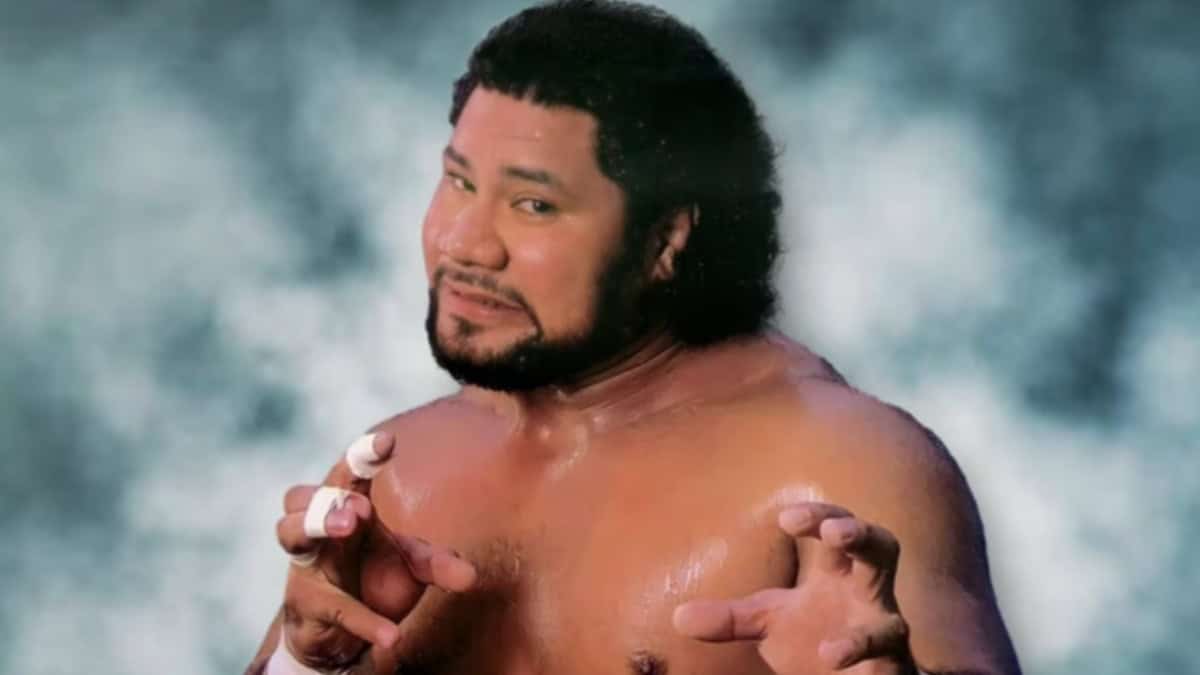
The God of War: Why Haku Is Universally Recognized as Wrestling’s Toughest Man
In the world of professional wrestling, the debate over who is the “toughest” legitimate fighter is a favorite topic among fans and historians. Names like Brock Lesnar, Kurt Angle, Ken Shamrock, and Dan Severn often dominate these conversations due to their pedigrees in amateur wrestling and mixed martial arts. However, when one poses the same question to the wrestlers who shared locker rooms in the 1980s and 1990s, the answer is almost unanimously singular. It is not a UFC Heavyweight Champion or an Olympic Gold Medalist. It is Tonga Fifita, known to World Wrestling Federation (WWF) fans as Haku and World Championship Wrestling (WCW) fans as Meng.
The legend of Meng is unique because it does not rely on televised shoot fights or athletic accolades in combat sports. Instead, it is built upon a collection of terrifying backstage anecdotes, bar fights, and eye-witness accounts from the industry’s most credible figures. From biting off noses to resisting police grade mace, the stories surrounding Fifita paint a picture of a man who possessed a level of primal strength and ferocity that terrified even the largest giants in the business.
From Sumo to Squared Circle
To understand the physical capabilities of Tonga Fifita, one must look at his origins. Born in the Kingdom of Tonga, Fifita was sent to Japan at a young age to train in the disciplined and grueling world of Sumo wrestling. Competing under the shikona (ring name) Fukunoshima, he rose through the ranks rapidly. Sumo training is notorious for its severity, focusing on balance, explosive power, and a high pain threshold.
However, his Sumo career was cut short due to a dispute involving the Japanese Sumo Association’s rules regarding foreign wrestlers. Following his departure from Sumo, he transitioned to professional wrestling under the tutelage of Genichiro Tenryu and Giant Baba in All Japan Pro Wrestling. This background gave him a center of gravity and a striking ability that few American wrestlers possessed. When he eventually migrated to North America, competing in Canada and later the WWF, he brought with him a reputation for being a legitimate “shooter”—someone who could disable an opponent for real if the situation called for it.
The Policeman of the Locker Room
In the territorial days and the early expansion era of the WWF, promoters often relied on specific wrestlers to maintain order. These enforcers, or “policemen,” were tasked with handling unruly fans, settling locker room disputes, or testing new talent to ensure they respected the business.
Haku fit this role perfectly. He was quiet, respectful, and generally kept to himself, but his capacity for violence was well-known. Speaking on his podcast The Snake Pit, Jake “The Snake” Roberts described Haku’s demeanor. Roberts stated, “He was the nicest guy in the world until you crossed him. And if you crossed him, you were dead. There was no in-between with Haku.”
This dual nature is a recurring theme in every story about him. He is frequently described as a generous, family-oriented man who would give a stranger the shirt off his back. Yet, alcohol or disrespect could flip a switch that turned him into a one-man wrecking crew.
The Jesse Barr Incident
One of the earliest and most gruesome stories verifying Haku’s reputation occurred involving wrestler Jesse Barr, who performed as Jimmy Jack Funk. The incident took place in the mid-1980s during a tour. While details vary slightly depending on the teller, the core of the story remains consistent.
According to accounts from wrestlers present at the time, Barr and Haku were drinking when a dispute arose. Barr, who also had a reputation as a tough amateur wrestler, allegedly made a disparaging remark about Haku’s background or ethnicity. Haku did not engage in a shouting match. Instead, he reacted with immediate physical force.
Haku reportedly kicked the teeth out of Barr’s mouth and, in the ensuing grapple, gouged Barr’s eye. The violence was so sudden and severe that it shocked the other wrestlers in the room. In his autobiography The Stone Cold Truth, Steve Austin recounted hearing the story, noting that Haku essentially popped Barr’s eye out of its socket. Barr was hospitalized and required significant medical attention, while Haku continued working without a scratch.
The BWI Airport Nose Biting
Perhaps the most infamous tale in the Haku’s career is the “BWI Incident.” This story has been retold by numerous wrestlers, including Kevin Sullivan and Bobby Heenan, and eventually confirmed by Fifita himself in shoot interviews.
The incident occurred at the airport bar in Baltimore (some accounts say St. Louis, but Baltimore is the most cited location). Haku was having a drink with fellow wrestler Siola “Siva” Afi. A man at the bar began mocking the wrestlers, calling them “fake” and making derogatory comments. Haku initially tried to ignore the man, asking him to leave them alone. The man persisted.
When the man escalated the confrontation, Haku decided to end it. He grabbed the man, sat him down, and bit a significant portion of the man’s nose off.
Speaking in a shoot interview for RF Video, Haku explained the mechanics of the fight with chilling nonchalance. He described holding the man and biting him, noting that he spat the piece of the nose out afterward. The incident resulted in a lawsuit and legal trouble for Fifita, but it cemented his status as a man who was not to be trifled with. The brutality of using one’s teeth in a bar fight demonstrated a level of savagery that went beyond a simple punch or headlock.
The Handcuffs and Mace
Another story that defies the laws of physics involves an altercation with police officers in St. Louis. According to the legend, a disturbance involving Haku and The Barbarian (Sione Vailahi) at a bar led to the police being called.
When officers arrived, they attempted to subdue Haku. Reports state that the officers used mace directly in his face. In most human beings, this would cause immediate blindness and incapacitation. Haku, however, reportedly inhaled the mace and looked at the officers with anger rather than pain.
The struggle escalated to the point where Haku was handcuffed. In a display of hysterical strength, Haku allegedly snapped the handcuffs. While some skeptics argue that the chain mechanism of the cuffs may have been faulty, witnesses stand by the claim that he broke the restraints through sheer force. It took multiple officers and significant backup to finally subdue him.
The Andre the Giant Connection
Andre the Giant was arguably the most powerful force in wrestling history. Standing over seven feet tall and weighing over 500 pounds, Andre did whatever he wanted. He was known to be a bully at times, intimidating other wrestlers for his own amusement. However, there were two men Andre never messed with: Harley Race and Haku.
In the Andre the Giant HBO documentary, several interviewees mentioned the respect Andre had for Haku. They were often travel partners. Andre knew that if a situation in a bar went south—which it often did when fans harassed the Giant—Haku was the only person capable of watching his back.
Ted DiBiase, the “Million Dollar Man,” recounted a story where he, Andre, and Haku were in a bar. A group of patrons began harassing them. Andre simply grabbed Haku’s shoulder and whispered, “Boss, take care of this.” Haku stood up, and the patrons, sensing the shift in energy, immediately backed down. The fact that the largest athlete in the world used Haku as his personal security speaks volumes about Fifita’s capability.
WCW and the Faces of Fear
When Haku moved to WCW and became Meng, his reputation traveled with him. He was paired with The Barbarian to form “The Faces of Fear.” During the Monday Night Wars, backstage politics were rampant. The NWo (New World Order) had significant creative control, and egos were running high.
Kevin Sullivan, who was the booker (head writer) for WCW at the time, utilized Meng’s reputation to keep the roster in check. In various interviews, Sullivan admitted that if a wrestler was refusing to sell moves or acting unprofessional, he would threaten to book them in a match against Meng.
One famous backstage rumor involves Bill Goldberg. During Goldberg’s undefeated streak, there was tension regarding his willingness to cooperate with other talent. It is alleged that management implied to Goldberg that if he did not follow the script, Meng would be sent out to the ring to “shoot” on him. Whether this threat was explicitly made or simply implied, the consensus in the locker room was that Meng was the one man who could legitimately stop Goldberg’s streak without a script.
Eric Bischoff’s Perspective
Eric Bischoff, the President of WCW, has spoken at length about Meng on his 83 Weeks podcast. When asked if he was ever afraid of the wrestlers on his roster, Bischoff consistently names Meng.
Bischoff recalled a specific instance where he had to fire Meng. The task terrified him. He expected a violent reaction. Instead, Meng was the consummate professional. Bischoff noted, “I walked into the room, and I was sweating. I told him, ‘Meng, I have to let you go.’ He looked at me, shook my hand, and said, ‘Thank you for the opportunity, Mr. Bischoff.’ It was the classiest exit I ever saw.”
This interaction highlights the dichotomy of the man. He respected the hierarchy and the business. He did not use his strength to bully his employers; he used it only when he felt he or his family were being disrespected.
Chris Benoit and the Respect of Peers
The late Chris Benoit, known for his own intensity and stiffness in the ring, held Meng in the highest regard. In shoot interviews, Benoit often told a story about the “Dungeon of Doom” era in WCW. He noted that while the characters were cartoonish, nobody laughed at Meng.
Rick Steiner, a collegiate wrestling standout and legitimate tough guy in his own right, also deferred to Meng. There is a famous story where the Steiner Brothers, known for working incredibly stiff and roughing up opponents, worked a match with the Faces of Fear. Backstage, Rick Steiner reportedly told his brother Scott, “Don’t mess with Meng. Do whatever you want with the other guy, but leave Meng alone.”
The 2001 Royal Rumble Return
In January 2001, Haku made a surprise return to the WWF at the Royal Rumble. At the time, he was actually the WCW Hardcore Champion. He walked out of WCW with their belt to return to Vince McMahon’s company, a week before WCW was sold.
His appearance in the Rumble was brief, but the reaction from the commentary team—Jim Ross and Jerry Lawler—was telling. They immediately sold the fear. He was not presented as a nostalgic comedy act; he was presented as a dangerous variable. Even in his 40s, the aura of Haku remained intact.
Life After Wrestling
Following his retirement from full-time competition, Tonga Fifita settled in Kissimmee, Florida. In a pivot that surprised many fans, the “toughest man in the world” became the manager of a Toyota dealership.
Accounts from fans who have visited the dealership describe a soft-spoken, kind grandfather figure who is happy to sign autographs and talk about the old days. He has also successfully raised a wrestling dynasty. His sons, Tama Tonga, Tanga Loa, and Hikuleo, have become stars in New Japan Pro Wrestling and WWE, carrying on the family legacy.
The Verdict
Why does the legend of Haku persist? In an industry built on “worked” fights and pre-determined outcomes, fans and wrestlers alike crave authenticity. They want to know that behind the theatrics, there is a real hierarchy of toughness.
Haku represents the apex of that hierarchy. He is the “final boss” of wrestling reality. The stories of nose biting, eye gouging, and resisting arrest are not just tall tales; they are warnings that were passed down from generation to generation of wrestlers.
Ric Flair perhaps summed it up best on his To Be The Man podcast. When asked who would win in a fight between Haku and anyone else, Flair did not hesitate.
“It’s Haku,” Flair said. “If I had a gun and he was sitting across the room, I wouldn’t shoot him. I’d be afraid he’d eat the bullet and then kill me.”
While the era of the bar-fighting wrestler has largely passed, replaced by video gamers and corporate branding, the shadow of Haku looms large. He remains the benchmark against which all tough guys are measured, and likely will remain so forever. He is the one man in the history of the sport who never needed a championship belt to prove he was the King.

