


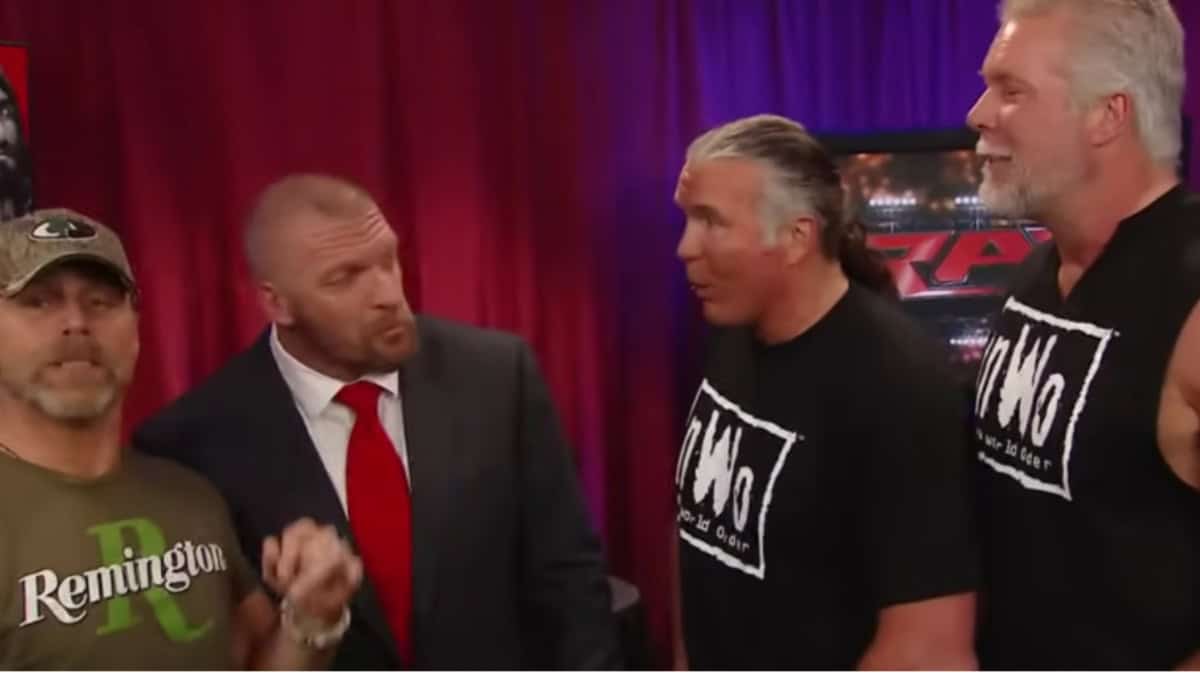
The Day Kayfabe Died: How the MSG Curtain Call Shattered Wrestling Tradition Forever
On the night of May 19, 1996, inside the hallowed halls of Madison Square Garden, four men stood in the center of a wrestling ring and dismantled a century of tradition in a matter of seconds. To the casual observer, it was simply a group of friends saying goodbye. To the wrestling industry, it was an act of treason. Known as “The Curtain Call,” this incident saw Shawn Michaels, Kevin Nash, Scott Hall, and Paul Levesque (Triple H) break character—shattering the “kayfabe” illusion that good guys and bad guys were sworn enemies—to embrace in front of a live audience.
The fallout from this single event was catastrophic and transformative. It resulted in the burial of a future legend, the rise of the sport’s biggest anti-hero, and the total shift in how professional wrestling was presented to the public. It is the defining moment where the “New Generation” ended and the chaotic, reality-blurred “Attitude Era” truly began.
The Power of The Kliq
To understand why the Curtain Call happened, one must understand the political landscape of the World Wrestling Federation (WWF) in the mid-1990s. The locker room was dominated by a backstage faction known as “The Kliq.” Composed of Shawn Michaels, Kevin Nash (Diesel), Scott Hall (Razor Ramon), Paul Levesque (Hunter Hearst Helmsley), and Sean Waltman (The 1-2-3 Kid), this group wielded unprecedented influence over Vince McMahon.
They were known for looking out for their own interests, often at the expense of other talent. They influenced booking decisions, match outcomes, and paydays. This naturally bred resentment among the rest of the roster, who viewed them as manipulative politicians. However, their bond with each other was genuine. They traveled together, ate together, and in an industry built on deception, they trusted only each other.
By early 1996, the landscape of wrestling was shifting. World Championship Wrestling (WCW), backed by the deep pockets of Ted Turner, was aggressively recruiting WWF talent. Kevin Nash and Scott Hall, two of the WWF’s biggest stars, were offered guaranteed contracts by WCW that Vince McMahon simply could not match. Both men decided to leave the WWF for the greener pastures of Atlanta.
The Farewell at the Garden
May 19, 1996, was scheduled to be the final night for Nash and Hall in the WWF. The event was a non-televised “house show” at Madison Square Garden. In the wrestling world, MSG is not just an arena; it is the spiritual home of the WWF. Performing there is a privilege, and protecting the business within its walls was considered a sacred duty.
The card featured two key matches involving The Kliq. Scott Hall, performing as the bad guy (heel) Razor Ramon, lost a match earlier in the night to Hunter Hearst Helmsley, who was also a heel. The main event featured the WWF Champion Shawn Michaels, the company’s top good guy (babyface), defending his title against Kevin Nash (Diesel) in a Steel Cage match.
The match itself was a brutal, hard-hitting affair befitting the rivalry. Michaels retained his championship, sending Nash off with a loss, as is customary for departing talent. However, as the match concluded, the script was discarded.
Scott Hall entered the ring to embrace his friend Nash. This was a minor infraction, as both were bad guys. But then, Hunter Hearst Helmsley entered the ring. Finally, Shawn Michaels, the hero who had just been battered by Diesel, stood up.
In a moment that stunned the traditionalists backstage, all four men—two babyfaces and two heels—met in the center of the ring. They wrapped their arms around each other in a four-way group hug. They raised each other’s hands, bowing to the crowd, acknowledging that their real-life friendship transcended the fictional storyline.
The Wrath of the Old Guard
Backstage, the reaction was immediate and volcanic. The agents and road producers, many of whom were legends from the territorial days, were appalled. To men like Arnold Skaaland and Gerry Brisco, protecting the business was the first commandment of wrestling. By hugging in the ring, The Kliq had exposed the business as a performance, insulting the fans who paid to see a fight.
Jim Cornette, who was working in creative and management at the time, has famously described his reaction in numerous interviews. He viewed it as a professional disgrace, arguing that if the wrestlers didn’t take the conflict seriously, why should the fans?
Vince McMahon’s initial reaction was reportedly mild. He had given permission for a “farewell,” though the specifics of the group hug were likely not fully detailed to him. However, as the days passed and the complaints from the locker room and his veteran advisors mounted, McMahon realized he had a mutiny on his hands. He had to send a message that kayfabe still mattered, even if he personally liked The Kliq.
The Punishment of Hunter Hearst Helmsley
When it came time to hand out discipline, McMahon’s options were limited.
-
Scott Hall and Kevin Nash: They were leaving for WCW the next day. They were untouchable.
-
Shawn Michaels: He was the WWF Champion and the face of the company. With Bret Hart taking time off and Nash/Hall gone, the roster was thin. Firing or burying Michaels would have been financial suicide.
-
Sean Waltman: He was in rehab/injured and not present in the ring.
That left Paul Levesque. Hunter Hearst Helmsley was a rising star, a mid-card heel with a bright future, but he wasn’t a champion and he wasn’t leaving. He became the scapegoat.
Levesque was summoned to Vince McMahon’s office. He was told in no uncertain terms that he would be eating “miles of sh*t” for the foreseeable future. His push was canceled immediately.
The most significant consequence involved the upcoming King of the Ring tournament in June 1996. The original booking plan was for Hunter Hearst Helmsley to win the tournament, elevating him to the main event status. That victory was stripped from him.
The Butterfly Effect: The Rise of Austin 3:16
With Helmsley in the doghouse, the WWF needed a new winner for the King of the Ring. They turned to a mechanic from Texas who had been struggling to find his footing as “The Ringmaster.” His name was Steve Austin.
Austin had recently adopted the “Stone Cold” persona, but he was not yet a superstar. When he was told he would win the tournament, he seized the opportunity. In the finals, he defeated Jake “The Snake” Roberts.
During his coronation speech, Austin mocked Roberts’ religious faith, ad-libbing the line that would define a generation: “You sit there and you thump your Bible, and you say your prayers, and it didn’t get you anywhere! Talk about your Psalms, talk about John 3:16… Austin 3:16 says I just whipped your ass!”
That promo became the highest-selling T-shirt in wrestling history and launched the Attitude Era. Historians argue that if the Curtain Call had not happened, Triple H would have won King of the Ring, Austin would not have cut that specific promo, and the “Stone Cold” phenomenon might never have ignited with such ferocity.
The Outsiders and the NWO
While Triple H was suffering in the mid-card, losing matches to hog farmers and jobbers as penance, Hall and Nash arrived in WCW. They used the heat from their departure—and the reality-based perception that they were “invaders” from the WWF—to form the New World Order (NWO).
The NWO angle was built entirely on the destruction of kayfabe. They acknowledged contracts, “the other organization,” and the behind-the-scenes maneuvering. The Curtain Call had primed the audience for this. The fans at MSG had cheered the breaking of the fourth wall, proving to promoters that the audience was ready for a product that acknowledged the “work.”
The Evolution of Triple H
Paul Levesque took his punishment without complaint. For a full year, he did jobs (lost matches) and worked his way back up from the bottom. This period of humility earned him the respect of the locker room, particularly The Undertaker, who had been one of the staunchest critics of the Curtain Call.
By 1997, Levesque had served his time. He won the King of the Ring one year late (1997) and eventually formed D-Generation X (DX) with Shawn Michaels. DX was, in essence, an on-screen version of The Kliq. They monetized the very rebellious attitude that had caused the Curtain Call. They mooned the audience, broke the rules, and mocked authority—and they became massive stars doing it.
Levesque’s journey from the scapegoat of MSG to the 14-time World Champion and eventually the Chief Content Officer of WWE is a testament to his resilience. He often cites the Curtain Call as a learning experience that toughened him up for the ruthless nature of the business.
The Legacy of the Curtain Call
Today, the MSG Curtain Call is viewed as the “Big Bang” of modern wrestling. It forced the industry to evolve.
Before May 19, 1996, wrestling presented itself as a legitimate athletic contest, even if everyone knew it wasn’t. After May 19, 1996, the industry began to wink at the audience. It acknowledged that the drama was scripted, but asked the fans to invest in the performers anyway.
It destroyed the old way of doing business. The concept of a heel and a face not being able to ride in the same car or be seen in public together evaporated. The internet wrestling community, which was in its infancy, exploded with discussion about the incident, fueling the rise of “smart” fans who cared more about backstage gossip than in-ring storylines.
The incident also cemented the bond between the Kliq members. Despite working for rival companies during the most heated war in wrestling history, they remained best friends. When Scott Hall passed away in 2022, the remaining members of the Kliq stood by his side, just as they had stood by his side in the ring at Madison Square Garden.
Conclusion
The MSG Curtain Call was a moment of arrogance, friendship, and rebellion. It was four young men deciding that their bond was more important than the rules of the business that made them stars. While it enraged the traditionalists and resulted in a year of professional purgatory for Triple H, it inadvertently saved the WWF.
By clearing the path for Stone Cold Steve Austin and forcing the WWF to embrace a grittier, more reality-based product, the hug at the Garden set the stage for the company’s greatest boom period. It was the night the wrestling world stopped pretending, and in doing so, it became more real than ever before.

