


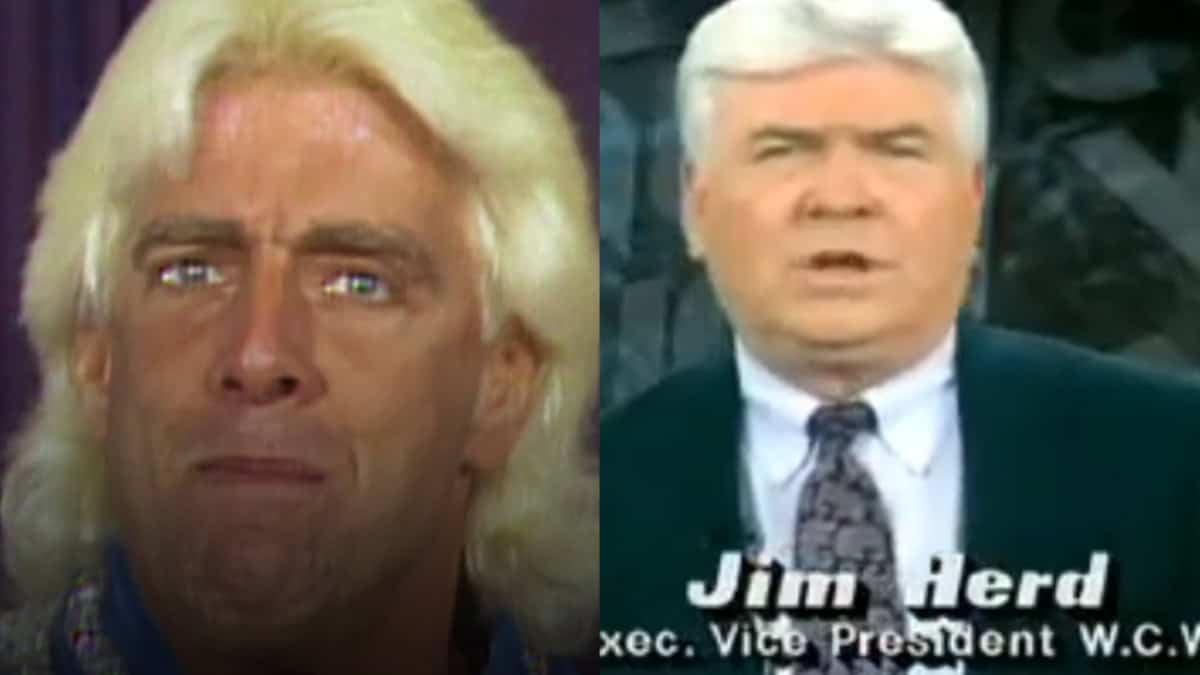
The Pizza Man vs. The Nature Boy: How Jim Herd Drove Ric Flair to the WWF
The story of how a Pizza Hut executive drove the greatest wrestler alive to the competition, taking the sport’s most prestigious prize with him, is a saga of ego, disrespect, and a $25,000 deposit that changed the industry forever.
The New Sheriff in Town
In November 1988, Ted Turner purchased Jim Crockett Promotions to prevent the loss of high-rated wrestling programming on TBS. The company was rebranded as World Championship Wrestling. To run this new corporate entity, Turner executives appointed Jim Herd.
Herd’s background was not in sports entertainment or athletics. He had previously managed the St. Louis station KPLR-TV, which broadcasted “Wrestling at the Chase,” but his most cited qualification was his tenure as a regional manager for Pizza Hut. He was brought in to cut costs and streamline operations, viewing the wrestling industry not as a unique cultural phenomenon, but as just another product to be managed like fast food franchises.
From the moment he arrived, Herd viewed the wrestling business with disdain. He believed the product was antiquated and needed to be repackaged for a younger, mainstream audience. He felt the NWA traditions were holding the company back from competing with Vince McMahon’s World Wrestling Federation (WWF). Consequently, he introduced characters that remain punchlines to this day, such as The Ding Dongs (a tag team of hunchbacks with bells).
However, his biggest obstacle was Ric Flair. In 1989, Flair was undeniably the best wrestler in the world. He was the NWA World Heavyweight Champion, a workhorse who wrestled hour-long draws night after night. But to Jim Herd, Flair was a relic. He saw a 40-year-old man with a “flabby” physique who was being paid too much money to wrestle a style that Herd deemed obsolete.
The Clash of Philosophies
The tension began almost immediately. Flair, who had been booking the territory (writing the storylines), was removed from his position as head booker in early 1990. Herd wanted to dismantle the “Good Old Boys” network that he felt protected Flair and his associates.
In his autobiography To Be The Man, Flair described the hostility he felt from Herd. He noted that Herd did not understand the concept of a “draw.” Herd looked at the bottom line and saw Flair’s salary—which was significantly higher than the rest of the roster due to his tenure and drawing power—as a liability rather than an asset. He did not appreciate that Flair’s matches were the glue holding the house show circuit together.
The creative differences reached a nadir when Herd began to pressure Flair to change his character. He felt the “Nature Boy” persona—the bleached blonde hair, the sequined robes, and the “Stylin’ and profilin'” catchphrases—was played out. In a meeting that has become legendary for its absurdity, Herd suggested that Flair should cut his signature hair, wear an earring, and rebrand himself as “Spartacus,” a gladiator character.
The idea was met with disbelief by Flair and his contemporaries. To ask Ric Flair to stop being Ric Flair was akin to asking Mickey Mouse to shave his ears. It demonstrated a fundamental misunderstanding of the audience’s emotional investment in the character. Flair refused the change, deepening the rift between the champion and the executive.
The Black Scorpion Debacle
The animosity was further fueled by the “Black Scorpion” storyline in late 1990. Herd was desperate for a new top villain to challenge Sting, who had recently won the title. The concept was a masked man from Sting’s past who performed magic tricks. The angle ran for months without a clear plan of who was under the mask.
As the reveal date at Starrcade 1990 approached, Herd realized none of the available options would satisfy the audience. In a panic, he forced Ric Flair to don the mask. Flair, ever the professional, agreed to do the job to save the main event, but it was humiliating. He had to perform magic tricks on television and wrestle in a mask, only to lose to Sting again. It was a clear indication that Herd viewed Flair as a utility player rather than a legend.
The Contract Dispute
By the spring of 1991, the situation had become untenable. Flair’s contract was up for renewal. At the time, Flair was making approximately $750,000 per year, a figure justified by his position as the face of the company and his grueling schedule.
Jim Herd wanted to slash that number. During contract negotiations, Herd proposed a significant pay cut, reducing Flair’s salary to roughly $350,000. Additionally, he wanted to reduce Flair’s role in the main event, positioning him as a mid-card veteran to put over younger talent like Lex Luger and Barry Windham.
While Flair had no issue putting over talent—he had famously made Sting a star at the first Clash of the Champions—he refused to accept a pay cut while he was still carrying the company’s main event scene. He argued that he was still the biggest draw in the company and that a pay cut was disrespectful to his contribution. The negotiations stalled, with neither side willing to budge.
The Firing
The breaking point came in early July 1991. Flair was the WCW World Heavyweight Champion (which was represented by the NWA Big Gold Belt). He was scheduled to defend the title against Lex Luger at the Great American Bash in a steel cage match.
Two weeks before the pay-per-view, Jim Herd called Ric Flair. The conversation, as recounted by Flair in various shoot interviews and documentaries, was brief and brutal. Herd informed Flair that they had reached an impasse regarding the contract.
“Fuck you and your contract.”
Flair recalled thinking the sentiment, though the conversation was strictly business. Herd told him, “You are no longer the champion.”
Ric Flair was fired. The face of the franchise, the man who built the territory, was let go over the phone just weeks before the biggest show of the summer. It was a move of astounding arrogance, leaving the promotion without a champion and without a main event.
The $25,000 Deposit
This is where Jim Herd’s lack of wrestling knowledge proved catastrophic. In the National Wrestling Alliance, the World Heavyweight Champion was required to pay a $25,000 security deposit on the title belt. This money served as insurance to ensure the champion would not leave with the belt or refuse to drop it to a successor. It was a bond, held by the NWA Board of Directors, to be returned with interest when the champion lost the title.
When Ric Flair was fired, he was the champion. He still had the belt. He asked Jim Herd for his $25,000 deposit back, plus the accumulated interest.
Herd refused. He told Flair to send the belt back to the office, and they would sort out the money later. Flair, knowing the treacherous nature of the business and feeling completely disrespected, refused to return the physical belt until he received his check.
Legally, Ric Flair owned the belt. It was collateral for a debt that WCW/NWA refused to pay.
The Heist of the Century
Ric Flair immediately called Vince McMahon. The two had circled each other for years, but the timing had never been right. Now, Flair was a free agent, and he had the NWA World Title in his gym bag.
McMahon saw the opportunity to strike a fatal blow to his competition. He signed Flair immediately. He then devised a plan to introduce Flair to the WWF audience not just as a new wrestler, but as the “Real World’s Champion.”
In September 1991, Bobby “The Brain” Heenan appeared on the WWF show Prime Time Wrestling. In his hands, he held the Big Gold Belt. It was a shocking visual. For decades, that belt represented the “enemy” promotion. Seeing it on WWF television was a declaration of war.
When Flair finally appeared on WWF television, he wore the belt. The WWF blurred the belt digitally on screen to avoid direct trademark infringement litigation, but everyone knew what it was. Flair proclaimed himself the “Real World Champion,” challenging the legitimacy of WWF Champion Hulk Hogan. This angle was revolutionary, as it was one of the first times the WWF explicitly acknowledged the existence of another world title.
The Disaster at the Great American Bash
Back in WCW, the fallout was immediate and disastrous. With Flair fired, the main event of the Great American Bash 1991 was ruined. Jim Herd was forced to scramble.
He stripped the title from Flair (in storyline) and declared the title vacant. The cage match was rebooked as Lex Luger vs. Barry Windham to determine the new champion.
The atmosphere at the Baltimore Arena on July 14, 1991, was toxic. The crowd, aware that Flair was gone, hijacked the show. Throughout the night, loud chants of “We Want Flair” drowned out the action in the ring. The fans felt cheated. They had paid to see the Nature Boy, and instead, they got a vacant title match born of corporate incompetence.
When Luger and Windham—two popular babyfaces—entered the cage, the crowd turned on them. They were booed mercilessly. In a panic to salvage the match, the agents called an audible. Lex Luger turned heel mid-match, utilizing Harley Race and Mr. Hughes to cheat and win the title. The turn made little narrative sense and was a desperate reaction to a hostile crowd.
The show is widely considered one of the worst pay-per-views in WCW history, a testament to the chaos Jim Herd had unleashed.
Legal Battles and the Return of the Belt
WCW eventually filed a lawsuit to stop Flair from showing the belt on WWF television. The legal wrangling continued for months. Ultimately, the two sides reached a settlement.
Ric Flair received his $25,000 plus interest (reportedly totaling around $38,000). In exchange, he returned the Big Gold Belt to WCW. By that time, however, the damage was done. The WWF had established Flair as a superior star, and WCW looked like a minor league operation that couldn’t pay its bills.
Ironically, when the belt was returned, WCW had already created a new world title belt (the smaller “Western” design used by Luger and Sting). The Big Gold Belt sat in a closet for months before being revived in 1992 for the NWA tag team tournament and eventually becoming the primary WCW World Title again known as the “International” title, and later merging back into the main lineage.
The End of the Herd Era
Jim Herd’s tenure did not last much longer. The decline in ratings, the loss of Flair, and the disastrous attendance numbers led to his resignation in early 1992. He was replaced by Bill Watts, and later Eric Bischoff.
Herd’s legacy in wrestling is almost entirely negative. His decision to fire Ric Flair over a contract dispute is viewed as one of the greatest unforced errors in business history. He took a situation that required diplomacy and turned it into a public relations nightmare. He alienated the fanbase, devalued the championship, and handed his biggest competitor a main event star on a silver platter.
Flair’s WWF Run and Return
Ric Flair’s run in the WWF was successful, though brief. He won the 1992 Royal Rumble to become the WWF Champion in what is often cited as the greatest Rumble performance of all time. He finally got his “dream match” with Randy Savage at WrestleMania VIII.
However, by 1993, Flair felt the pull of home. He returned to WCW, where he was greeted as a returning hero. By then, Jim Herd was gone, and the “Spartacus” idea was nothing more than a bad memory.
Historical Significance
The Flair vs. Herd conflict established a precedent for the “Monday Night Wars” that would follow a few years later. It highlighted the importance of talent relations and the dangers of corporate interference in wrestling booking.
It also elevated the mystique of the Big Gold Belt. The fact that the title was held hostage and appeared on rival television gave it a legendary status that surpassed other championships.
In his 30 for 30 documentary, Flair reflected on the incident with a mix of bitterness and vindication. He noted that Jim Herd tried to kill the “Nature Boy,” but all he did was prove that Ric Flair was bigger than any promoter. The image of the Big Gold Belt on WWF TV remains the ultimate symbol of a champion who knew his worth and a promoter who didn’t.