

The Death of a Giant: How the AOL Time Warner Merger Killed WCW
The Turner Safety Net
To understand how WCW fell so hard, one must understand what kept it alive. For years, WCW was owned by Turner Broadcasting System (TBS), led by media mogul Ted Turner. Turner had a deep affinity for professional wrestling. When financiers and executives urged him to sell the company during its lean years in the early 1990s, Turner famously refused, stating that “wrestling helped build this network.”
As long as Ted Turner was in charge, WCW had a safety net. It could lose money, make mistakes, and survive because the boss liked having wrestling on his Superstation. This protection allowed Eric Bischoff to spend aggressively in the mid-90s, signing Hulk Hogan, Randy Savage, and launching Monday Nitro to compete directly with Raw.
However, in 2000, the corporate landscape shifted violently. America Online (AOL) announced a merger with Time Warner (which owned Turner Broadcasting). The resulting entity, AOL Time Warner, was a behemoth focused on synergy, stock prices, and “upscale” demographics. Ted Turner’s influence was significantly diluted. He was no longer the king of his castle; he was a vice chairman in a conglomerate that viewed wrestling as “low-brow” entertainment that repelled high-end advertisers.
The Financial Bleed
While the corporate wolves were circling, WCW was doing itself no favors. By the year 2000, the creative direction of the company had collapsed. Under the erratic booking of Vince Russo and the mismanagement of the executive committee, the product had become unwatchable for millions of fans.
The year 2000 was a financial bloodbath. WCW reportedly lost $62 million in a single year. The company was burning cash on bloated contracts for wrestlers who weren’t being used, expensive production costs, and ill-fated reboots.
Despite the losses, there was still value in the brand. Nitro and Thunder were still among the highest-rated shows on TNT and TBS, respectively. In the television business, ratings usually equal survival. Eric Bischoff, who had been removed from power in 1999, saw an opportunity. He believed that with the right ownership and a creative overhaul, WCW could be profitable again.
The Fusient Media Ventures Deal
In late 2000, Eric Bischoff formed a partnership with Fusient Media Ventures, a group of investors led by Brian Bedol and Steve Kotlowitz. Their goal was to purchase WCW from AOL Time Warner.
The negotiations were advanced. According to Bischoff’s account on his 83 Weeks podcast, the deal was essentially done. Fusient would take majority ownership of the company, while AOL Time Warner would retain a minority stake and, crucially, keep WCW programming on their networks (TNT and TBS) for a period of ten years.
Bischoff had a plan. He intended to take the company off the air for a “Big Bang” reboot. The plan involved moving the tapings to Las Vegas, focusing on a harder-hitting, more athletic style of wrestling, and utilizing the younger talent like Booker T, Scott Steiner, and Goldberg.
A press conference was even held in January 2001 to announce that Fusient had entered a letter of intent to purchase the brand. The locker room breathed a sigh of relief. It appeared that WCW would survive, independent of the WWF, and continue to provide jobs for the boys.
The Kellner Decision
The deal hinged on one non-negotiable asset: television time. A wrestling promotion without a television slot is essentially a local independent show. Fusient was buying the company based on the guarantee that Nitro and Thunder would remain on the air.
Enter Jamie Kellner. In March 2001, Kellner was appointed Chairman and CEO of Turner Broadcasting System. His mandate was to clean up the network’s image and improve profitability. Kellner reviewed the portfolio and made a swift decision regarding WCW.
Despite the ratings, Kellner decided that professional wrestling did not fit the image of the network. He believed it dragged down the advertising rates (CPM) for the other shows on the channel.
In a fateful phone call, Kellner’s office informed Brad Siegel (the Turner executive handling the sale) that WCW programming would be cancelled on TNT and TBS immediately.
This decision killed the Fusient deal instantly. Without television slots, the company was worthless to Bedol and Bischoff. They withdrew their offer. WCW was now an entity with massive debt, expensive contracts, and no platform to broadcast its content.
The Fire Sale
With Fusient out, AOL Time Warner was desperate to unload the asset. They did not want to manage the liquidation; they just wanted it gone. Brad Siegel reached out to the only other buyer in the market: Vince McMahon.
The leverage had shifted entirely to the WWF. McMahon knew that without TV, WCW was dead in the water. He also knew that AOL Time Warner wanted to wash their hands of the wrestling business before their quarterly earnings call.
The final purchase price was staggering in its lowness. The WWF purchased the trademarks, the tape library (containing thousands of hours of footage from JCP, WCW, and NWA), and selected contracts for approximately $2.5 million. To put that in perspective, WCW had paid Master P nearly $300,000 for a few appearances just two years prior.
However, the $2.5 million figure is often debated. It generally refers to the intellectual property and trademarks. The tape library was valued slightly higher in separate accounting, but the total package was less than $5 million. McMahon essentially bought his biggest competitor for the price of a mid-card wrestler’s downside guarantee.
Crucially, the WWF did not buy the Time Warner contracts of the top stars. Wrestlers like Goldberg, Sting, Kevin Nash, Hulk Hogan, and Ric Flair had guaranteed contracts with the parent company (AOL Time Warner), not WCW directly. They were paid millions of dollars to stay home and sit out the remainder of their deals rather than take a buyout to work for Vince McMahon immediately. This is why the “Invasion” angle that followed lacked the biggest names.
The Final Nitro
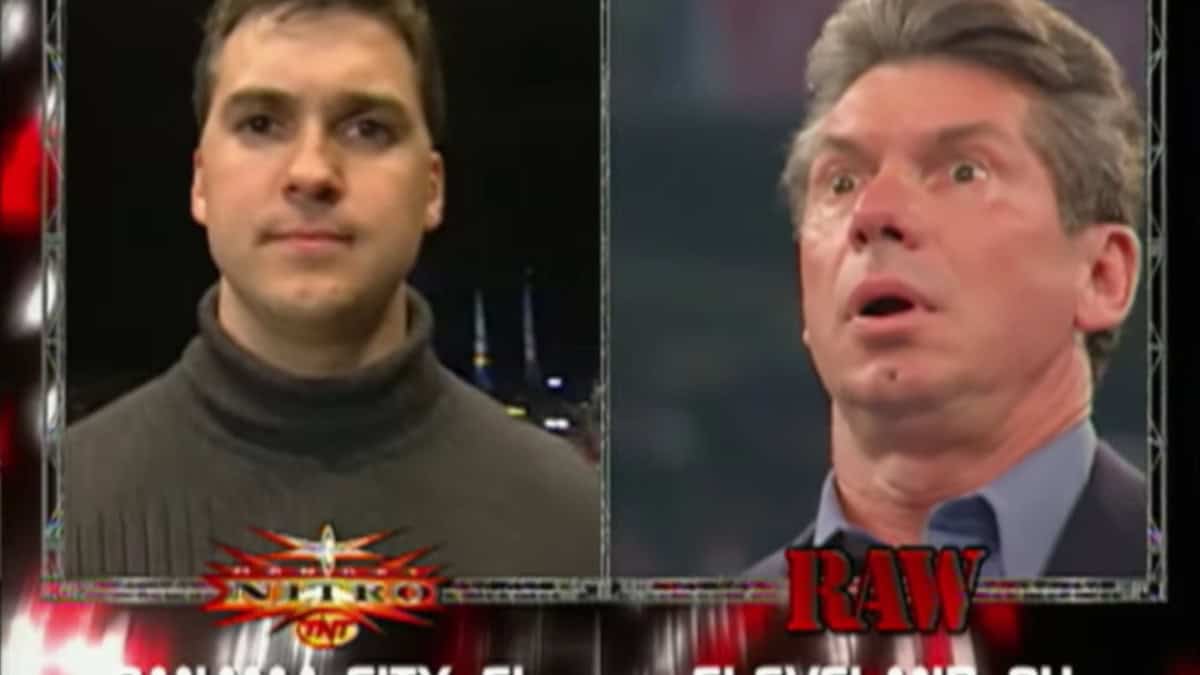
The sale was finalized on Friday, March 23, 2001. The following Monday, March 26, the final episode of Nitro took place in Panama City Beach, Florida. It was “Spring Break Out,” an outdoor show.
The atmosphere backstage was a mix of funeral and graduation. Wrestlers were told that morning that the company had been sold to the WWF. Shane McMahon flew down to Florida to address the talent.
In his book Booker T: From Prison to Promise, Booker T described the uncertainty. “We didn’t know if we had jobs. We didn’t know if Vince was going to fire us all. It was the scariest day of my life.”
Shane McMahon was surprisingly gracious backstage, shaking hands and assuring the talent that the WWF was looking to evaluate everyone. However, the tension was high.
Vince’s Victory Lap
The broadcast began with Vince McMahon appearing via satellite from Cleveland. He gloated. It was a promo, but it was rooted in absolute truth.
“I’m the only one who can grab a club and beat the competition over the head with it,” McMahon sneered.
Throughout the night, the show cut back to Vince. It culminated in the final segment where Shane McMahon appeared live in the ring at Nitro. In a storyline twist, Shane announced that “the name on the contract does say McMahon… but it reads Shane McMahon.” This set up the Invasion angle, positioning Shane as the owner of WCW.
The final match in WCW history (on Nitro) was fittingly between Ric Flair and Sting. They were the two men who had built the company. Before the match, they embraced. They worked a classic, emotional match. Sting won with the Scorpion Deathlock. They hugged in the ring, a poignant goodbye to the brand they loved.
The Jeff Jarrett Incident
While Flair and Sting got a respectful sendoff, another star received a public execution. Jeff Jarrett, a former WWF star who had left the company on bad terms in 1999 (holding up Vince for money before dropping the Intercontinental Title), was backstage at Nitro.
During the broadcast, Vince McMahon was shown watching a monitor where Jarrett was speaking. McMahon scoffed, “J-E-Double-F, J-A-Double-R-E-Double-T… You’re fired!”
While this played out as a television segment, it was legitimate. Jarrett was not picked up by the WWF. The firing was real, and it was broadcast to millions. It would be nearly 20 years before Jarrett was welcomed back into the WWE fold.
The Aftermath
The purchase of WCW by the WWF resulted in a monopoly. For the next 18 years, until the formation of All Elite Wrestling (AEW) in 2019, there was no major competition on national television.
The tape library became the backbone of the WWE Network (now on Peacock), preserving the history of the NWA and WCW for future generations. The intellectual property allowed WWE to sell nWo shirts, Goldberg figures, and legacy merchandise for decades.
However, the immediate aftermath—the “Invasion” storyline—is largely viewed as a creative failure. Without the heavy hitters like Hogan and Flair (who were sitting at home collecting Time Warner checks), the WCW “invaders” were positioned as mid-carders and systematically beaten by WWF stars.
Historical Significance
The sale of WCW serves as a case study in corporate mismanagement. In 1998, WCW was poised to put the WWF out of business. Three years later, it was sold for scrap parts.
For Vince McMahon, it was the ultimate victory. He had not only survived the war; he had conquered the enemy. The image of the WCW logo on the WWF TitanTron remains the definitive symbol of the Attitude Era’s conclusion.
Jamie Kellner, the man who cancelled the wrestling, is often vilified by fans. However, from a strictly corporate media perspective, his decision aligned with the goals of AOL Time Warner at the time. He didn’t care about wrestling history; he cared about ad rates. In doing so, he inadvertently handed the keys to the wrestling kingdom to one man, changing the sport forever.