


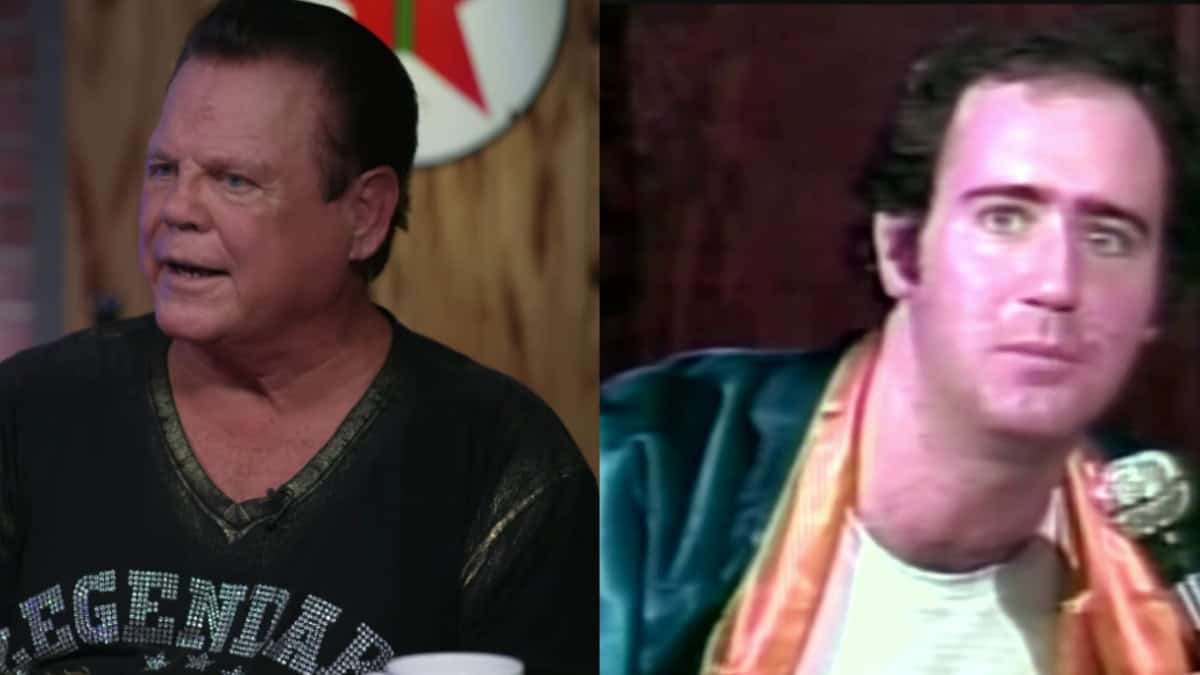
On July 28, 1982, the audience of Late Night with David Letterman witnessed a moment of television that felt dangerously unscripted. Andy Kaufman, the eccentric star of the sitcom Taxi, sat wearing a neck brace, looking disheveled and paranoid. Beside him sat Jerry “The King” Lawler, the muscular, crown-wearing wrestling icon of Memphis, Tennessee.
For decades, the public believed this animosity was real. They believed the “Intergender Wrestling Champion” and the “King of Memphis” genuinely despised one another. In reality, they were witnessing the greatest piece of performance art in the history of professional wrestling—a carefully orchestrated “work” that revolutionized how celebrities interacted with the sport and established the blueprint for the “worked shoot” era that would arrive fifteen years later.
The Intergender Champion
To understand the feud, one must understand Andy Kaufman’s obsession with professional wrestling. Unlike other celebrities who viewed wrestling as a sideshow, Kaufman respected the theatricality and the psychology of the “heel” (villain). He understood that the goal was not to be liked, but to be hated.
Kaufman began his wrestling career by wrestling women. He declared himself the “Intergender Wrestling Champion of the World,” offering a $1,000 prize to any woman who could pin him. It was a misogynistic, cowardly gimmick designed to incite genuine rage. He taunted the audience, telling them they were stupid and poor, and he wrestled with a technical proficiency that allowed him to dominate his untrained female opponents without hurting them.
However, Kaufman wanted to take the act to a bigger stage. He initially approached Vince McMahon Sr., the head of the World Wrestling Federation (WWF), with the idea of bringing his act to Madison Square Garden. McMahon Sr., a traditionalist, rejected the idea, fearing it would turn his sport into a circus.
Undeterred, Kaufman reached out to wrestling photographer and journalist Bill Apter. Apter connected Kaufman with Jerry Lawler, the co-owner and top star of the Continental Wrestling Association (CWA) in Memphis. Unlike McMahon, Lawler understood the value of free publicity. He saw an opportunity to pack the Mid-South Coliseum every Monday night.
The Invasion of Memphis
Andy Kaufman arrived in Memphis in 1982 and immediately went to work destroying the local culture. In a series of vignettes and promos that are still studied today for their effectiveness, Kaufman insulted the intelligence, hygiene, and lifestyle of the Southern audience.
He famously taught the Memphis audience how to use soap and toilet paper. He claimed he was from Hollywood and therefore superior to the “hicks” of Tennessee. The heat was nuclear. People didn’t just boo Andy Kaufman; they wanted to kill him.
Lawler played the role of the city’s defender perfectly. He was the local boy made good, the King who would stand up to the Hollywood elite. The tension built until Lawler finally agreed to wrestle Kaufman, but not before Kaufman raised the stakes by offering to marry any woman who could beat him and agreeing to shave his head if he lost.
The Piledriver: April 5, 1982
The match took place at the Mid-South Coliseum. The atmosphere was hostile. Kaufman, wearing his wrestling gear, pranced around the ring, stalling and taunting Lawler.
When the physical engagement finally happened, Lawler allowed Kaufman to put him in a headlock, giving the comedian a moment of hope. However, the King quickly turned the tables. He suplexed Kaufman, a move that looked devastating to the uninitiated audience.
Then, Lawler executed the Piledriver.
At the time, the Piledriver was a banned move in Memphis (in storyline), sold as a maneuver that could break a man’s neck. Lawler delivered the move, driving Kaufman’s head into the canvas. But he wasn’t done. He picked Kaufman up and delivered a second Piledriver.
Kaufman lay motionless. The referee called for the bell. Medics rushed the ring. Kaufman was placed on a stretcher and rushed to the hospital.
The injury was a work, but the execution was perfect. Kaufman stayed in the hospital for days, wearing a neck brace and claiming he had suffered severe cervical trauma. The Memphis Commercial Appeal and other local news outlets covered it as a legitimate sporting injury. Kaufman threatened lawsuits. The lines between the show and the news began to blur.
The Letterman Appearance
The feud went national on Late Night with David Letterman. This was not a wrestling program; it was a mainstream talk show watched by millions of people who had never seen a match in the Mid-South Coliseum.
Kaufman, still wearing the neck brace months later, appeared fragile. He demanded an apology. Lawler refused, stating that Kaufman had no business in a wrestling ring. The tension escalated until Lawler delivered the slap.
The sound of the slap was loud, uncomfortably real, and shocking. Kaufman’s reaction—scrambling back onto the stage, shouting obscenities, and throwing coffee at Lawler—was unlike anything seen on late-night TV.
David Letterman, who was reportedly not in on the full extent of the work, sat at his desk, bemused and slightly concerned. The segment ended with Lawler sitting stoically while Kaufman was dragged away by security.
The next day, the media went into a frenzy. Was it real? Was Kaufman hurt? The ambiguity was the point. Kaufman and Lawler refused to break character. They maintained the animosity in every public appearance.
The Secret Partnership
The truth of the relationship between Jerry Lawler and Andy Kaufman was kept secret for over a decade. It was not until after Kaufman’s death in 1984 (from lung cancer) that the details began to emerge.
In reality, Lawler and Kaufman were friends. They had planned the entire angle together. Kaufman, a student of the game, had insisted on the slap. He wanted the humiliation. He wanted the heat.
In the documentary Man on the Moon (and the subsequent biopic), Lawler revealed that Kaufman had mailed him the check for his appearance fee before the match even took place, with a note thanking him for the opportunity. They respected each other immensely. Lawler respected Kaufman’s commitment to the bit, and Kaufman respected Lawler’s ability to control a crowd.
Regarding the slap, Lawler later explained that just before they went on air, Kaufman told him, “When we come back from the commercial, I’m going to start ripping on you. I’ve had enough. You just hit me.” The force of the slap was real—Kaufman wanted it to look good—but the anger was entirely manufactured.
Historical Significance
The Kaufman-Lawler feud is the “Big Bang” of celebrity involvement in wrestling. Before Kaufman, celebrities were usually guest timekeepers or ring announcers who waved to the crowd. Kaufman showed that a celebrity could be an active participant in the storylines, taking bumps and generating revenue.
His influence is seen in every celebrity crossover since. When Mike Tyson pushed Stone Cold Steve Austin, it was the Kaufman blueprint. When Bad Bunny hit a Canadian Destroyer at WrestleMania, he was walking through the door Kaufman kicked open.
Moreover, the feud introduced the concept of “meta-wrestling” to a broad audience. It played with the viewer’s knowledge that wrestling was “fake” by presenting a scenario that felt too raw to be scripted. It was the precursor to the NWO, the Montreal Screwjob (in terms of interest), and the reality-based storylines of the modern era.
The Legacy of the Artist
Andy Kaufman died on May 16, 1984. He never broke character regarding the Lawler feud. To the very end, he protected the business better than many of the wrestlers he worked with.
Jerry Lawler continues to speak of Kaufman with reverence. He credits Andy with putting Memphis wrestling on the national map. In the archives of the sport, the image of Kaufman in his neck brace, screaming at the King, stands as a monument to the power of belief. It proved that if you commit hard enough to the lie, the world will believe it is the truth.

