


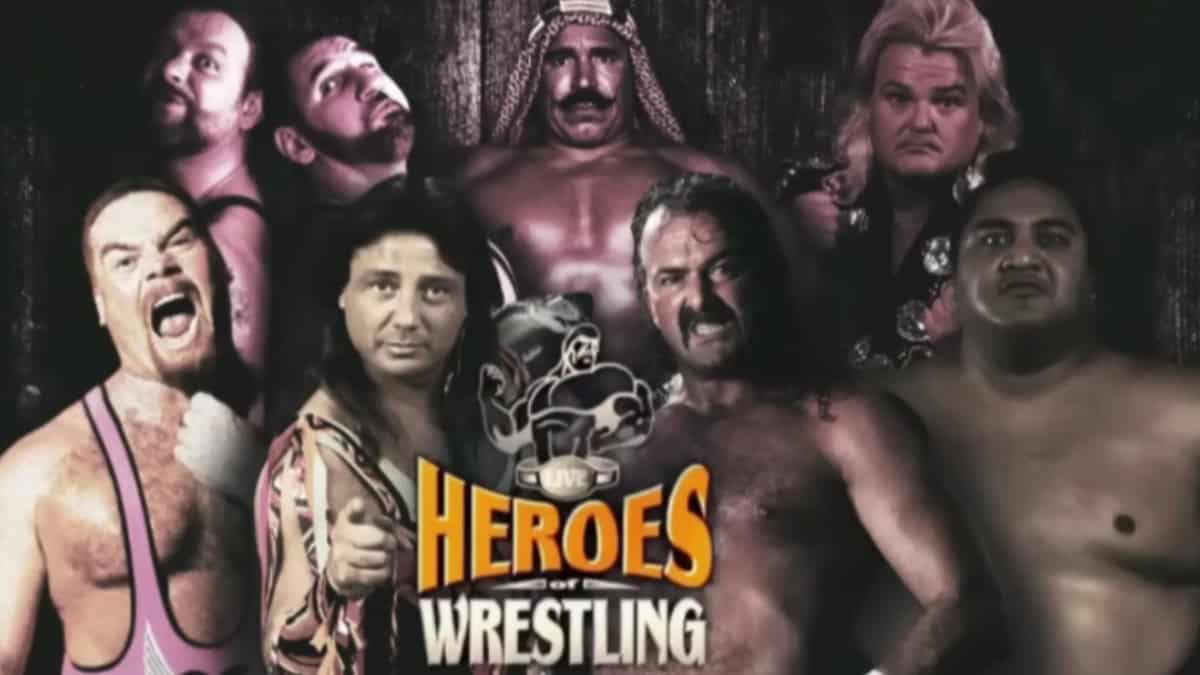
In the late 1990s, professional wrestling was at the peak of its popularity. The “Monday Night Wars” between the World Wrestling Federation (WWF) and World Championship Wrestling (WCW) had created a massive, hungry audience. Amidst this boom, a niche market emerged for nostalgia—fans who yearned for the simpler times of the 1980s, before the crash-TV style of the Attitude Era took over.
On paper, the card looked like a solid independent supershow. It featured names like Jimmy “Superfly” Snuka, The Iron Sheik, Greg “The Hammer” Valentine, and King Kong Bundy. However, the execution on the night of October 10, 1999, resulted in what is universally regarded as the worst pay-per-view in the history of the industry.
It was a night where everything that could go wrong did go wrong. But beyond the technical glitches and poor match quality, the event is remembered for a singular, harrowing tragedy: the public implosion of Jake “The Snake” Roberts. What was advertised as a celebration of legends devolved into a grotesque display of addiction and physical decline, culminating in a main event that remains difficult to watch to this day.
The Concept and the Commentary
The premise of Heroes of Wrestling was simple: bring back the stars of the 1980s for one night of action. However, the production values were akin to a public access television show. The lighting was dim, the audio was muffled, and the crowd at the Casino Magic hotel was sparse and quickly grew restless.
The disaster began in the broadcast booth. The play-by-play announcer was Randy Rosenbloom, a stick-and-ball sports commentator who clearly had zero knowledge of professional wrestling. He struggled to identify moves, mispronounced names (famously calling a dropkick a “leg kick”), and generally seemed confused by the spectacle before him.
Beside him was Dutch Mantell, a wrestling veteran who spent the entire three-hour broadcast desperately trying to cover for Rosenbloom’s incompetence and the chaos unfolding in the ring. The lack of chemistry between the two set an awkward tone that permeated the entire evening.
The undercard was a parade of sadness. The Bushwhackers defeated The Iron Sheik and Nikolai Volkoff in a match that exposed the severe mobility issues of all four men. A match between Stan Lane and Tully Blanchard ended in a confusing finish that the referee seemed to botch. But the audience was waiting for the double main event: Jake Roberts vs. Jim “The Anvil” Neidhart, and King Kong Bundy vs. Yokozuna.
The Pre-Match Promo
The first sign that the show was veering off the rails came during a backstage interview segment. Jake Roberts was scheduled to cut a promo to hype his match against Neidhart.
When the camera cut to Roberts, it was immediately apparent that he was in no condition to perform. His eyes were glazed, his speech was slurred, and his balance was unsteady. He was visibly intoxicated.
The promo itself was a rambling, incoherent diatribe that mixed gambling metaphors with dark threats.
“You don’t want to play cards with me. You don’t want to play 21. You got 22? I got 22? You want to play… blackjack? I got two of those, too.”
He continued to ramble about “snakes” and “spinning the wheel,” leaving the interviewer, Michael St. John, looking visibly uncomfortable. In the production truck, the decision was made to keep rolling, broadcasting a man in the throes of a substance abuse crisis to a paying audience. It was a moment of exploitation that foreshadowed the disaster to come.
The Entrance
When it was time for the co-main event, Jim Neidhart made his entrance first. He looked professional, if slightly out of shape. Then, Jake Roberts’ music hit.
Roberts emerged from the curtain with his signature snake bag over his shoulder. He stumbled down the aisle. At one point, he stopped to interact with the fans, allowing a woman to touch his chest in a lingering, uncomfortable moment.
Upon entering the ring, Roberts took the snake, a large python named Damien (or Revelations), out of the bag. What followed was one of the most bizarre and disturbing visuals in wrestling history. Roberts, seemingly unable to control his own motor functions or the snake, held the reptile in a position near his groin. He began to stroke the snake in a manner that mimicked masturbation, while making suggestive faces at the crowd.
The audience in Mississippi fell silent. This was not “heel heat.” This was the uncomfortable silence of people realizing they were witnessing a breakdown. In the commentary booth, Dutch Mantell tried to make jokes, but the panic in his voice was audible.
The “Match”
The bell rang, and the situation deteriorated further. Jake Roberts could barely stand. He stumbled around the ring, attempting to engage Neidhart.
Neidhart, a seasoned professional trained in the legendary Hart Dungeon, tried to guide Roberts through a simple sequence. He attempted to lock up, but Roberts fell over. Neidhart tried to put him in a headlock to hold him up, but Roberts went limp.
At one point, Roberts rolled out of the ring and confronted the fans in the front row, nearly falling into their laps. He demanded a chair. He grabbed a fan’s drink. It was chaos.
Realizing that a match was impossible, Neidhart and the referee seemingly called an audible. Neidhart took control, engaging in a “shoot” grappling hold to keep Roberts grounded and prevent him from hurting himself. The crowd began to chant “DDT! DDT!”, hoping for Roberts’ finisher, but it was clear Roberts could not perform the move.
Eventually, King Kong Bundy—who was scheduled for the main event—ran to the ring to interfere. This was not the planned finish. It was a rescue mission. The promoter or the agents in the back realized they needed to get the match off the air.
Bundy attacked Roberts, causing a disqualification (or a no-contest; the ruling was unclear). Then, Yokozuna made his way to the ring.
The Saddest Main Event
The scheduled main event was supposed to be King Kong Bundy vs. Yokozuna. However, because the Roberts/Neidhart match had fallen apart so spectacularly, the decision was made on the fly to combine the two matches into a tag team bout: Jake Roberts and Yokozuna vs. King Kong Bundy and Jim Neidhart.
This decision required Jake Roberts, who could barely walk, to continue performing.
The focus shifted to Yokozuna. Rodney Anoa’i, a former two-time WWF Champion, was a shadow of his former self. His weight had ballooned to an estimated 600-700 pounds. He was visibly struggling to breathe just standing on the apron. His ring gear was stained, and he moved with a labored, painful gait.
The tag team match was a tragedy in two parts. On one side, you had Jake Roberts, incapacitated by substances. On the other, you had Yokozuna, incapacitated by his weight. Carrying the load were Neidhart and Bundy, two professionals trying to salvage a train wreck.
The match consisted mostly of Neidhart and Bundy working over Roberts, who lay on the mat for extended periods. When Yokozuna finally received the “hot tag,” he could do little more than chop Bundy and deliver a leg drop.
The finish came when Yokozuna hit the “Banzai Drop” on Bundy. However, the visual was heartbreaking. Yokozuna was so large and exhausted that he could barely climb the ropes. He fell onto Bundy more than he dropped. The referee counted three.
The show ended with Yokozuna and a stumbling Jake Roberts celebrating in the ring. There was no joy in the victory. There was only relief that it was over.
The Immediate Fallout
The reaction from the wrestling community was instant condemnation. The Wrestling Observer Newsletter and other publications savaged the event. It was labeled a disgrace to the business and a dangerous exploitation of talent.
The pay-per-view buyrate was abysmal, reportedly drawing around 29,000 buys. It was a financial failure for Fosstone Productions. Plans for a follow-up event, Heroes of Wrestling 2, were immediately scrapped. The company dissolved, vanishing as quickly as it had appeared.
For the wrestlers, the fallout was personal. Jim Neidhart and King Kong Bundy were praised for their professionalism in handling an impossible situation. But for the two stars of the “team,” the consequences were dire.
The Fate of Yokozuna
The appearance at Heroes of Wrestling was one of the final major appearances for Yokozuna. His weight continued to be a life-threatening issue. Despite efforts to lose weight and return to the WWF, his body simply gave out.
On October 23, 2000—just one year after this disastrous event—Rodney Anoa’i died of pulmonary edema in a hotel room in Liverpool, England. He was 34 years old. The footage from Heroes of Wrestling stands as a grim documentation of his final decline, a visual record of a supreme athlete trapped in a body that was failing him.
Jake Roberts’ Rock Bottom
For Jake Roberts, Heroes of Wrestling was widely considered his “rock bottom,” although his struggles would continue for another decade. The footage of him stroking the snake and slurring his promo became infamous. It was used in documentaries and compilations as the definitive example of a wrestling tragedy.
Roberts spent the next decade battling his demons, appearing in independent shows in various states of disarray. It wasn’t until 2012, when he moved into the “Accountability Crib” with Diamond Dallas Page (DDP), that he finally turned his life around.
Through DDP Yoga and a renewed focus on sobriety, Roberts rebuilt his health and his relationship with his family. He was inducted into the WWE Hall of Fame in 2014, a redemption story that seemed impossible on that night in Mississippi in 1999.
Historical Legacy
Heroes of Wrestling serves as a cautionary tale for the industry. It highlighted the dangers of nostalgia acts that lack regulation or wellness policies. It exposed the dark underbelly of the independent circuit, where promoters would book names regardless of their ability to perform safely.
The event is often cited alongside The degeneration of the AWA and the Herb Abrams UWF as the nadir of professional wrestling organization.
While bad matches are common, Heroes of Wrestling was different. It wasn’t just bad; it was sad. It took childhood heroes and presented them as broken men. It stripped away the magic of the 1980s to reveal the harsh, painful reality of the 1990s for those who had been left behind by the industry’s evolution. It remains, firmly, the night the heroes fell.