


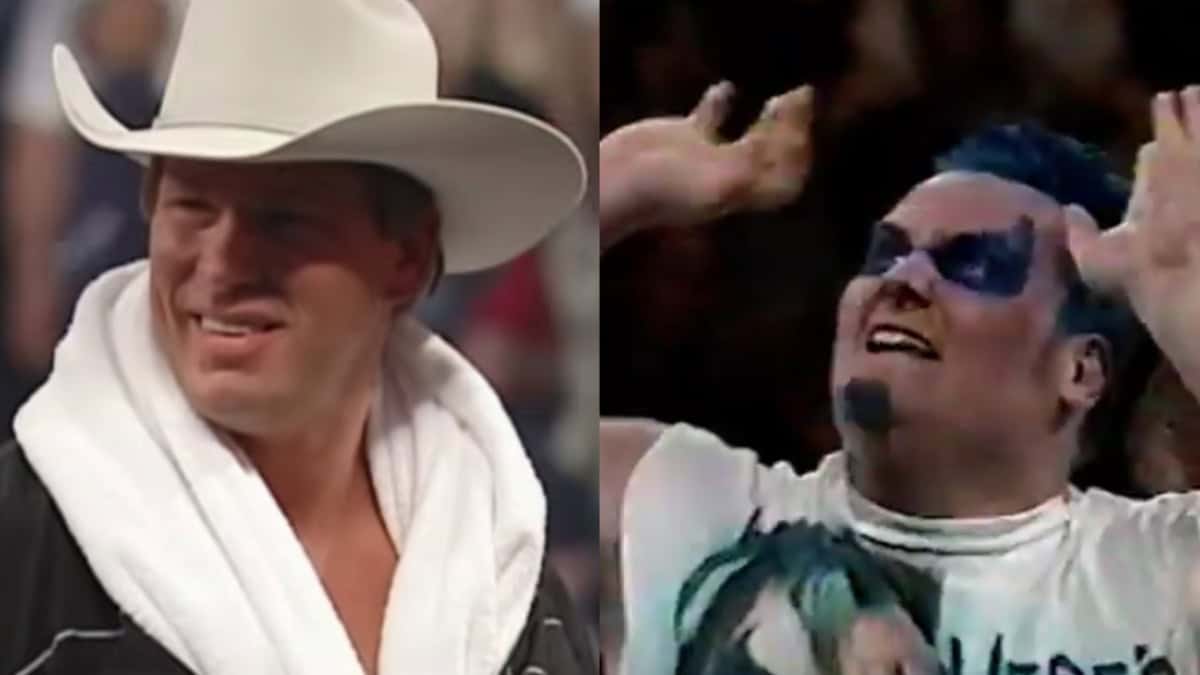
On June 12, 2005, World Wrestling Entertainment (WWE) revived the spirit of Extreme Championship Wrestling (ECW) for a pay-per-view titled One Night Stand. Held at the Hammerstein Ballroom in New York City, the event was a critical and commercial success, praised for its authentic atmosphere and chaotic energy. The show concluded with a massive, scripted brawl between the “ECW Originals” and the “WWE Crusaders,” a faction of Raw and SmackDown superstars led by Eric Bischoff and John “Bradshaw” Layfield (JBL).
What followed was a brutal, unscripted beating that left Heffron bloodied and bewildered. The incident pulled back the curtain on the culture of bullying that reportedly permeated the WWE locker room, exposed the fragility of “kayfabe” during inter-promotional angles, and ultimately led to one of the stiffest, most vindictive chair shots ever delivered on national television as a form of “frontier justice.”
The Context: The Wrestling God and the Blue Guy
To understand why the assault occurred, one must examine the disparity in status between the two men. In 2005, JBL was a top-tier main eventer. He was a large, imposing Texan known for his stiffness in the ring and his hazing of younger talent backstage. He was a “locker room general” who enforced the rules, often with a heavy hand.
The Blue Meanie, by contrast, was a comedy act. He was an ECW original known for his blue hair, half-shirt, and dance moves. He was not a fighter; he was a character. He had previously worked for the WWF as “Bluedust” but had left the company years prior.
The animosity stemmed from comments Heffron had made online. In the years between his WWF stints, Heffron had given interviews and posted on forums describing JBL as a backstage bully. While these comments were largely ignored by the public, word reached JBL. In the wrestling business, “dirtsheet heat” can be dangerous. JBL, feeling disrespected by a wrestler he viewed as beneath him, allegedly decided to teach Heffron a lesson if they ever crossed paths.
The Hammerstein Ballroom Incident
The opportunity for confrontation arrived at One Night Stand. The closing segment of the pay-per-view called for the WWE superstars, who had been heckling the show from a balcony all night, to rush the ring and brawl with the ECW alumni.
It was a chaotic scene involving dozens of wrestlers. In a standard battle royal or mass brawl, wrestlers are trained to “work light”—to throw punches that look good but make little contact—to ensure no one gets hurt in the confusion.
As the brawl commenced, JBL located The Blue Meanie. According to Heffron’s later accounts, he saw JBL approaching and assumed they would lock up for a standard exchange. Instead, JBL grabbed Heffron by the shirt and began throwing legitimate, heavy punches to his face.
The assault was one-sided. JBL, a former brawler, unloaded on Heffron. He pulled Heffron’s shirt over his head—a hockey fight tactic—blinding him, and continued to strike him. One punch connected with a recent surgical scar on Heffron’s forehead (he had recently been stapled up following a match). The wound opened immediately.
Heffron collapsed to the corner, blood pouring down his face. He was confused, hurt, and unable to defend himself against the much larger man. The brawl continued around them, with most of the other performers unaware that a real fight was happening in the corner. When the cameras went off the air, Heffron was left needing medical attention, his face a mask of red.
The Backstage Fallout
When the wrestlers returned to the locker room, the reality of the situation set in. Heffron was furious and physically battered. The “ECW Originals,” a tight-knit group that prided themselves on looking out for one another, were incensed.
There was a palpable tension backstage. Some reports suggest that Francine, an ECW valet, witnessed the beating and alerted the others. Heffron confronted the situation with a level of restraint, but the incident quickly became a PR liability for WWE.
The internet wrestling community exploded. Photos of Heffron’s mangled face circulated online. The narrative was clear: a corporate bully had assaulted a defenseless independent wrestler on a show designed to celebrate the underdog.
Legally, WWE was in a precarious position. The Blue Meanie was not under contract with WWE at the time; he was booked for a one-night appearance. This meant he could potentially sue JBL and WWE for assault and battery. To avoid a lawsuit and a public relations nightmare, WWE had to make a deal.
The Deal: A Job and a Receipt
In the days following the pay-per-view, WWE reached out to Heffron. They offered him a short-term contract to reunite with his old faction, the BWO (Blue World Order), on SmackDown. This was effectively “hush money” in the form of employment. It gave Heffron a payday and a chance to be on national TV again.
However, in the unwritten laws of professional wrestling, a paycheck does not settle a physical debt. If a wrestler takes liberties with another, the victim is owed a “receipt”—a free shot to even the score.
The receipt was scheduled for the July 7, 2005, episode of SmackDown. The main event was a No Disqualification match between JBL and The Blue Meanie.
The Enforcer: Stevie Richards
While The Blue Meanie was the victim, he was not known as a striker or a tough guy. He was unlikely to hurt JBL in a one-on-one fight. Enter Stevie Richards.
Richards was Meanie’s longtime friend and partner in the BWO. He was also a veteran who had survived serious neck injuries and was known for his intensity. He took the disrespect toward Meanie personally.
During the match on SmackDown, the script called for Richards to interfere and hit JBL with a steel chair. In a standard match, a chair shot is “worked.” The attacker hits the fleshy part of the back or, if hitting the head (which was legal at the time), pulls the swing slightly to minimize impact while the victim puts their hands up.
This was not a standard match.
The Chair Shot
As JBL stood in the center of the ring, Stevie Richards wound up. He did not aim for the back. He did not pull the swing.
Richards swung the steel chair with everything he had, connecting directly with JBL’s skull.
The sound was sickening—a loud, metallic crack that echoed through the arena. It was not a “glancing blow.” It was a full-force impact. JBL went down instantly. He was busted open, bleeding profusely from the head.
It was one of the stiffest chair shots in the history of the company. It was violent, dangerous, and undeniably a receipt for the beating Meanie had taken weeks earlier.
The Locker Room Reaction
The chair shot stunned the audience and the locker room. Even in an era of “ruthless aggression,” the violence of the strike was shocking.
However, the reaction from JBL was surprising to some. Known as a traditionalist who respected the code of the business, JBL took the hit. He did not complain. He did not try to have Richards fired.
In later interviews, JBL admitted that he had it coming. He acknowledged that he had been too rough with Meanie at One Night Stand and that the chair shot was the price he had to pay to settle the debt. He famously told Richards backstage, “We’re even.”
The Aftermath
The Blue Meanie’s run in WWE was short-lived, but he left with his dignity restored. The incident elevated the status of Stevie Richards, who gained a reputation as a man who would stand up for his friends regardless of the political consequences.
For JBL, the incident did little to soften his reputation as a bully, but it did reinforce his toughness. He took a shot that would have hospitalized most men and finished the match.
The feud between JBL and the Blue Meanie serves as a bridge between two eras. It had the lawlessness of the ECW days and the polished, corporate clean-up of the WWE era.
Historical Significance
Today, the incident at One Night Stand and the subsequent chair shot on SmackDown are viewed as one of the last true examples of “policing the territory.” It was a dispute settled not by lawyers or human resources, but by violence in the ring.
It highlights the dangerous reality of the industry in the mid-2000s, where personal grievances were often aired in front of millions of people, and where the line between a performance and a fistfight was dangerously thin. The image of the Blue Meanie, bloodied and swollen in the corner of the Hammerstein Ballroom, remains a graphic reminder that in wrestling, the “bad guys” aren’t always playing a character.

