


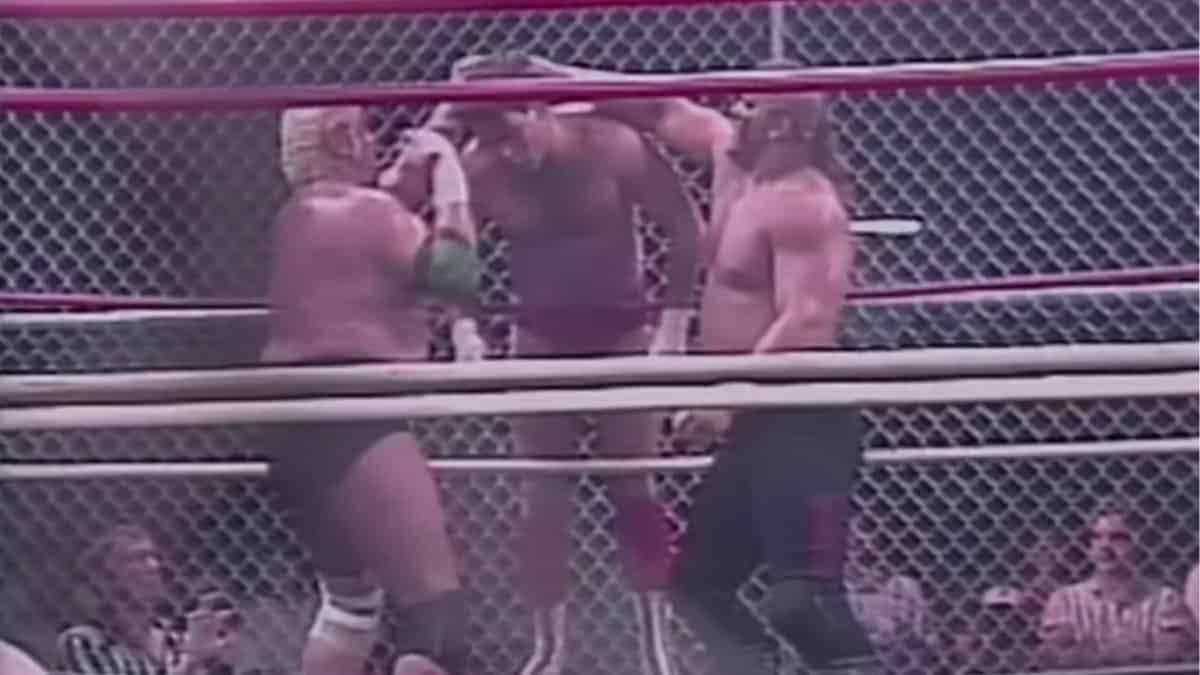
In the summer of 1987, Jim Crockett Promotions was embroiled in one of the hottest periods in the history of the National Wrestling Alliance (NWA). The territory was dominated by The Four Horsemen—Ric Flair, Arn Anderson, Tully Blanchard, and Lex Luger—a stable of elite wrestlers who flaunted their wealth, held all the championships, and systematically dismantled every hero who stood in their way.
The concept—two rings, one giant cage, ten men, and a roof—was a logistical nightmare and a creative gamble. However, when the cage door locked on July 4, 1987, at The Omni in Atlanta, it produced not just a match, but a genre of violence that would define the NWA and survive for decades to come.
The Inspiration: Beyond Thunderdome
The genesis of WarGames is one of the most famous stories in wrestling creativity. According to Rhodes, he was watching the 1985 film Mad Max Beyond Thunderdome, starring Mel Gibson and Tina Turner. The film features a gladiatorial arena called the Thunderdome, a steel cage structure where disputes are settled.
Rhodes was captivated by the concept of a closed environment where the combatants were enclosed not just on the sides, but on the top. He wanted to adapt this for wrestling, but he faced a spatial problem. A standard wrestling ring was too small to contain the massive brawls he envisioned between the Horsemen and their rivals.
His solution was unprecedented. He decided to use two rings, placed side-by-side.
In his autobiography and various interviews, Rhodes described the moment of creation. He sketched the design on a napkin (some accounts say a legal pad) while traveling. He drew two squares for the rings and a large rectangle around them to represent the cage. Crucially, he drew a roof. The roof was essential because it prevented the “cowardly heel” escape tactic that had become a cliche in cage matches. In WarGames, the only way to win was to make your opponent surrender.
The Rules of Engagement
The rules Rhodes devised were complex but brilliant in their ability to build drama. The match would begin with one man from each team for a five-minute period. After that, a coin toss (which the heels always won) would determine which team sent the next man in.
This created a “man advantage” for the villains. For two minutes, the babyface would be trapped in a 2-on-1 handicap match. This cycle would alternate until all ten men were in the cage.
Only when all ten men were inside did “The Match Beyond” begin. At that point, the match could only be won by submission or surrender. There were no pinfalls. This stipulation added a layer of gritty realism; to win, you had to physically break your opponent or force them to quit.
Selling the Concept to the Boys
When Rhodes presented the idea to the locker room, the reaction was mixed. The logistics were daunting. Putting two rings in an arena required sacrificing expensive ringside seats. Constructing a custom cage with a roof was an engineering challenge.
Furthermore, the talent realized the physical toll the match would take. The cage was not made of chain-link fencing like modern cages; it was heavy steel mesh. The roof meant the ceiling was low—roughly six to seven feet above the turnbuckles—which eliminated high-flying moves and made the environment claustrophobic.
However, the roster for the inaugural match was a “Who’s Who” of toughness. The Horsemen (Flair, Anderson, Blanchard, Luger) and their manager J.J. Dillon agreed to the match. Opposing them were The Road Warriors (Hawk and Animal), Nikita Koloff, Paul Ellering, and Dusty Rhodes himself.
July 4, 1987: The Omni
The debut of WarGames was the centerpiece of the Great American Bash tour. The atmosphere in The Omni was electric. The sight of the massive, double-ring structure hanging above the arena floor signaled to the fans that they were about to witness something historic.
The match began with Arn Anderson representing the Horsemen and Dusty Rhodes representing the Super Powers. The psychology was perfect. Anderson, the “Enforcer,” targeted Rhodes’ injured arm. When the period ended, the heels won the coin toss (naturally), and Tully Blanchard entered.
The match built perfectly on the “hope spots.” Every time the babyfaces seemed doomed by the numbers game, the clock would count down, and the crowd would explode as a fresh hero—like the explosive Road Warriors—charged the ring to even the odds.
The Violence and the Low Ceiling
Once “The Match Beyond” began, the brutality escalated. The low ceiling played a significant role. At one point, the Road Warriors pressed the Horsemen over their heads, driving them into the steel roof or the mesh. The sound of bodies hitting the metal reverberated through the arena.
The wrestlers bled. Dusty Rhodes, known for his “crimson mask,” was battered. Ric Flair, wearing his expensive wrestling gear, was covered in blood and sweat. The cage mesh was unforgiving, grating against foreheads and arms.
The finish of the match was designed to protect the top stars while delivering a satisfying conclusion. The babyfaces cornered the Horsemen’s manager, J.J. Dillon. Dillon was not a wrestler; he was a manager in his late 40s.
The Road Warriors executed their finisher, the Doomsday Device, on Dillon. However, because of the low roof, Hawk couldn’t stand on the top turnbuckle. He had to crouch and hold the mesh to deliver the clothesline. The impact was awkward and devastating.
J.J. Dillon landed badly. He separated his shoulder and broke a bone upon impact. As he screamed in legitimate agony, he verbally submitted. The referee called for the bell. The babyfaces had won, the Horsemen were vanquished, and the crowd in Atlanta went home happy.
The Evolution of the Concept
The success of the first WarGames was immediate. It drew huge gates and became the signature match of the Great American Bash tour. JCP ran WarGames matches in multiple cities throughout the summer of 1987, burning out the talent but filling the coffers.
The match became an annual tradition in WCW. It produced legendary moments, such as the 1991 match involving the dangerous “Sting’s Squadron” vs. “The Dangerous Alliance,” and the 1992 match which is often cited as the greatest WarGames match ever due to the intensity of the Dangerous Alliance vs. Sting’s Squadron (again).
However, as WCW entered the Hogan era, the concept was diluted. The rules were tweaked, pinfalls were allowed, and the cage was sometimes not even used properly. By the late 90s, WarGames had become a shadow of its former self, culminating in the disastrous “WarGames 2000” on an episode of Nitro which featured three tiers of cages and Vince Russo wearing a football helmet.
The NXT Revival
After WCW was purchased by the WWF in 2001, the WarGames concept sat on the shelf for nearly two decades. Vince McMahon reportedly disliked the concept because it required too much space and blocked view of the audience.
However, in 2017, Triple H—a student of the NWA style—revived the match for the NXT brand. NXT TakeOver: WarGames brought the double ring and the cage back to a new generation. The modern version removed the roof to allow for high-flying spots, but kept the spirit of the two-ring warfare.
It proved so successful that it eventually made its way to the main roster, becoming the theme for the Survivor Series premium live event in 2022, replacing the traditional elimination matches.
The Legacy of Dusty’s Vision
The creation of WarGames remains Dusty Rhodes’ greatest contribution to wrestling booking. It was a perfect synthesis of spectacle and psychology.
It worked because it solved a fundamental problem: how to have a chaotic brawl that still had structure. The timed intervals built anticipation. The closed cage eliminated outside interference (theoretically). The submission-only rule added stakes.
Today, when fans see two rings pushed together, they know what is coming. They know that blood will be spilled, alliances will be tested, and for at least one night, the “Match Beyond” will return. It stands as a testament to the idea that sometimes, the best solution to a booking problem is to simply add more steel.