


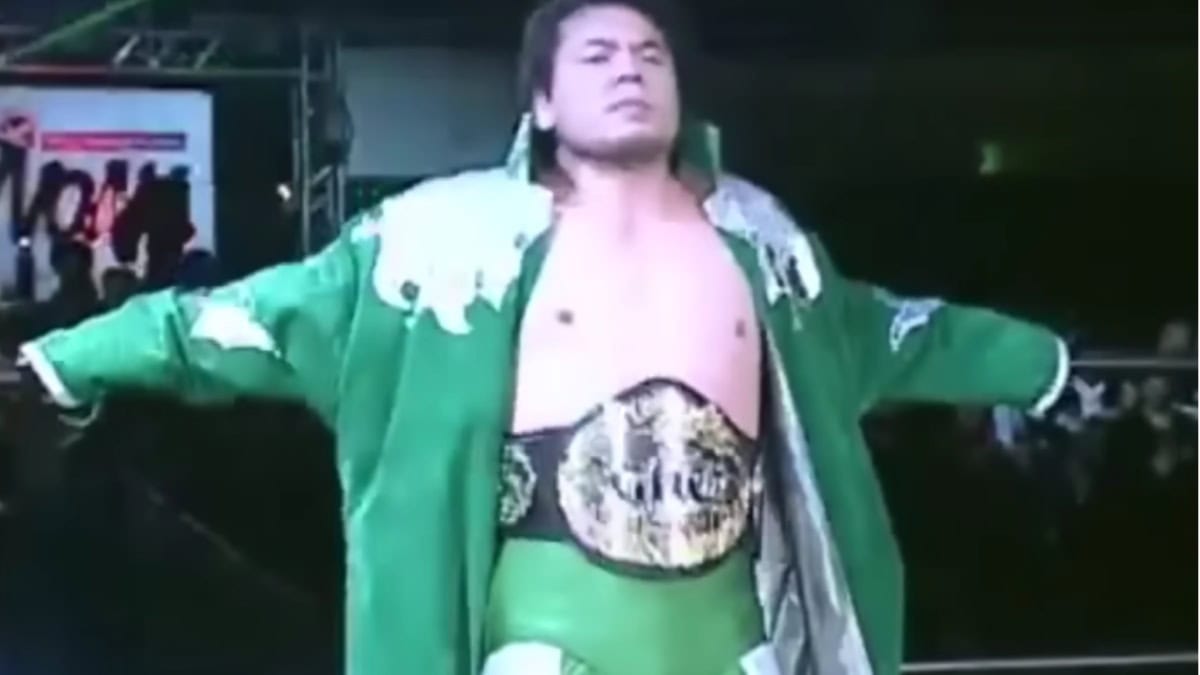
In the pantheon of professional wrestling, few figures commanded the reverence of Mitsuharu Misawa. He was the stoic ace of All Japan Pro Wrestling (AJPW) and the founder of Pro Wrestling Noah. To his fans, he was the “Standard Bearer of the Coming Generation,” a man who popularized the “King’s Road” style—a genre of wrestling defined by escalating danger, stiff strikes, and head-dropping suplexes.
During a main event tag team match, a routine maneuver resulted in a catastrophic spinal injury. Mitsuharu Misawa died in the ring, surrounded by weeping proteges and a silent, stunned audience. His death was not just the loss of a legend; it was a grim indictment of the very style he helped create, forcing the industry to confront the lethal reality of “fighting spirit.”
The Emerald Warrior
To understand the shock of his death, one must understand Misawa’s stature. He was the Japanese equivalent of Hulk Hogan and Ric Flair combined, possessing the drawing power of the former and the technical mastery of the latter.
Throughout the 1990s, Misawa engaged in a series of legendary rivalries with Toshiaki Kawada, Kenta Kobashi, and Akira Taue. These matches are still considered the gold standard of in-ring storytelling. However, they were brutal. The “King’s Road” style demanded that wrestlers take dangerous bumps on their necks to prove their toughness.
By 2009, Misawa was 46 years old. His body was a wreck. He suffered from severe cervical osteophytes (bone spurs) in his neck. His shoulders were ruined. He reportedly needed help just to brush his teeth or get out of bed in the morning.
Despite the physical agony, Misawa felt a responsibility to his company. As the owner and top star of Pro Wrestling Noah, he believed he needed to be in the main event to sell tickets. The television deal had been cancelled, and the company was struggling financially. Misawa, the captain of the ship, refused to step down, even as his body screamed for him to stop.
The Match: June 13, 2009
The card in Hiroshima was titled Southern Navigation. The main event featured Mitsuharu Misawa and his young protege, Go Shiozaki, defending the GHC Tag Team Championships against Akitoshi Saito and Bison Smith.
The match followed the standard Noah formula. It was hard-hitting and intense. However, observers noted that Misawa looked slow. His movement was labored, a common sight in his final years. He was surviving on instinct and adrenaline.
Approximately 25 minutes into the match, the finish sequence began. Akitoshi Saito, a respected veteran known for his karate background, isolated Misawa.
The Move: The Backdrop Driver
Saito set Misawa up for a high-angle backdrop driver (a back suplex). It is a move Misawa had taken thousands of times in his career. It involves the opponent grabbing the wrestler around the waist, lifting them high into the air, and dropping them on their upper back and neck.
Saito lifted Misawa. However, due to fatigue or the degradation of his nervous system, Misawa did not tuck his chin. He did not rotate enough to land on his shoulder blades.
Misawa plummeted to the mat, spiking directly on his head and neck. The impact compressed his cervical spine with devastating force.
The crowd watched as Misawa rolled over slightly and then went motionless. The referee, realizing Misawa was unresponsive, asked, “Misawa, can you move?” There was no answer. Misawa’s body had gone limp.
The Silence of Hiroshima
Saito, initially unaware of the severity, covered Misawa for the pin. The referee hesitated, then counted to three to end the match quickly. But Misawa did not kick out. He did not move after the bell.
The celebration was cut short immediately. The ringside doctor and young wrestlers (young boys) rushed the ring. They attempted to revive Misawa. He was in cardiac arrest.
The scene in the arena turned from confusion to horror. The chants of “Mi-Sa-Wa! Mi-Sa-Wa!” slowly died out, replaced by the screams of fans realizing that the hero was not getting up. His face reportedly turned a dark shade of purple, a sign of oxygen deprivation and massive trauma.
Paramedics brought an AED (Automated External Defibrillator) into the ring. They attempted CPR. Go Shiozaki, Misawa’s partner, grabbed the microphone and screamed at Misawa to wake up. “President! President!” he yelled, tears streaming down his face.
Opponent Akitoshi Saito knelt in the corner, his head in his hands, watching the frantic attempts to save the life of the man he had just wrestled.
The Diagnosis: C1-C2 Separation
Misawa was rushed to Hiroshima University Hospital. Despite the efforts of the medical team, he was pronounced dead at 10:10 PM.
The official cause of death was officially listed as cervical spinal cord transection. The impact of the suplex had separated his C1 and C2 vertebrae. This is essentially an internal decapitation. It severed the connection between the brain and the body, causing immediate respiratory arrest and heart failure.
The police briefly investigated the incident as a potential case of professional negligence but ultimately ruled it a tragic accident. There was no malice involved; it was a wrestling move gone wrong on a body that had simply run out of durability.
The Guilt of Akitoshi Saito
The tragedy cast a dark cloud over Akitoshi Saito. In a culture that values honor, being the man who killed the “God of Wrestling” was a heavy burden.
Saito famously requested to speak to the fans the following night. He stood in the ring, bowed, and offered to retire or even take his own life to atone for the accident.
In a moment of profound grace, the Misawa family and the Noah roster rallied around Saito. They assured him that it was an accident and that Misawa—a warrior who lived by the code of the ring—would never want Saito to end his career over a ring mishap. The fans, too, supported Saito, chanting his name and telling him to fight on. Saito continued to wrestle, dedicating the rest of his career to Misawa’s memory, often looking to the sky before matches.
The Aftermath for Noah
The death of Misawa was a blow from which Pro Wrestling Noah never fully recovered. He was the heart, soul, and business brain of the operation. Without his star power, attendance dwindled. Without his leadership, the backstage politics became fractured.
Furthermore, the death sparked a massive debate in Japan regarding the safety of the “King’s Road” style. The era of the dangerous head-drop suplexes—moves like the Tiger Suplex ’85, the Burning Hammer, and the Backdrop Driver—came under intense scrutiny.
While the style did not disappear completely, there was a noticeable shift. Referees became stricter about stopping matches when a wrestler appeared concussed. The “fighting spirit” spots, where wrestlers would no-sell dangerous moves, were viewed with more skepticism.
Legacy of the Emerald King
Mitsuharu Misawa left behind a complex legacy. He is widely regarded as one of the greatest in-ring performers in history. His catalogue of five-star matches is unrivaled. He innovated moves like the Emerald Flowsion and the Tiger Driver ’91.
However, his death serves as the ultimate cautionary tale of the industry. It highlights the toxic pressure placed on top stars to perform through injury, and the dangerous cumulative effect of spinal trauma. Misawa gave his life for the business, quite literally.
Every June 13th, the wrestling world pauses to remember the man in the emerald green tights. His theme song, “Spartan X,” still evokes goosebumps in arenas across Japan. He was the Unsinkable Battleship, but on a humid night in Hiroshima, the waters of the King’s Road finally claimed him.