


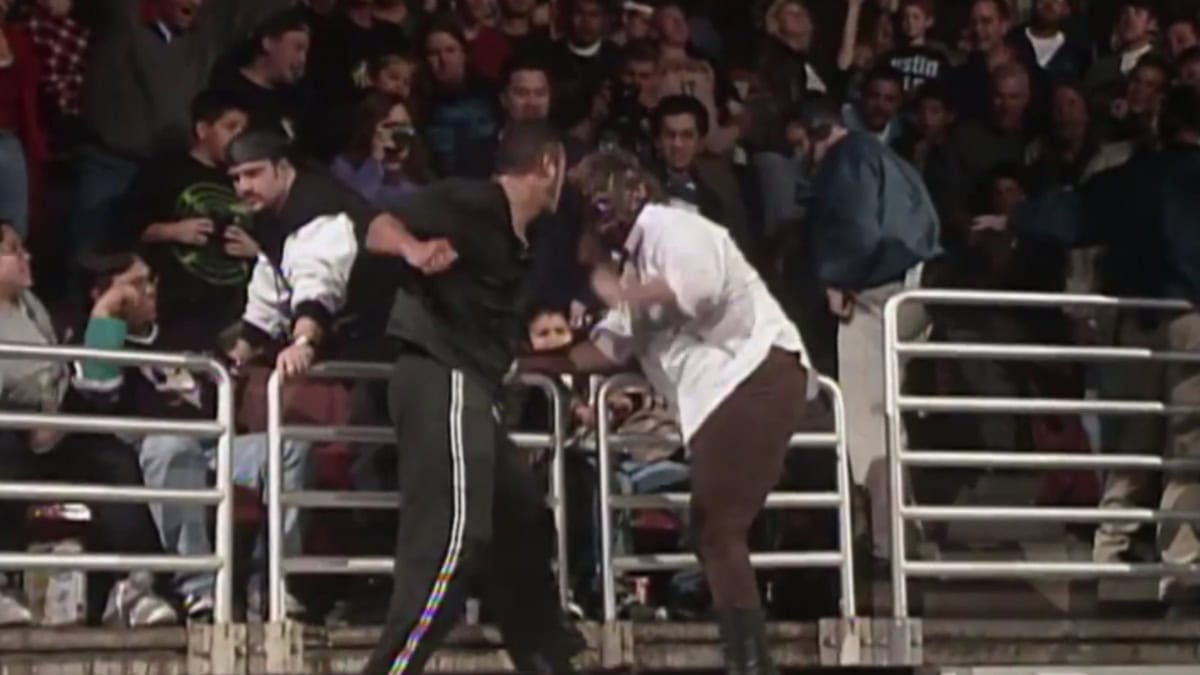
On January 24, 1999, the World Wrestling Federation (WWF) presented the Royal Rumble pay-per-view from the Arrowhead Pond in Anaheim, California. While the event is traditionally centered around the 30-man battle royal, the undercard featured a WWF Championship match between The Rock (Dwayne Johnson) and Mankind (Mick Foley). The stipulation was an “I Quit” match, a contest that can only end when one competitor verbally submits.
The Planning and the Agreement
In the days leading up to the event, Mick Foley was heavily involved in the creative planning of the match. Known for his high threshold for pain and his willingness to perform dangerous stunts—such as his fall from the Hell in a Cell structure six months prior—Foley pitched an ending designed to garner sympathy for his character.
The proposed finish involved Foley being handcuffed with his hands behind his back. Rendered defenseless, The Rock would strike him with a steel chair until Foley was unconscious. To protect the character’s integrity, Foley would not actually say “I Quit.” Instead, the plan was to play a pre-recorded audio clip of Foley saying the phrase over the public address system while he lay unconscious.
Foley and The Rock discussed the specifics of the chair shots. According to Foley’s autobiography, Have A Nice Day, they agreed on five strikes to the head. Foley told The Rock to “swing for the fences” to ensure the shots looked realistic on camera. He trusted Johnson, a former football player known for his athleticism and control, to deliver the blows safely.
The Execution of the Match
The match began as a brawl throughout the arena, utilizing ladders, electrical equipment, and the announce tables. It followed the standard formula of a “hardcore” match typical of the era. The turning point occurred when The Rock retrieved a pair of handcuffs and successfully locked Foley’s hands behind his back.
With Foley unable to protect his head with his hands—the standard method wrestlers use to absorb chair shots—he was entirely vulnerable. The match moved toward the entrance ramp for the finale.
The Incident: Eleven Unprotected Shots
The agreement for five shots was disregarded during the heat of the moment. The Rock delivered the first shot, which knocked Foley down. As Foley struggled to his feet, The Rock struck him again.
The violence escalated quickly. Foley, dazed and suffering from a concussion, attempted to turn his back to absorb the blows on his shoulders or upper back. However, The Rock continued to circle him, aiming specifically for the cranium.
In total, The Rock delivered eleven unprotected chair shots directly to Mick Foley’s skull.
The severity of the impacts was audible and visual. The chair dented upon impact. Foley’s head was lacerated, and he began bleeding profusely. After the final shot, Foley collapsed on the entrance ramp, unconscious. The Rock placed the microphone near Foley’s face, and the production truck played the pre-recorded “I quit” audio to end the match.
The Documentary Evidence: Beyond the Mat
Unlike most wrestling matches where backstage reactions are anecdotal, the 1999 Royal Rumble was documented by a film crew. Director Barry Blaustein was filming his documentary Beyond the Mat and had been granted unprecedented access to the WWF during this period.
Blaustein’s crew was situated in the front row with Mick Foley’s family: his wife, Colette, and his two young children, Dewey and Noelle. The footage captured their real-time reaction to the violence.
As the chair shots continued past the agreed-upon number, the mood in the front row shifted from excitement to terror. Colette Foley can be seen screaming, “Stop it!” Noelle, Foley’s daughter, began to cry hysterically. Dewey, his son, looked on in shock.
The scene became so distressing that Colette grabbed the children and fled the arena floor before the match officially ended. This footage remains one of the most controversial pieces of media in wrestling history, as it stripped away the veneer of “entertainment” and showed the genuine human cost of the performance.
The Immediate Aftermath
Foley was transported backstage to the medical area. He had suffered a severe concussion and required extensive stitching to close the gash in his scalp.
In the documentary footage, a semi-conscious Foley is seen smiling groggily, asking the gathered officials, ” Was it good?” He was unaware of how many times he had been hit or the severity of the scene he had just participated in.
The reaction among the roster was somber. Other wrestlers, who are generally desensitized to staged violence, expressed concern regarding the brutality. The number of shots and the lack of protection were viewed as excessive even by the standards of the Attitude Era.
The Conflict Between Rock and Foley
A significant point of contention arose following the match regarding The Rock’s conduct. It is customary in professional wrestling for opponents to check on each other immediately after a match, especially one involving high-risk spots or legitimate injury.
The Rock did not check on Foley in the medical room that night. He left the arena without speaking to him.
Foley addressed this in his second book, Foley Is Good. He admitted to being hurt and angry that a man he considered a friend and professional peer did not show basic concern after delivering such punishment. He said, “I was hurt that he didn’t come check on me. I think he was afraid of what he would see.”
The silence between the two lasted for some time. Foley felt that The Rock had taken liberties with his safety, hitting him far more times than agreed upon, and then failed to offer the professional courtesy of an apology.
The Reconciliation
The tension was eventually resolved weeks later. The Rock approached Foley backstage and apologized for the incident. He explained that he had gotten “caught up in the moment” and lost count of the shots. He also admitted that he was shaken by the violence and didn’t know how to face Foley immediately afterward.
Foley accepted the apology. The two went on to form the “Rock ‘n’ Sock Connection” later that year, a comedic tag team that became one of the most popular acts in company history. Their on-screen chemistry suggested that the personal animosity had been fully resolved.
The Family’s Trauma
The impact on Foley’s family was lasting. Foley has stated in interviews that he did not allow his children to watch wrestling for a significant period after that night. He also expressed deep regret for allowing them to be ringside.
When Foley finally watched the footage from Beyond the Mat himself, he was horrified. He admitted that seeing his wife and children in such distress changed his perspective on his career. “It’s a bad parenting moment,” Foley said in a 2013 interview. “I can’t watch it. It’s the only match of mine I can’t watch.”
The incident served as a wake-up call for Foley regarding his retirement. While he continued to wrestle for another year full-time, he began to transition away from the extreme “death match” style that had defined his earlier career.
Medical Analysis: The CTE Factor
In 1999, the medical understanding of concussions in sports was limited compared to modern standards. The term CTE (Chronic Traumatic Encephalopathy) was not yet part of the wrestling lexicon. However, retrospective analysis of the “I Quit” match places it at the center of the head trauma debate.
Dr. Chris Nowinski, a former wrestler and co-founder of the Concussion Legacy Foundation, has cited matches like this as examples of the dangerous culture that existed in the industry. The chair shots delivered by The Rock were “full swings” to the unprotected head.
Foley has since pledged to donate his brain to science upon his death to help researchers understand the long-term effects of such trauma.
Changes in Industry Regulations
The “I Quit” match at Royal Rumble 1999 is often cited as a catalyst for the eventual banning of chair shots to the head.
For nearly a decade following the match, chair shots to the head remained legal in WWE. However, following the double-murder suicide of Chris Benoit in 2007 and the subsequent focus on brain injuries, WWE radically altered its wellness policy.
In 2010, WWE officially banned chair shots to the head. Under current rules, any use of a chair must be directed to the back or the gut. A wrestler delivering a shot to the head faces fines, suspension, and potential termination.
When modern fans or wrestlers view the 1999 match, the reaction is often one of discomfort rather than entertainment. The match is no longer celebrated for its “toughness” but rather studied as an example of negligence.

