


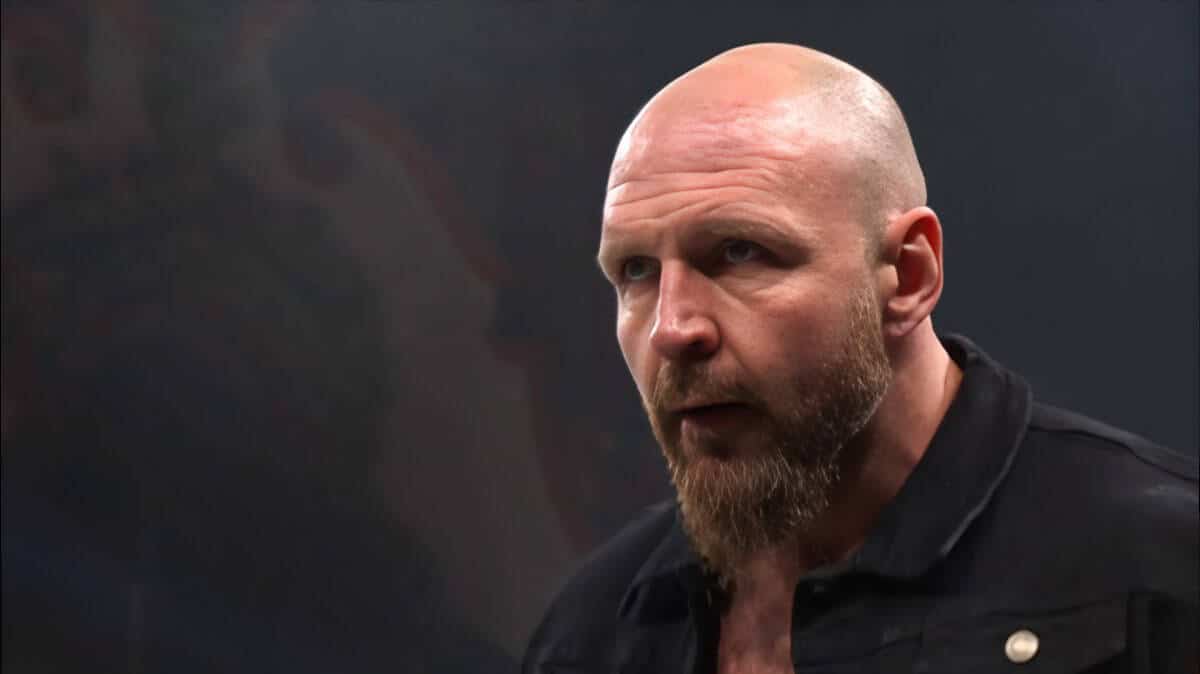
In an interview with his wife Renee on Up Close with Renee, AEW Continental Champion Jon Moxley opened up about his rivalry with Konosuke Takeshita, the culture he’s built with the Death Riders, and the personal toll of chasing mastery.
Jon Moxley does not believe most people in professional wrestling know what they’re talking about. He said as much during an interview with his wife, Renee Paquette, for AEW’s YouTube channel.
Wheeler Yuta Kept His Word
The interview opened with the fallout from Wheeler Yuta’s head-shaving stipulation. Moxley framed the moment not as a loss but as proof of character.
“A lot of people would not want to risk the humiliation of being shaven in the middle of the ring on live TV, beamed across the entire world in an arena full of people. That takes guts,” Moxley said. “I think it shows Wheeler’s character, that he took the risk and he stepped up and he took it on the chin.”
Moxley sees Yuta as part of a specific breed of wrestler built for longevity. “It’s not about starting strong. It’s about how long can you remain steady? Endurance is the key factor in this sport,” he said. “A long time from now, when countless flashes in the pan have come and flamed out, guys like Daniel Garcia, guys like Wheeler, who have the endurance, who have the character, they will remain.”
Building the Death Riders
Moxley was direct about what drove him to form the group. “I’m looking around, and I’m like, I’m surrounded by clowns everywhere,” he said. “This culture does not represent me. I do not represent it. I’m not gonna get pulled in this direction. You can’t change people, but you can build.”
He called the Death Riders the achievement he’s most proud of in his career. The name itself, he explained, came from Japan — borrowed from a goodwill jacket advertising carnival daredevils who ride motorcycles inside steel balls. “It’s a word that means nothing, but to me, it means something now,” he said. “I don’t think I would be here if not for these people. I don’t know what I would be doing. I might be in jail by this point.”
Moxley singled out Marina Shafir’s work ethic as the standard for the group. “If every wrestler in this sport worked as hard every single day as Marina Shafir, everybody would be 1,000 times better,” he said. He described watching Shafir doing pool exercises and shadow boxing in the morning, then jumping rope outside the arena before going to war that same night. “Never turns it off,” he said.
He also praised Gabe Kidd’s willingness to take on difficult, thankless work without hesitation. “When I say to him, I have a job for you — it’s really difficult, it’s not going to pay any extra, a lot of people are going to hate you, the stakes are very high, and you will get no credit, no applause whatsoever, maybe the opposite — before I even finish my sentence, he’s looking for a place to sign his name on the paper.”
“I Was Not Gifted Anything”
When Renee asked where his discipline comes from, Moxley rejected any notion of natural talent. “I was not gifted anything. It’s not who my daddy is. It’s not my physical skills and gifts,” he said. “I’ve never been the front runner. I’ve never had a choice but to do everything the hard way, to do everything manual, to do everything analog.”
He drew a line between wrestlers motivated by external rewards and those driven internally. “There are people who are motivated by the external — the money, the cars, the belts, the Instagram followers,” he said. “There are people who are intrinsically motivated. There are people who want to get good at the thing, and that is their motivation. These are the people I surround myself with.”
Feeling Disconnected
The conversation took a personal turn when Moxley described a growing inability to relate to the people around him.
“I’m really having a hard time — last couple years especially,” he said. “I feel like everybody is sucked into some game that I’ve just opted out of, and I feel very disconnected from the entire world.”
Renee told him that was concerning to hear. Moxley pushed back on the framing. “It’s not lonely,” he said. “I just don’t care about the things most other people care about. In the ring, none of that matters or exists. Everything makes sense in the ring.”
He explained that the ring is where he goes to learn, not to perform. “I say, seek first to understand, not to be understood. So I go to the ring seeking to understand,” he said. “Every time I get to be in the ring is a chance to increase my understanding of this.”
Takeshita at Revolution
Moxley called Takeshita the toughest challenge in AEW. “I think Takeshita might be the best guy in AEW,” he said. “If there was one guy that I wouldn’t totally bet the farm that I’m 100% sure I can take him out, it’s Takeshita.”
He described a shared understanding between the two that goes beyond language. “I don’t know this guy at all. I haven’t hung out with this guy. We don’t even speak the same language. I know nothing about this guy, but I know everything about him.”
Their 20-minute draw ate at him. “I was not willing to walk away with a 20-minute draw. I would rather choke on my own vomit and die than be satisfied with a 20-minute draw,” he said. “I would rather just lose. Just go for it and die on my shield and get knocked out, then sit on a plane for 15 hours on the way back from Australia replaying this 20-minute draw in my head.”
He described the state of competition he reaches with opponents like Takeshita — a place where the arena full of thousands goes silent and all he hears is “flesh on flesh, the sound of the boards under the ring, the sound of the rope snapping, the sound of the other guy’s breath coming out of his lungs.”
His conclusion was definitive: “God damn it, he is not going to beat me at Revolution. He’s just not. I can’t see it any other way.”
The Continental Championship as Identity
Moxley described the Continental Championship not as a prop but as an identity. “It’s not a belt you put on. It’s not a trophy you hold up. It’s an identity, and you either are it or you’re not,” he said.
He also pushed back against any suggestion he’s reached his ceiling. “I am not at my peak yet. Hundreds of times people want to write me off going back decades,” he said. “There’s always another door and you open and there’s a whole other room, and you didn’t even know that was there.”
He acknowledged the physical cost. “If most wrestlers — nine out of 10 — if they spent 24 hours a day in my body, they would just quit,” he said. “They would think they got malaria or something.”
Fatherhood and Identity
Renee steered the conversation toward their daughter Nora, who insists on texting Moxley before bed to tell him he’s the best wrestler in the world. Rather than soften, Moxley connected fatherhood to the same framework.
“Have the Death Riders been involved in some heinous acts? Some very unpopular decisions? But I would do them all again, and if necessary, I’ll do worse. That’s part of the identity too,” he said. “Whether I have to explain that to my daughter or to the people who are riding with me — be exactly who I need to be and do exactly what I need to do every single day.”
He described fatherhood as its own version of the same chase. “You want to talk about opening a new door and seeing a new room you didn’t even know existed — it’s every single day,” he said. “As she grows, that will challenge me to grow in conjunction with her.”
The Impossible Goal
Renee closed by asking if there’s one final achievement Moxley wants from his career. His answer was immediate.
“I want to be able to step into the ring and control the temperature in the room with my mind,” he said. “Which is impossible, which is exactly why it’s worth chasing.”
If you use quotes from this article, please credit the source and include a h/t to WrestlingNews.co for the transcription.

