


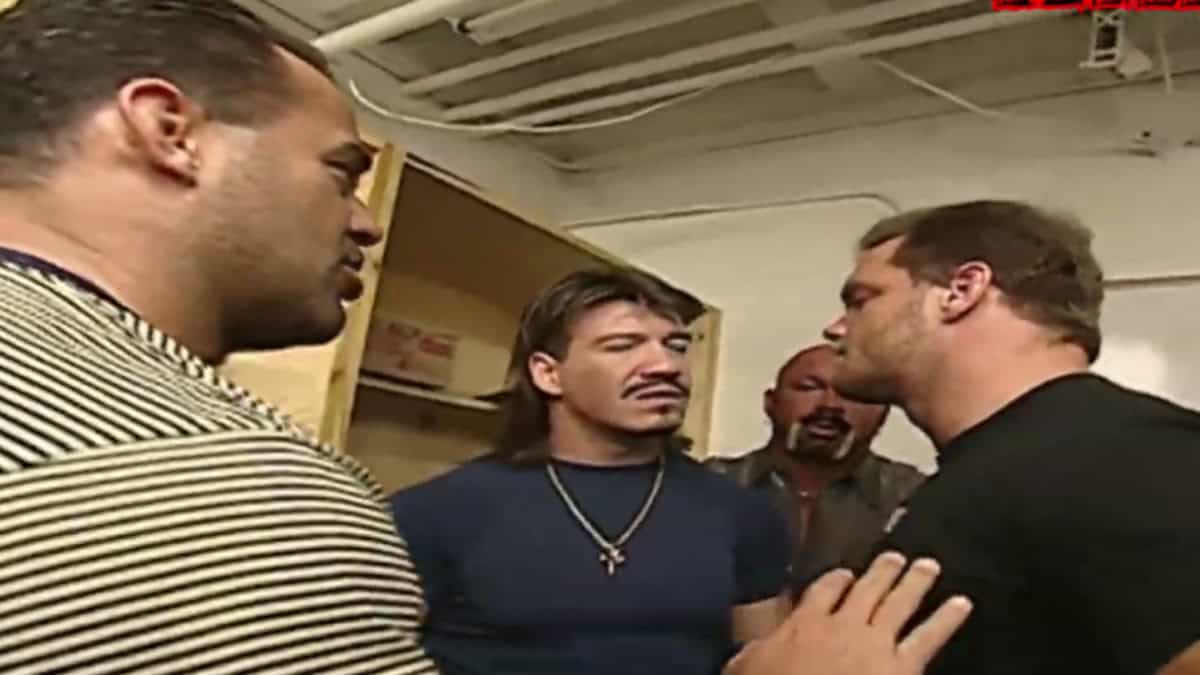
The Exodus: How the Departure of the Radicalz Sealed WCW’s Fate
The Context: A Ship Without a Captain
By early 2000, WCW was in a state of creative and administrative chaos. The company had spent the previous year hemorrhaging money and viewers. To stem the tide, they had hired Vince Russo and Ed Ferrara, the writers credited with the WWF’s “Attitude Era” success. However, Russo’s “crash TV” style had failed to stabilize the ratings, and his conflicts with management led to his removal from power in January 2000.
With Russo out, WCW management made a decision that sent shockwaves through the locker room: they appointed Kevin Sullivan as the head booker.
Sullivan was a veteran of the business, known for his dark, demonic character and his old-school mentality. While he had a mind for wrestling, his appointment created an immediate, personal crisis for one of the company’s top stars: Chris Benoit.
The Personal Conflict: Benoit vs. Sullivan
The tension between Chris Benoit and Kevin Sullivan was not professional; it was deeply personal. Years earlier, Sullivan had booked a storyline in which his real-life wife, Nancy (known on-screen as Woman), had an affair with Benoit. In a case of life imitating art, Chris and Nancy genuinely fell in love. Nancy divorced Sullivan and married Benoit.
While Sullivan had maintained a level of professionalism in the years following the divorce, the dynamic shifted entirely when he was handed the “pencil”—the power to decide winners, losers, and career trajectories. Benoit, naturally, feared that Sullivan would use his new authority to bury him professionally or humiliate him on television out of spite.
This fear was not isolated to Benoit. His closest friends in the company—Eddie Guerrero, Dean Malenko, and Perry Saturn—shared his anxiety. They viewed themselves as the workhorses of the company, the technical wrestlers who put on the best matches but were constantly overlooked in favor of aging legends like Hulk Hogan and Kevin Nash. They believed that under a Sullivan regime, the “glass ceiling” would become concrete. They dubbed their backstage faction “The Revolution,” mirroring their on-screen stable, but their fight was very real.
The Meeting with Bill Busch
The inciting incident for the departure occurred in mid-January. Upon hearing of Sullivan’s promotion, the group requested a meeting with Bill Busch, the senior vice president of WCW.
The group, which initially included Shane Douglas and Konnan, presented a united front. They issued an ultimatum: if Kevin Sullivan was the booker, they wanted their releases. They argued that the working environment had become hostile and that they had no faith in the creative direction of the company.
Busch was placed in an impossible position. He could not fire his newly appointed head booker just because the talent demanded it—that would set a precedent of anarchy. However, he also could not afford to lose the core of his mid-card and main event scene.
In a desperate attempt to placate the wrestlers, Busch and the booking committee offered a peace offering. They decided to put the WCW World Heavyweight Championship on Chris Benoit.
Souled Out 2000: The Hollow Victory
The Souled Out pay-per-view took place on January 16, 2000, in Cincinnati, Ohio. The main event was scheduled to be Bret Hart vs. Sid Vicious, but Hart was sidelined with a severe concussion (the injury from Goldberg that eventually ended his career). The title was vacated.
The new main event was set: Chris Benoit vs. Sid Vicious for the vacant WCW World Heavyweight Championship.
Backstage, the atmosphere was toxic. Benoit had made it clear that winning the belt would not change his mind. He told management that he was leaving, regardless of the outcome. Yet, WCW management believed that the allure of being “World Champion”—the pinnacle of the profession—would be enough to seduce him into staying. It was a gamble on his ego.
Benoit went out and defeated Sid Vicious. He made the larger man tap out to the Crippler Crossface. Confetti fell, and Benoit held the Big Gold Belt aloft. It should have been the crowning achievement of his career. Instead, it was a farewell gesture.
According to Bob Ryder, a WCW insider and journalist at the time, Benoit handed the belt back to management immediately after the show. He purportedly said, “I told you I was leaving.”
The Negotiation and The Threat
The day after Souled Out, the situation exploded. Benoit, Guerrero, Malenko, and Saturn refused to fly to the Nitro taping. They held firm on their demand for a release.
Bill Busch threatened legal action. He claimed they were in breach of contract. However, the wrestlers had leverage. They threatened to go public with the disarray within the company, citing the “hostile work environment” created by the Sullivan situation. There were rumors that they would file a lawsuit claiming constructive dismissal.
WCW, already under scrutiny from its parent company Time Warner for its financial losses, wanted to avoid a messy, public legal battle. They also arrogantly believed that the four men, while talented, were not “needle movers” like Hogan or Goldberg. The prevailing thought among the “Old Guard” of WCW was that these were just “vanilla midgets” (a derogatory term for smaller, technical wrestlers) who could be easily replaced.
On January 19, 2000, Bill Busch granted unconditional releases to Chris Benoit, Eddie Guerrero, Dean Malenko, and Perry Saturn.
Shane Douglas was the only member of the group left behind. Reports vary on why; some suggest WCW refused to release him because he was seen as a more valuable talker, while others suggest Douglas had a specific contract dispute or hesitated at the final moment. Regardless, “The Franchise” remained in a sinking ship while his friends grabbed the life raft.
The Jump to Stamford
The four men wasted no time. They reached out to Jim Ross, the Head of Talent Relations for the World Wrestling Federation (WWF).
For the WWF, this was a windfall. Vince McMahon was in the midst of a red-hot period, but his main event scene was thinning due to injuries to Steve Austin and The Undertaker. Acquiring four world-class workers instantly deepened the roster and weakened the competition.
Jim Ross signed them almost immediately. The turnaround was so fast that there was barely time for the wrestling newsletters (“dirt sheets”) to confirm the news before it happened on television.
January 31, 2000: The Radicalz Arrive
The debut of the group on Raw is War remains one of the most memorable moments of the Attitude Era. They did not debut with a vignette or a surprise run-in. They simply sat in the front row.
During a match between the New Age Outlaws and Al Snow/Steve Blackman, the camera panned to the ringside area. Jim Ross, on commentary, acknowledged them.
“Wait a minute. There’s Benoit. Malenko. Saturn. Guerrero.”
It was a stark departure from how WCW handled defections. When WWF guys went to WCW, they were often presented as “invaders” (like the NWO). Here, the WWF acknowledged them as competitors looking for a job.
Later in the night, the group interfered in the main event, attacking the New Age Outlaws and aligning themselves (briefly) with Triple H and Stephanie McMahon. They were dubbed “The Radicalz.”
The Cost of the Jump: Eddie’s Injury
The debut was electric, but it came with a price. In their very first match on Raw, performing a tag team bout against the New Age Outlaws, Eddie Guerrero attempted his signature Frog Splash.
When he landed, his elbow struck the canvas awkwardly. He shattered his elbow immediately. It was a horrific start to his WWF tenure. While the other three proceeded to mix it up with the roster, Guerrero was sidelined for weeks, fearing that he had blown his big opportunity. However, his charisma was undeniable. Even with his arm in a sling, he managed to get over with the fans, eventually sparking his on-screen romance with Chyna (“Mamacita”).
The Long-Term Impact
The defection of the Radicalz shifted the balance of workrate heavily in the WWF’s favor.
- Chris Benoit: Quickly ascended to the upper card, engaging in classic rivalries with Chris Jericho, The Rock, and Kurt Angle.
- Eddie Guerrero: Became one of the most beloved figures in WWE history, eventually winning the WWE Championship in 2004.
- Dean Malenko: captured the Light Heavyweight Championship and had a memorable run before retiring to become a producer.
- Perry Saturn: Had a mixed run, winning the European Title but struggling with gimmick changes (including the infamous “Moppy” angle).
For WCW, the loss was catastrophic. They had lost the heart of their show. The mid-card matches, which often saved the broadcast when the main events were lackluster, suffered significantly. The morale in the locker room plummeted. It reinforced the narrative that WCW was a place where young talent went to die, and the WWF was where talent went to become stars.
The Sid Footnote
An interesting historical footnote involves the WCW title reign of Chris Benoit. Because he left the day after winning it, WCW refused to acknowledge the reign for years. On the Nitro following Souled Out, they claimed that Sid Vicious’s foot was under the rope during the submission, rendering the victory void. They stripped the title from the departed Benoit and erased the moment from their immediate history.
Legacy of the Defection
The Radicalz jumping ship was the final confirmation that the Monday Night Wars were effectively over. While WCW would limp on for another year, the talent drain was irreversible. The WWF had captured the imagination of the fans and the loyalty of the best wrestlers in the world.
For the four men involved, it was a gamble on themselves. They traded guaranteed money in a relaxed (albeit chaotic) environment for the grueling, competitive world of Vince McMahon. In doing so, they proved that talent, when given the proper platform, rises to the top. The image of the four of them standing in the ring on Raw, arms raised, remains the definitive symbol of the shifting tides of the year 2000.

