


In the lexicon of professional wrestling, the term “shoot” refers to an unscripted moment where reality pierces the veil of performance. Throughout the history of the sport, there have been worked shoots (scripted moments designed to look real) and legitimate shoots (actual conflicts). However, on July 9, 2000, at WCW’s Bash at the Beach, the industry witnessed a collision of the two that resulted in the most confusing, destructive, and litigious night in the history of World Championship Wrestling.
The Context: A Company in Freefall
To understand the toxicity of Bash at the Beach 2000, one must understand the desperate state of WCW at the time. The company, which had dominated the ratings war against the WWF just two years prior, was now hemorrhaging money. The creative direction was being led by Vince Russo and Eric Bischoff, who had formed an uneasy alliance to “reboot” the promotion.
Their on-screen storyline, “The New Blood vs. The Millionaire’s Club,” was a meta-commentary on the real backstage politics. The New Blood (younger talent backed by Russo) were trying to push out the Millionaire’s Club (established legends like Hogan, Flair, and Nash). While the storyline had potential, the reality was far more bitter. Russo genuinely believed that the older stars were holding the company back and needed to be phased out. Hulk Hogan, armed with a contract that gave him “absolute creative control” over his character, refused to step aside without a fight.
Leading into Bash at the Beach, the booking plan was for the WCW World Heavyweight Champion, Jeff Jarrett, to defend his title against Hulk Hogan. Russo wanted Jarrett to retain the title, solidifying him as the top heel. Hogan, exercising his contractual power, refused to lose. He argued that he should win the title, claiming he was still the only man capable of drawing a rating.
The Backstage Standoff
The hours leading up to the show in Daytona Beach, Florida, were filled with shouting matches and tense negotiations. According to Eric Bischoff’s account on his 83 Weeks podcast, the atmosphere was poisonous. Hogan and Russo were at an impasse.
Brad Siegel, the Turner Broadcasting executive overseeing WCW, attempted to mediate. Ultimately, a compromise—or what Hogan thought was a compromise—was reached. The plan, as understood by Hogan and Bischoff, was a “worked shoot.” Jarrett would lay down in the ring, allowing Hogan to pin him effortlessly. Hogan would then take the belt, cut a promo complaining about the company’s nonsense, and leave the arena. The storyline would be that Hogan was taking the belt home, setting up a tournament for a “new” title, with Hogan returning months later for a massive champion vs. champion unification match.
Russo, however, had a different ending in mind.
The Incident: The Fingerpoke of Doom II
When the match began, Jeff Jarrett walked to the center of the ring and laid down on his back. Vince Russo, who was at ringside, threw the championship belt into the ring and yelled at Hogan to pin him.
Hogan, looking visibly frustrated (though whether this was acting or genuine anger remains debated), put his foot on Jarrett’s chest. The referee counted to three. Hogan was announced as the new WCW World Heavyweight Champion.
Hogan grabbed the microphone. “Is this your deal, Russo?” he asked. “That’s why this company is in the damn shape it’s in, because of bullshit like this.”
Hogan took the belt and walked out of the Ocean Center. He reportedly left the building immediately with Eric Bischoff. He believed the angle was executed as planned. He expected to go home, stay off TV for a few months, and return as the exile champion.
The Russo Promo
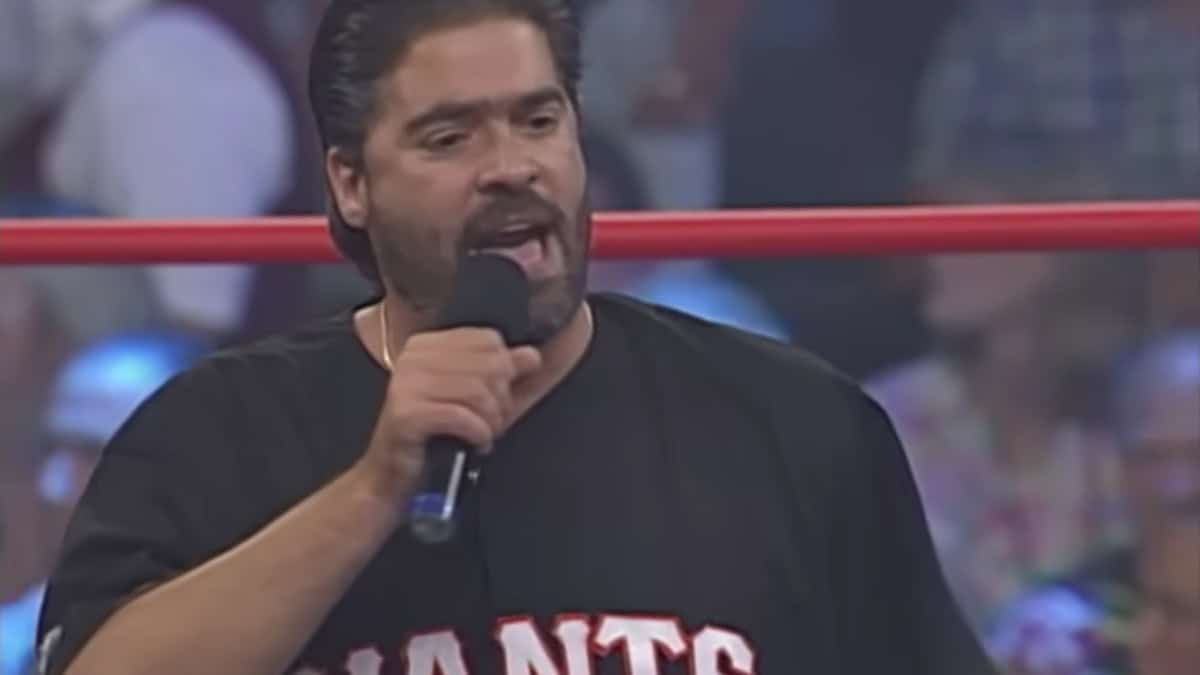
Later in the broadcast, Vince Russo returned to the ring. This is where the script was allegedly discarded. Russo delivered a promo that many historians view as the final nail in the coffin of WCW’s credibility.
Russo, red-faced and screaming, addressed the audience and the locker room. He didn’t just advance a storyline; he eviscerated Hulk Hogan’s character and person.
“Three weeks ago, I left WCW… and I came back for one reason. I came back for that guy, that man, that woman… for everybody in the back that busts their ass week in and week out for WCW.”
He continued, turning his venom toward Hogan. “And I’ve got to be honest with you… there is a politician in the back that is a piece of shit.”
The crowd gasped. Russo continued to tear into Hogan, referencing his “creative control” clause and his refusal to put over younger talent.
“I sat there and I promised you that there would never be another day in this company where a piece of garbage like Hulk Hogan, with his creative control, is going to hold that belt hostage,” Russo yelled. “So, Hulk Hogan, you can have that belt… but as far as I’m concerned, that belt is the Hulk Hogan Memorial Belt. It means absolutely nothing!”
Then came the line that sparked the lawsuit.
“And goddammit, I promise you one thing… you will never see that piece of shit Hulk Hogan again!”
Russo declared that because Hogan had walked out, there would be a new title match immediately between Jeff Jarrett and Booker T.
The Booker T Moment
In the midst of this chaos, a star was born. Booker T, one of the most talented and loyal workers in the company, was thrust into the main event. He defeated Jeff Jarrett in an impromptu match to win his first WCW World Heavyweight Championship.
It was a feel-good moment. Booker T was genuinely emotional, and the fans rallied behind him. However, the shadow of the Hogan/Russo incident loomed large. The championship victory, which should have been the headline, became a footnote to the backstage drama.
The Lawsuit: Bollea vs. Russo
Hulk Hogan (Terry Bollea) watched the show later and was furious. He claimed he had no idea Russo was going to go out and void his title win, nor did he know Russo would defame him personally on a global broadcast. Hogan believed the agreement ended when he walked out the door. He felt Russo had gone into business for himself to bury Hogan and breach his contract.
Hogan filed a defamation of character lawsuit against Vince Russo, Time Warner, and WCW. The lawsuit argued that Russo’s comments about Hogan being a “politician,” a “piece of shit,” and using “creative control” damaged his real-life reputation and marketability as an entertainer. He also claimed breach of contract regarding the creative control clause.
The legal battle dragged on for years. It moved from state to federal courts. The defense mounted by Time Warner/Russo was fascinating: they argued that professional wrestling is a work. They claimed that “Hulk Hogan” is a fictional character, a villain/hero who is subject to ridicule as part of the show. Therefore, Russo calling “Hulk Hogan” a piece of garbage was no different than a character in a movie insulting another character.
Hogan’s legal team argued that the lines were blurred so severely that the audience—and the industry—took Russo’s comments as factual statements about Terry Bollea, the man, not Hulk Hogan, the character.
The Verdict and Legacy
In 2002, a judge dismissed the defamation portion of the lawsuit. The court ruled that in the context of professional wrestling, hyperbolic insults are part of the “theater” and that Hogan, by participating in a business built on “worked shoots,” could not claim defamation for comments made during a wrestling broadcast. The court essentially ruled that you cannot defame a fictional character in a fictional universe.
Hogan continued to pursue claims regarding breach of contract and other issues, but the momentum was gone. The lawsuit was eventually settled or dismissed on all counts by 2005.
Hulk Hogan never appeared in WCW again. His tenure, which began with a ticker-tape parade in 1994, ended with him driving away from a rainy arena in Daytona Beach while being insulted on TV. He would not return to a major wrestling ring until the NWO debut in WWE in 2002.
The Survivor: Booker T
The only positive outcome was Booker T. Despite the tainted circumstances of his win, he took the ball and ran with it. He carried WCW through its final miserable months with dignity and high-quality matches. When WWE bought WCW in 2001, Booker T was one of the few stars to transition successfully, eventually becoming a Hall of Famer.
Bash at the Beach 2000 remains the ultimate example of the “work” becoming a “shoot” and ruining the business in the process. It proved that when the people in charge stop caring about the story and start fighting for their own egos, the only loser is the paying fan.

