


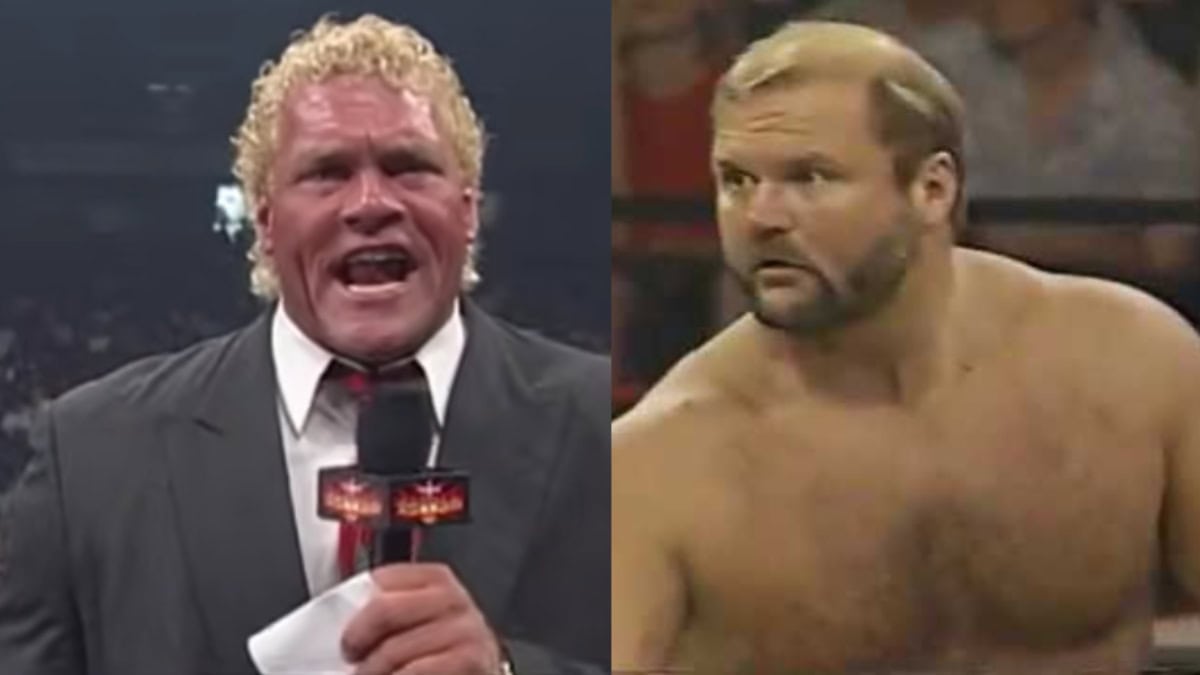
Blood in Blackburn: The True Story of the Sid Vicious and Arn Anderson Hotel Fight
In the history of professional wrestling, “backstage heat” usually refers to verbal disagreements, political maneuvering, or minor scuffles. However, on October 27, 1993, in Blackburn, England, a backstage dispute escalated into a life-threatening situation that forever altered the landscape of World Championship Wrestling (WCW). The violent altercation between Sid Vicious and Arn Anderson involving a pair of scissors is not merely a locker room fable; it is a documented tragedy that resulted in severe physical injuries, immediate terminations, and a complete rewrite of the company’s biggest event of the year, Starrcade.
The Context: WCW in 1993
To understand the tension leading up to the incident, one must examine the state of WCW in late 1993. The company was in a state of transition. Eric Bischoff had recently been promoted to Executive Producer, tasked by Turner Broadcasting to turn around a wrestling promotion that was losing money and market share to the World Wrestling Federation (WWF).
Bischoff’s strategy relied on shifting focus from the “old guard” of southern wrestling technicians to larger-than-life characters and powerhouses. Central to this vision was Sid Vicious (Sid Eudy). Sid had returned to WCW after a stint in the WWF where he had main-evented WrestleMania VIII. He possessed the look, the size, and the intensity that Bischoff believed could attract a mainstream audience.
The plan for Starrcade 1993, scheduled for December, was set in stone: Sid Vicious would challenge Big Van Vader for the WCW World Heavyweight Championship. It was intended to be a “passing of the torch” moment, crowning Sid as the new face of the franchise. The promotional machine was already in motion, with posters printed and storylines written to facilitate this coronation.
In contrast, Arn Anderson (Marty Lunde) represented the foundation of the company. A founding member of the Four Horsemen, Anderson was widely respected for his in-ring ability and his mind for the business. However, in the eyes of management looking for the “next big thing,” Anderson was often viewed as a supporting player rather than a marquee attraction.
The European Tour
In October 1993, WCW embarked on a grueling tour of Europe. These tours were notoriously exhausting, involving long bus rides, unfamiliar accommodations, and a compressed schedule. By the time the roster arrived in Blackburn, England, fatigue and tension were already high.
On the night of October 27, the crew was staying at the Moat House Hotel. As was customary after shows, many wrestlers gathered in the hotel bar to unwind. Alcohol was consumed, loosening inhibitions and fueling simmering resentments.
According to multiple witness accounts, including those of 2 Cold Scorpio and Vader, the initial verbal sparring began between Sid Vicious and Arn Anderson in the bar area. The conversation turned to the topic of “drawing money.” Sid, confident in his position as the incoming champion, reportedly made disparaging remarks about Ric Flair and the Four Horsemen, suggesting that they were “old men” who were holding back the younger talent.
Anderson, fiercely loyal to Flair and the Horsemen legacy, took exception to the comments. The argument intensified, with Sid asserting that he was the future of the business while Anderson was a relic of the past. While voices were raised, the situation initially appeared to de-escalate when the bar closed, and the wrestlers retreated to their rooms.
The Escalation
The conflict did not end in the bar. Accounts suggest that Sid, still agitated by the exchange, paced in his room and grew increasingly angry. Feeling disrespected by Anderson, he decided to confront him again.
Sid went to Arn Anderson’s room on the hotel’s corridor. When Anderson opened the door, the verbal altercation resumed immediately. This time, however, it turned physical.
In his autobiography To Be The Man, Ric Flair described the scene based on the accounts of those present. He noted that Sid possessed a chair leg—reportedly broken off from a chair in his own room—which he used to strike Anderson. Anderson, realizing the physical threat of the much larger man, seemingly fought back with whatever was available.
The chaotic brawl spilled out of the room and into the hallway. It was during this melee that a pair of scissors was introduced into the fight. The origin of the scissors remains a point of varying detail—some claim they were safety scissors from a medical kit, while others describe them as standard grooming scissors—but the damage they inflicted was indisputable.
The Incident
The fight became a struggle for survival. Both men sustained stab wounds as they wrestled for control of the weapon. 2 Cold Scorpio (Charles Scaggs), who was in a nearby room, is credited by many, including Anderson, as the person who likely saved Anderson’s life.
In a shoot interview with RF Video, 2 Cold Scorpio detailed the horrific scene he encountered. He described stepping into the hallway to see Sid standing over Anderson, striking him repeatedly. Scorpio intervened, physically separating the men and alerting the rest of the roster and hotel security.
The physical toll was staggering. Arn Anderson suffered approximately 20 stab wounds to his chest and back. One wound narrowly missed his heart, and others caused significant nerve damage affecting his left arm—a crucial injury for a professional wrestler. Sid Vicious suffered several stab wounds to his stomach and chest.
When the other wrestlers and road agents arrived on the scene, the severity of the situation caused immediate panic. The hallway was covered in blood. An ambulance was called, and both men were rushed to a local hospital for emergency treatment.
The Police Investigation and Legal Fallout
The Lancashire Constabulary arrived at the Moat House Hotel to investigate the incident. Given the severity of the injuries and the presence of a weapon, it was treated as a potential attempted murder or grievous bodily harm case.
Both men were interviewed by the police while in the hospital. However, in a move consistent with the wrestling industry’s “code of silence” prevalent at the time, neither man chose to press formal charges against the other. The mutual refusal to cooperate with a prosecution meant that the police eventually closed the case without making arrests, allowing the wrestlers to return to the United States once they were medically cleared.
The lack of criminal charges did not save them from professional consequences. The incident was a public relations nightmare for WCW. A hotel room bloodbath involving their top star and a respected veteran undermined the company’s attempt to present a polished, mainstream product.
The Professional Aftermath
Upon reviewing the details of the incident, WCW management, led by Eric Bischoff, had to make a swift decision. The narrative that emerged was that Sid was the aggressor, having returned to Anderson’s room to re-ignite the fight after the bar incident concluded.
As a result, Sid Vicious was fired from World Championship Wrestling.
This decision was catastrophic for the booking plans. With Starrcade less than two months away, the main event was gone. The promotional materials featuring Sid were scrapped. The company was forced to pivot rapidly.
To fill the void, WCW turned to the man Sid had insulted in the bar: Ric Flair. The storyline was hastily rewritten to feature Ric Flair putting his career on the line against Big Van Vader. The main event of Starrcade 1993 became Ric Flair vs. Vader, with the stipulation that if Flair lost, he would retire. This pivot resulted in one of the most emotional and celebrated matches in WCW history, a match that would not have happened without the Blackburn incident.
The Injuries and Recovery
Arn Anderson’s recovery was painful and uncertain. The nerve damage he sustained threatened his ability to use his left hand effectively. In his podcast, ARN, Anderson has spoken about the long road to rehabilitation and the mental toll of the attack. He returned to the ring, but the physical scars remained visible for the rest of his career.
Sid Vicious recovered from his wounds relatively quickly but found himself exiled from the major promotions in the United States for a period. He eventually returned to the WWF in 1995, re-establishing himself as a top star, but the “scissors incident” followed his reputation for years, marking him as a volatile personality in the eyes of promoters.
Reconciliation
Remarkably, the wrestling business often necessitates strange bedfellows. Years later, both Sid and Arn Anderson found themselves employed by WCW again during the Monday Night Wars.
Professionalism prevailed over personal animosity. The two men co-existed in the same locker room and even worked together in matches. In 2000, during the dying days of WCW, they were involved in an on-screen angle where Sid challenged the current champion, seemingly putting the real-life bad blood behind them for the sake of the paycheck.
Speaking on his podcast, Anderson reflected on the reconciliation, stating, “We are not friends. We don’t send Christmas cards. But we are professionals. We went to work.”
Legacy of the Incident
The Sid Vicious vs. Arn Anderson fight remains one of the most cited examples of legitimate violence in wrestling history. It serves as a grim reminder of the pressures of the road, the toxicity that can brew in a competitive environment, and the dangerous mix of alcohol and ego.
For wrestling historians, it is a supreme “What If?” scenario. Had the fight not occurred, Sid Vicious would have likely defeated Vader at Starrcade 1993. Ric Flair might not have had his career-defining victory in Charlotte. The trajectory of the WCW World Title would have shifted entirely, potentially changing the landscape of the industry leading into the arrival of Hulk Hogan in 1994.
Instead, the “Blackburn Incident” stands as a bloody footnote in the timeline of WCW—a night where reality crashed violently into the scripted world, leaving physical and historical scars that never fully faded.
A Warning from History
Today, the story is often told to young wrestlers as a cautionary tale. It highlights the importance of walking away from heated situations and the catastrophic consequences of losing control.
In his book Controversy Creates Cash, Eric Bischoff discussed the difficulty of managing that situation. He noted that while losing Sid was a blow to his business plans, keeping him would have caused a mutiny in the locker room. The roster sided with Anderson, the loyal soldier, over Sid, the erratic star.
The incident solidified Arn Anderson’s reputation as a survivor. Despite being stabbed multiple times, he not only survived but returned to perform at a high level. For Sid, it added a layer of infamy to his aura, a dangerous unpredictability that—ironically—made him an even more compelling character to fans who knew the story, even if promoters were wary of the man behind it.
The Moat House hotel fight remains the ultimate example of a “shoot” going wrong. It stripped away the pageantry of professional wrestling to reveal the raw, often ugly humanity of the performers who live their lives on the road.

