


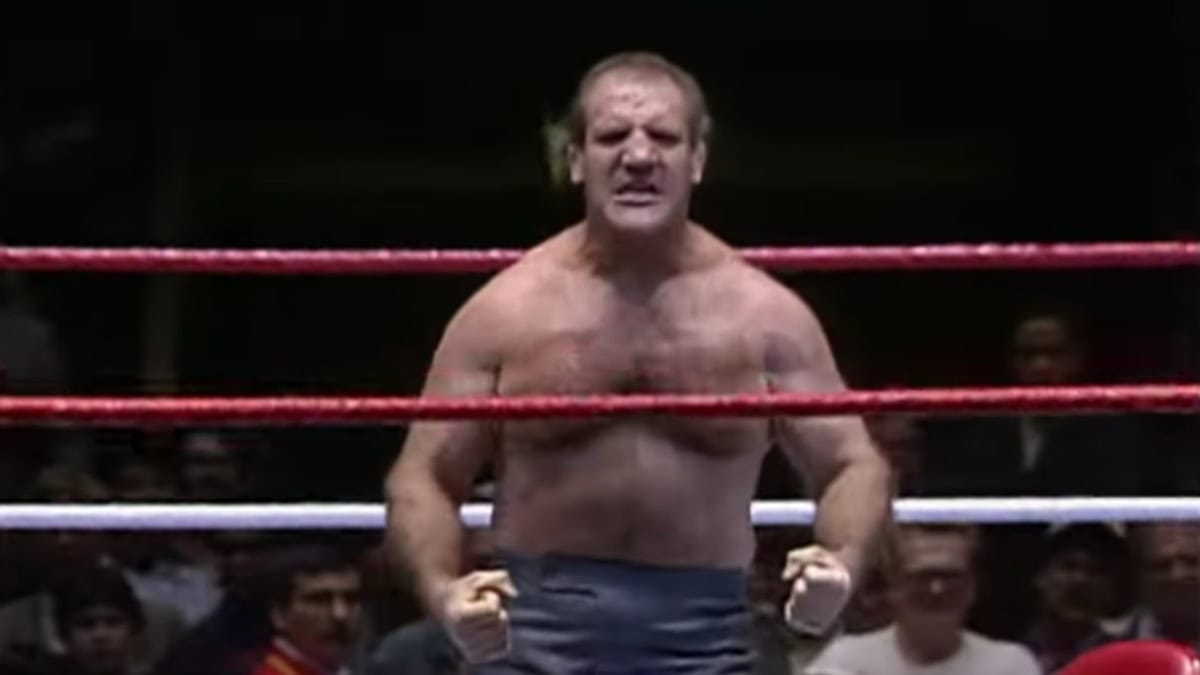
On April 26, 1976, the World Wide Wrestling Federation (WWWF) held a live event at Madison Square Garden in New York City. The main event featured the WWWF Heavyweight Champion, Bruno Sammartino, defending his title against challenger Stan Hansen. During the contest, a botched wrestling maneuver resulted in Sammartino suffering a broken neck.
The Participants and Context
In 1976, Bruno Sammartino was the central figure of the WWWF. He was in the midst of his second reign as champion, having previously held the belt for nearly eight years. To the fanbase in the Northeast, particularly the Italian-American community, Sammartino was viewed as a legitimate athlete and a dominant force. His wrestling style was grounded in power moves and brawling, reflecting his background in weightlifting.
Stan Hansen was a relatively new addition to the WWWF roster. A former collegiate football player from West Texas State University, Hansen utilized a chaotic, stiff wrestling style. This style was partly necessitated by his poor eyesight; without corrective lenses, Hansen reportedly struggled with depth perception, leading him to work physically close to his opponents to ensure contact.
Vince McMahon Sr., the promoter of the WWWF, booked Hansen as a credible threat to Sammartino. The storyline was simple: Hansen was a wild, unpredictable brawler capable of hurting the champion.
The Incident at Madison Square Garden
The match on April 26 began as a standard brawl. Hansen used strikes and kicks to control the pace, while Sammartino retaliated with punches. The crowd at Madison Square Garden was engaged, supporting the champion.
Approximately 15 minutes into the match, the injury occurred. The sequence called for Stan Hansen to execute a scoop slam on Bruno Sammartino.
During the execution of the move, Hansen failed to maintain a secure grip or balance. Accounts differ on the exact cause—whether it was sweat, improper positioning, or a miscommunication—but the result was definitive. Sammartino did not rotate fully to land on his back. Instead, he fell at a steep angle, landing directly on the crown of his head.
The impact compressed Sammartino’s spinal column. The force fractured the sixth cervical vertebra (C6).
Immediate Reaction and Conclusion of the Match
In the ring, the effects were immediate. Sammartino lay motionless for several seconds. In later interviews, he stated that he felt a sensation of extreme heat followed by a temporary loss of feeling in his limbs. Despite the fracture, he did not lose consciousness.
Stan Hansen, adhering to the professional wrestling code of staying in character, continued to attack the champion. He kicked and stomped Sammartino. As the initial shock of the impact subsided, Sammartino regained some sensation and movement.
Rather than signaling the referee to stop the match due to injury, Sammartino attempted to continue. He pulled himself up using the ring ropes. The match proceeded for a short time longer. Hansen struck Sammartino in the head, opening a laceration that began to bleed profusely.
The referee observed the condition of the champion. Seeing the excessive blood on Sammartino, the referee called for the bell. The official ruling was a match stoppage due to blood loss. Stan Hansen was declared the winner of the match, though championships cannot change hands on a count-out or stoppage, meaning Sammartino retained the title.
Medical Diagnosis and Storyline Pivot
Following the match, the scene was chaotic. The audience threw debris at Stan Hansen as he exited the arena. Bruno Sammartino refused to be carried out on a stretcher. He walked back to the dressing room under his own power, a decision that likely risked further injury to his unstable spine.
Upon medical examination, doctors confirmed the fracture. They informed Sammartino that the break was millimeters away from his spinal cord, which could have resulted in permanent paralysis. He was hospitalized and placed in traction.
The WWWF promotional team needed to address the champion’s absence and the nature of the injury on television. However, admitting that a scoop slam—a basic wrestling move—caused the injury would not benefit the storyline. Instead, the promotion attributed the broken neck to Stan Hansen’s finishing maneuver, the “Lariat.”
By claiming the Lariat broke Sammartino’s neck, it established the move as lethal and cemented Hansen’s reputation as a “neck breaker.”
Recovery and Rehabilitation
Doctors initially advised Bruno Sammartino to retire from professional wrestling. They warned that returning to the ring could lead to further damage. Sammartino disregarded this advice. He felt an obligation to the promoter and the fanbase to return and conclude the storyline.
Within two months of the injury, Sammartino returned to the ring. This timeline was aggressive, given the severity of the fracture.
Showdown at Shea
The return match was booked for Showdown at Shea, a supercard held at Shea Stadium in Queens, New York, on June 25, 1976. The event was closed-circuit televised to other locations, increasing the reach of the card.
The main event was Bruno Sammartino vs. Stan Hansen. The narrative was built entirely around revenge and survival. The question posed to the audience was whether Sammartino could withstand the Lariat that had purportedly broken his neck just eight weeks prior.
The event drew a reported attendance of over 32,000, with thousands more watching via closed-circuit.
The match followed a brawling formula similar to their previous encounter. Hansen targeted the neck and Sammartino fought back. In the end, Sammartino defeated Hansen. The finish occurred outside the ring, with Hansen being counted out after a brawl resulting in Sammartino retaining his title.
Long-Term Impact on Careers
The broken neck incident had lasting effects on both men. For Bruno Sammartino, it marked the beginning of the physical decline that would lead to the end of his second title reign. He held the championship for nearly another year, losing it to Superstar Billy Graham in April 1977. He wrestled a reduced schedule afterward and retired from full-time competition in 1981.
For Stan Hansen, the incident was a career-maker. The notoriety of being the man who broke Bruno Sammartino’s neck made him a top draw. He utilized this reputation in Japan, where he became the most successful foreign wrestler in the history of All Japan Pro Wrestling. The Lariat became one of the most protected and feared finishing moves in the industry.

