


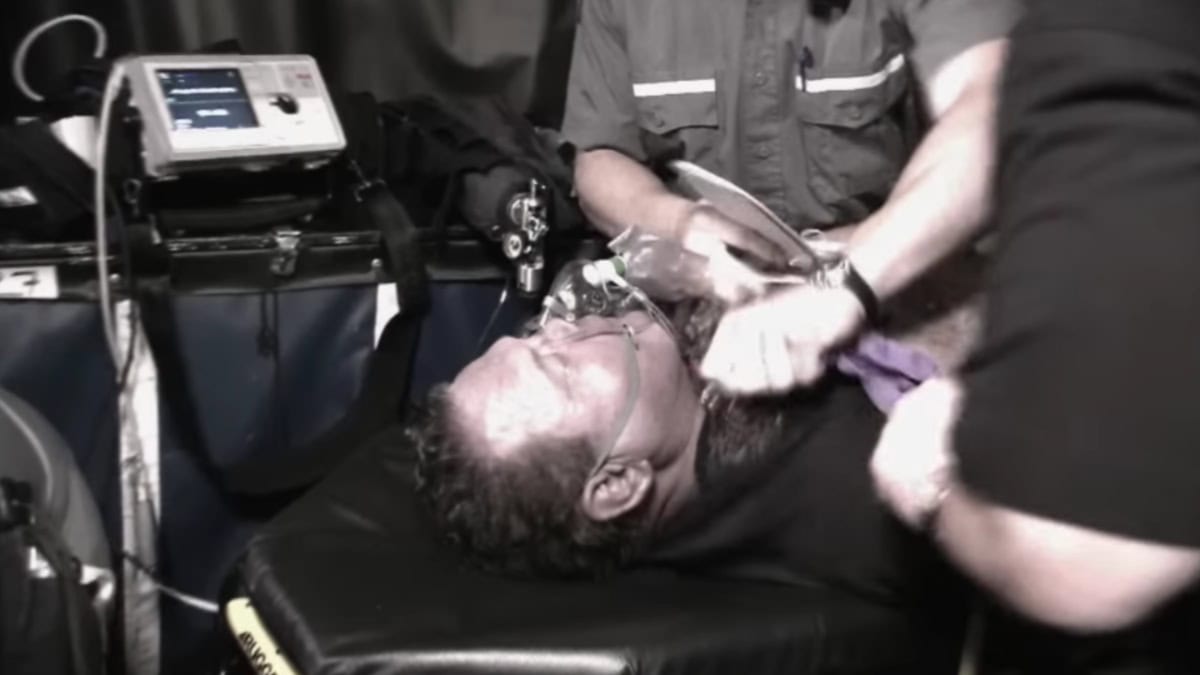
On September 10, 2012, World Wrestling Entertainment (WWE) broadcast Monday Night Raw live from the Bell Centre in Montreal, Quebec, Canada. The show was proceeding as a standard episode until the third hour, when the scripted reality of professional wrestling was shattered by a legitimate medical emergency. Jerry “The King” Lawler, the Hall of Fame commentator, suffered a massive heart attack while sitting at the broadcast table.
The Match Before the Collapse
The context of Lawler’s heart attack involves his physical activity earlier in the evening. Despite being 62 years old at the time, Lawler was still an active in-ring competitor on the independent circuit and occasionally for WWE.
On this specific episode of Raw, Lawler was booked in a tag team match. He partnered with Randy Orton to face CM Punk and Dolph Ziggler. The match took place in the middle of the show. Lawler performed his signature maneuvers, including a dropkick and his diving fist drop from the second rope. He took bumps and exerted himself physically.
Following the match, which his team won, Lawler celebrated and returned to the backstage area. He changed back into his commentary attire and returned to the announce desk to call the remainder of the show alongside Michael Cole.
The Collapse
The incident occurred during a tag team match between Kane and Daniel Bryan (Team Hell No) and The Prime Time Players (Titus O’Neil and Darren Young).
As the match progressed in the ring, Michael Cole, who was sitting to Lawler, noticed a disturbance. According to Cole’s later accounts in interviews, he heard a sound coming from Lawler that resembled snoring.
Lawler then slumped forward onto the announce table before sliding out of his chair and collapsing onto the concrete floor.
In the ring, the wrestlers continued the match, initially unaware of the severity of the situation. However, the crowd in the Bell Centre turned their attention away from the action. A hush fell over the arena as fans near the announce desk stood up to see what was happening.
The Medical Response
WWE ringside physician Dr. Michael Sampson was seated near the timekeeper’s area, just feet away from the announce desk. He reacted immediately.
Dr. Sampson jumped over the barricade to attend to Lawler. Upon assessment, he determined that Lawler was unresponsive and had no pulse. Lawler was in full cardiac arrest.
The medical team initiated CPR immediately. In a stroke of fortune, the paramedics on-site had an automated external defibrillator (AED) ready. They applied the pads to Lawler’s chest. Dr. Sampson administered a shock.
While this was happening, the cameras studiously avoided the announce table. The directive from the production truck, led by Kevin Dunn and Vince McMahon, was to keep the shot focused on the ring to protect Lawler’s dignity and prevent the audience from seeing the resuscitation efforts.
The match in the ring finished quickly. The Prime Time Players and Team Hell No exited. The crowd was silent, watching as Lawler was lifted onto a stretcher and wheeled to the backstage area.
For the television audience, the situation was confusing. The commentary stopped abruptly. The cameras remained fixed on the ring or wide shots of the crowd.
Once Lawler was taken backstage, Michael Cole was left alone at the desk. Cole, who had often played a villainous character on television, dropped all pretense. He was visibly shaken.
Vince McMahon communicated with Cole through his headset. The decision was made that the show would continue, but there would be no commentary. The remaining matches would take place in silence out of respect for Lawler.
For the rest of the broadcast, the only audio was the ring noise and the murmurs of the crowd. Every fifteen minutes, Michael Cole would provide a somber update to the camera. “This is not part of the entertainment. This is a real-life situation. Jerry Lawler has suffered a heart attack.”
Cole’s updates were factual and grim. He informed the audience that Lawler was receiving CPR and was being transported to a Montreal hospital. He confirmed that Lawler was breathing independently and reacting to light, a crucial sign of neurological function.
The Fight for Life Backstage
Backstage, the scene was chaotic. Jerry Lawler’s heart had stopped beating. According to Lawler’s later interviews, he was clinically dead for approximately 20 to 30 minutes.
The medical team continued to work on him in the ambulance loading dock area. They shocked him repeatedly—seven times in total—before his heart rhythm was restored. He was intubated and rushed to a nearby hospital where surgeons placed a stent in his blocked coronary artery.
The blockage was determined to be in the left anterior descending artery, often referred to as the “widowmaker.”
The Aftermath and Recovery
Jerry Lawler survived the night. He was placed in a medically induced coma to allow his body to heal. Tests later revealed that he suffered no permanent brain damage, a rare outcome for someone who had been without a pulse for such an extended period.
In the days following the heart attack, the wrestling world rallied around him. The footage of his collapse was never aired, but the memory of the silent broadcast remained vivid for fans.
Lawler made a full recovery. He returned to WWE television on November 12, 2012, just two months after the incident. He was greeted with a standing ovation.
However, the heart attack effectively ended his in-ring career with WWE. While the company allowed him to return to commentary, they would not clear him to wrestle again due to the liability and the risk to his health. Lawler continued to wrestle on the independent circuit for years afterward, maintaining that he felt physically capable, but his days of competing on Raw were over.
Legacy of the Incident
The night Jerry Lawler died on live television served as a testament to the advancements in WWE’s medical protocols. The immediate presence of Dr. Sampson and the availability of the AED undoubtedly saved Lawler’s life. Had the attack happened in a hotel room or on a plane, the outcome would likely have been fatal.

