


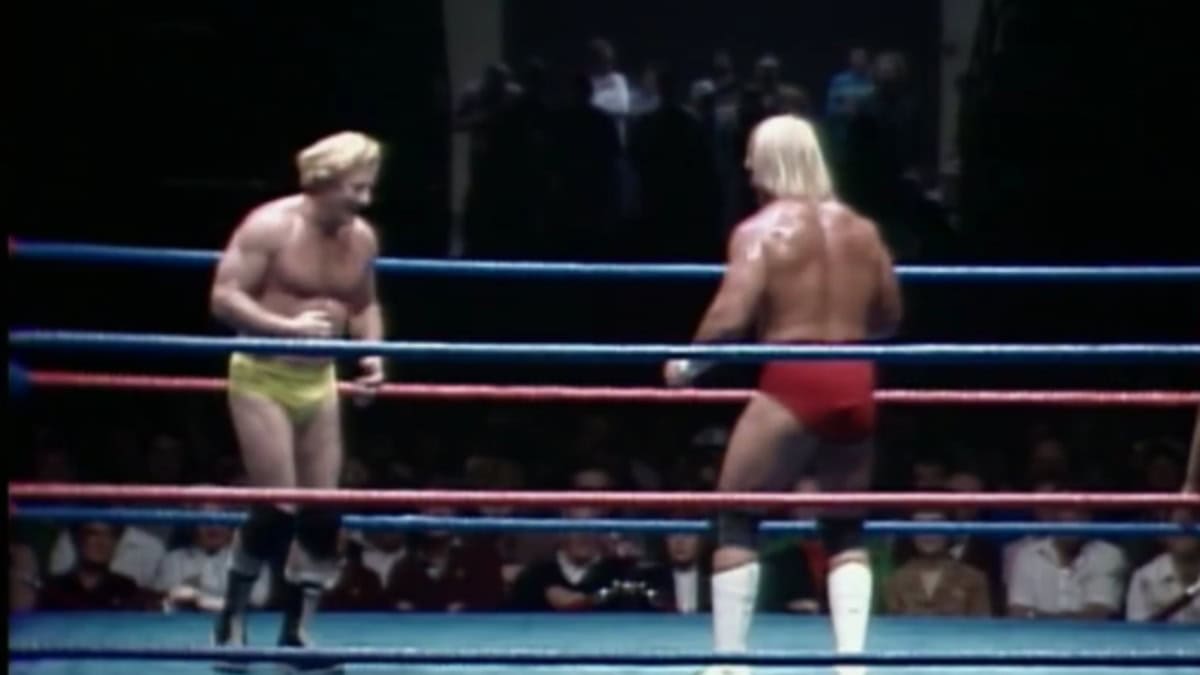
In the early 1980s, the landscape of professional wrestling was a patchwork of regional fiefdoms, but few were as powerful, profitable, or respected as the American Wrestling Association (AWA). Based in Minneapolis, Minnesota, the AWA controlled a massive territory that stretched from Chicago to San Francisco, and from Winnipeg to Denver. It was a kingdom built on the back of “real” wrestling, legitimate athletes, and the iron will of its owner and champion, Verne Gagne.
The Kingdom of Gagne
To understand the fall, one must understand the foundation. Verne Gagne was a legitimate grappler. An alternate for the 1948 U.S. Olympic wrestling team and an NCAA champion, Gagne viewed professional wrestling as a serious athletic endeavor. When he broke away from the National Wrestling Alliance (NWA) in 1960 to form the AWA, he built the promotion in his own image.
The AWA style was technical, logical, and grounded. The champions were men like Gagne himself, Nick Bockwinkel, and Mad Dog Vachon—men who could arguably handle themselves in a legitimate fight. Gagne controlled the business with a tight grip, prioritizing credibility over showmanship. For twenty years, this formula worked. The AWA consistently drew sellout crowds to the St. Paul Civic Center and the Chicago Amphitheatre.
However, as the 1980s dawned, the culture was shifting. The MTV generation was emerging, and they wanted larger-than-life characters, not just headlocks and takedowns. Gagne, comfortable in his philosophy, failed to see the tsunami on the horizon.
The Hulk Hogan Ultimatum
The beginning of the end for the AWA can be traced to a specific conflict involving Hulk Hogan. In the early 80s, Hogan had become a pop culture phenomenon following his appearance as “Thunderlips” in the movie Rocky III. He returned to the AWA as a babyface, and the reaction was unlike anything the territory had ever seen.
“Hulkamania” was born in the AWA. Hogan was selling out arenas and moving merchandise at a record pace. The fans were clamoring for him to defeat the aging, technical champion, Nick Bockwinkel, to win the AWA World Heavyweight Championship.
From a business perspective, putting the title on Hogan was the obvious move. It would have strapped the company to the hottest rocket in entertainment. However, Verne Gagne resisted. To Gagne, Hogan was not a “wrestler.” He was a brawler, a showman, and he lacked the amateur credentials that Gagne fetishized.
Furthermore, the dispute was financial. Gagne famously demanded a percentage of Hogan’s earnings from merchandise and his tours of Japan. Gagne argued that since he promoted Hogan, he was entitled to a cut of all revenue Hogan generated. Hogan, realizing his own value, vehemently disagreed.
The creative frustration reached its peak during a series of matches in 1983 known as the “Super Sunday” era. On multiple occasions, Gagne booked Hogan to “win” the title from Bockwinkel, sending the crowd into a frenzy, only to reverse the decision on a technicality (the “Dusty Finish”) after the match. Gagne believed this would keep the fans coming back to see the eventual victory. Instead, it frustrated Hogan and signaled to him that Gagne would never truly make him the face of the company.
Enter Vince McMahon
While Gagne was quibbling over percentages and wrestling holds, Vince McMahon Jr. was buying the World Wrestling Federation (WWF) from his father and plotting a national takeover. McMahon recognized exactly what Gagne did not: Hulk Hogan was the key to the future.
In late 1983, McMahon made Hogan an offer he couldn’t refuse. He promised him the WWF Championship, national exposure, and the creative freedom to be the star. Hogan left the AWA without notice. He famously mailed a telegram to Gagne that read simply: “I’m not coming back.”
On January 23, 1984, Hulk Hogan defeated The Iron Sheik to win the WWF Championship. “Hulkamania” ran wild, not for the AWA, but for the competition. Gagne had let the biggest drawing card in history slip through his fingers because he didn’t know a wristlock from a wrist watch.
The Great Talent Raid
Losing Hogan was a mortal wound, but what followed was a massacre. Vince McMahon knew that to destroy the AWA, he needed more than just its top star; he needed its infrastructure.
McMahon targeted the AWA’s top talent and production staff. He hired “Mean” Gene Okerlund, the AWA’s beloved interviewer, whose voice and chemistry with the wrestlers were integral to the television product. He hired Bobby “The Brain” Heenan, the greatest manager in the business, and Jesse “The Body” Ventura, the charismatic commentator.
In a short span, the AWA lost its face (Hogan), its voice (Okerlund), and its heat (Heenan). Gagne was left with a depleted roster of aging veterans and young, unproven talent.
Stagnation and The Stan Hansen Debacle
Despite the raids, the AWA still had a chance to survive. They had incredible young talent coming up through Gagne’s training camp, including Scott Hall, Curt Hennig, and The Rockers (Shawn Michaels and Marty Jannetty).
However, Gagne refused to pivot his booking philosophy. He continued to push older, “credible” wrestlers at the top of the card. When he finally decided to put the AWA World Title on a new monster heel, Stan Hansen, in 1985, it resulted in another embarrassment.
Stan Hansen, a rugged brawler who made massive money in Japan, refused to drop the AWA title to Nick Bockwinkel in June 1986. Hansen felt that losing to the smaller, older Bockwinkel would hurt his reputation in Japan.
In a moment of legendary pettiness, Hansen ultimately left the building and, reportedly, ran over the AWA championship belt with his truck before mailing the battered strap back to Gagne. The AWA was forced to award the title to Bockwinkel via forfeit, further damaging the prestige of a championship that once meant everything.
WrestleRock and the Rap
By 1986, Gagne attempted to modernize. Seeing the success of the WWF’s WrestleMania, the AWA launched its own supercard, WrestleRock 86, held at the Metrodome in Minneapolis.
To promote the event, the company produced the “WrestleRock Rumble,” a rap video featuring the AWA roster. While intended to be hip and current, the video is now viewed as a cringe-inducing artifact of a company completely out of touch with pop culture. Watching elderly wrestlers like Verne Gagne and Nick Bockwinkel awkwardly rap awkward lyrics highlighted just how far behind the AWA was compared to the slick MTV production of the WWF.
Although WrestleRock drew a respectable crowd, it was a financial disappointment. The company was losing momentum rapidly.
The ESPN Deal: Exposure Without Profit
In a move to gain national visibility, the AWA secured a television deal with ESPN. On paper, being on a major cable network should have been a savior. In reality, the deal was flawed.
Unlike the WWF’s deal with USA Network or WCW’s deal with TBS, the AWA’s slot on ESPN was not a significant revenue generator. It aired at inconsistent times, often pre-empted by live sports. Furthermore, the AWA did not receive substantial rights fees. The exposure helped them maintain a semblance of national relevance, but it did not fill the coffers.
The production values of the ESPN show—often filmed in a small, pink-walled studio in Las Vegas or Minneapolis—looked minor league compared to the pyrotechnics and arenas of the WWF.
The Team Challenge Series
As the 1990s approached, the AWA was on life support. The roster had been stripped bare. Curt Hennig and The Midnight Rockers had all defected to the WWF.
In a final, desperate attempt to create something “new,” the AWA launched the “Team Challenge Series” (TCS) in 1989. The concept involved dividing the roster into three teams to compete for points in various matches.
The TCS was confusing, poorly produced, and mocked by the few fans still watching. It was the death rattle of a promotion that had lost its identity.
The End of the Road
By 1990, the AWA could no longer afford to run house shows. They stopped touring. The final AWA World Heavyweight Champion was Larry Zbyszko, who won the vacant title in a battle royal.
In 1991, Verne Gagne finally filed for bankruptcy. The assets of the company, including its vast and valuable tape library, were eventually purchased by the WWF. The territory that had once ruled the Midwest, the promotion that had trained Ric Flair, The Iron Sheik, and Ricky Steamboat, simply ceased to exist.
Legacy of Obstinance
The collapse of the AWA is frequently attributed to the aggressive expansion of Vince McMahon, and while that is the external cause, the internal cause was Verne Gagne’s stubbornness.
In his autobiography Controversy Creates Cash, Eric Bischoff (who got his start in the AWA office) described Gagne as a man stuck in time. Gagne believed that the audience would always pay to see “real” wrestling. He believed that Hulk Hogan was a flash in the pan. He believed that he could bully talent into staying loyal without paying them competitive wages.
He was wrong on all counts.
The death of the AWA proved that in the wrestling business, tradition is not a shield against innovation. By refusing to evolve, refusing to pay his top star, and refusing to acknowledge that the business had changed, Verne Gagne didn’t just lose a war; he lost an empire. The AWA remains a beloved memory for older fans, but for historians, it is the ultimate example of how a failure to adapt can turn a kingdom into a graveyard.

