


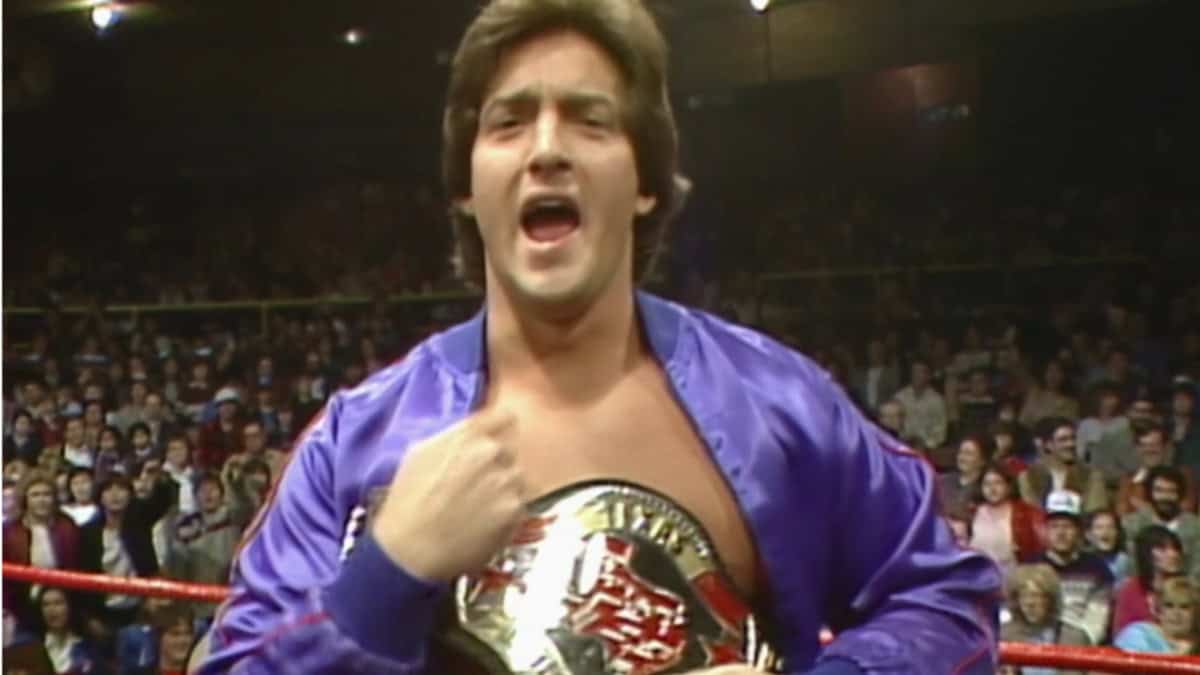
In the mid-1980s, Dallas, Texas, was the hottest wrestling territory in the world. World Class Championship Wrestling (WCCW), run by Fritz Von Erich, was a phenomenon that transcended the traditional boundaries of the sport. The wrestlers were not just athletes; they were rock stars who sold out the Cotton Bowl and were mobbed by screaming fans wherever they went. At the center of this hurricane of fame, money, and excess was Gino Hernandez.
Known as “The Handsome Half-Breed,” Hernandez was the perfect villain for the era. He was arrogant, flashy, and dripped with legitimate heat. He drove a Porsche, wore custom suits, and bragged about his expensive lifestyle. However, on February 4, 1986, the glamour came to a rotting end. Hernandez was found dead in his apartment in Highland Park, a wealthy enclave of Dallas.
The official cause of death was acute cocaine intoxication. But for nearly four decades, the wrestling world has refused to accept that finding. The circumstances surrounding his death—the locked door, the massive amount of drugs in his system, and his alleged connections to the organized crime underworld—have turned the death of Gino Hernandez into one of the most enduring and chilling cold cases in the history of the business.
The Man Who Lived the Gimmick
To understand the paranoia surrounding his death, one must understand the life of Charles Eugene Wolfe Jr., the man behind the Gino Hernandez persona. He broke into the business at a young age, trained by the legendary Jose Lothario. From the beginning, he possessed an unnatural charisma.
When he arrived in WCCW, he was paired with Chris Adams to form “The Dynamic Duo.” They were the antithesis of the clean-cut Von Erich brothers. They cut their hair short (eventually), wore sunglasses indoors, and exuded a “yuppie” arrogance that infuriated the blue-collar Texas crowd.
Hernandez didn’t just play a rich playboy on television; he lived it. In an era where “kayfabe” (protecting the reality of the business) was still law, Hernandez blurred the lines dangerously. He was frequently seen at the most exclusive nightclubs in Dallas, mingling with high-rollers and shadowy figures.
According to those who knew him, including manager Gary Hart and wrestler Jake “The Snake” Roberts, Hernandez began running with a crowd that was far more dangerous than any wrestling locker room. He allegedly cultivated relationships with major drug traffickers, using his celebrity status to gain entry into their world. This proximity to the cartel lifestyle fueled the rumors that would later swirl around his demise.
The Cotton Bowl and the Downward Spiral
The peak of Hernandez’s career came on October 6, 1985, at the second David Von Erich Memorial Parade of Champions. In front of over 26,000 fans at the Cotton Bowl, Hernandez and Adams lost a “Hair vs. Hair” match to Kevin and Kerry Von Erich. Having his head shaved was a humiliation ritual that usually signaled the end of a feud, but for Hernandez, it signaled the beginning of the end of his life.
Following the event, Hernandez’s behavior became increasingly erratic. The cocaine use, which had been a recreational part of the WCCW rock-star lifestyle, reportedly escalated into a severe addiction. He became paranoid.
In the Dark Side of the Ring episode dedicated to his death, friends and colleagues recounted how Hernandez began to believe he was being followed. He told people that he had “upset the wrong people” and that he owed money to dangerous men. He reportedly purchased a firearm for protection, a stark contrast to the carefree partier he had been just months prior.
In January 1986, he missed several bookings. In the wrestling business, “no-showing” is a cardinal sin, usually resulting in firing. But Hernandez wasn’t just missing shows; he was missing from the world.
The Discovery in Highland Park
By early February 1986, concerns for Hernandez’s safety grew. He had not been seen for days. On February 4, concerned associates and local law enforcement went to his apartment complex in Highland Park.
The scene they discovered was gruesome. The smell of decomposition was evident from the hallway. When police entered the apartment, they found Gino Hernandez dead. He had been deceased for approximately three to four days.
The details of the crime scene are the fuel for the conspiracy theories. Hernandez was found on the floor. Nearby was a bowl containing a substantial amount of cocaine. There were no signs of a struggle. The apartment was not ransacked. Most critically, the deadbolt on the door was locked from the inside.
To the police, it appeared to be a clear-cut case of accidental overdose. A young man with a history of drug use had simply partied too hard alone and his heart had given out. The medical examiner ruled the death accidental due to acute cocaine intoxication.
The Murder Theory: The Shadow of the Syndicate
Despite the official ruling, the wrestling community immediately suspected foul play. The skepticism was rooted in several anomalies.
First, the amount of cocaine in his system was staggering. While Hernandez was a user, the toxicology report indicated levels that suggested ingestion rather than just inhalation. This led to the theory that he was forced to swallow the drugs at gunpoint—a method of execution known to be used by cartels to mask murder as an overdose.
Second, there was the issue of the deadbolt. While the door was locked, skeptics argued that a professional hitman would have known how to exit and lock the door, or perhaps exited through a window (though reports on the window status vary).
Third, and most compellingly, was Hernandez’s own testimony. In the days leading up to his death, he had told multiple people, including his mother, that his life was in danger. He claimed he had crossed a local drug syndicate.
David Manning, a WCCW referee and booker, stated in interviews that Gino had told him he needed a gun because “they” were coming for him. The identity of “they” has never been officially confirmed, but the prevailing rumor in Dallas was that Hernandez was involved with a group based out of Enzo’s, an Italian restaurant and nightclub frequented by the roster.
The Funeral and the Fear
The funeral of Gino Hernandez was a tense affair. While some wrestlers attended, many stayed away. The atmosphere was thick with fear. There was a palpable sense that if Gino had been murdered by organized crime, being associated with him—even in death—could be dangerous.
Gary Hart, who managed Gino and was close to him, was visibly shaken. He later wrote in his autobiography that he believed Gino had gotten in over his head with people who did not care about his celebrity status.
For years, the story was whispered as a cautionary tale. It was the ultimate example of the “Wrestler’s Bubble”—the false belief that the toughness of the ring translates to the streets. Gino played a bad guy on TV, but he allegedly crossed real bad guys who didn’t follow a script.
New Revelations
Decades later, the case was revisited by Dark Side of the Ring. The documentary brought new information to light, including interviews with Gino’s ex-wife and a daughter he never knew he had.
The documentary also consulted with a forensic pathologist, Dr. Cyril Wecht. After reviewing the autopsy report, Wecht concluded that while the cocaine levels were high, they were not impossible for a heavy user to consume voluntarily. He cast doubt on the “forced ingestion” theory, noting the lack of trauma to the throat or mouth that would usually accompany being force-fed drugs.
However, the documentary did not close the door on foul play completely. It highlighted the strange fact that Gino, who was paranoid about his safety, would be sitting openly with a bowl of cocaine if he feared for his life.
The Legacy of the Handsome Half-Breed
Whether he was murdered or died by his own hand, the death of Gino Hernandez marked the end of an era for World Class Championship Wrestling. It was the first in a domino chain of tragedies that would claim the Von Erich brothers and eventually the territory itself.
Gino Hernandez was 28 years old when he died. He was on the verge of superstardom. Many historians believe he was destined for the World Wrestling Federation (WWF) or Jim Crockett Promotions, where he would have likely been a top-tier heel, possibly even a member of the Four Horsemen.
Instead, he remains a ghost of the Sportatorium. His story is a noir thriller set in the world of spandex and hairspray. It is a reminder that in the 1980s, the line between the character and the man was often blurred, and for Gino Hernandez, that line may have been erased by the very demons he courted to maintain his image.
The locked door of his Highland Park apartment remains a metaphor for his life: we can see the tragic result, but we may never truly know what happened inside the room when the lights went out.

