


In the lineage of the World Heavyweight Championship—the physical belt known as the “Big Gold”—there are names that evoke reverence: Lou Thesz, Ric Flair, Harley Race, Sting. These men bled, traveled thousands of miles, and wrestled hour-long draws to establish the championship as the pinnacle of professional wrestling.
The Context: Desperation and Synergy
To understand how an actor became the World Champion, one must understand the corporate structure of WCW in the year 2000. The company was owned by Time Warner, which also owned Warner Bros., the studio distributing the film Ready to Rumble.
The movie was a slapstick comedy featuring David Arquette and Scott Caan as wrestling superfans who try to help their idol (played by Oliver Platt) regain the title. WCW was heavily featured in the film, with cameos from Goldberg, Diamond Dallas Page (DDP), and Sting.
Corporate synergy mandated that WCW promote the film aggressively. At the same time, WCW was in a ratings freefall. The booking team, led by Vince Russo and Eric Bischoff, was operating under a philosophy of “Crash TV”—a style that prioritized shock value, celebrity involvement, and rapid-fire twists over logic or athletic competition.
Russo, in particular, was obsessed with garnering mainstream media attention. He believed that putting the World Title on a Hollywood celebrity would land WCW on the front page of USA Today and Entertainment Tonight. He viewed the championship belt not as a prize for athletic achievement, but as a prop to generate “buzz.”
The Setup: A Tag Team Stipulation
David Arquette had been brought into WCW storylines in the weeks leading up to the movie’s release. He was paired with Diamond Dallas Page, a close personal friend and the reigning WCW World Heavyweight Champion.
On the April 24, 2000 episode of Nitro, Arquette interfered in a match between DDP and Jeff Jarrett. In a scripted botch, Arquette’s interference backfired, costing DDP the match but setting up the narrative for Thunder.
The main event of Thunder, aired on April 26, was a tag team match: Diamond Dallas Page and David Arquette vs. Jeff Jarrett and Eric Bischoff. The stipulation, devised by Vince Russo, was crucial. It was not a standard tag match. The rule was that whoever scored the pinfall would become the WCW World Heavyweight Champion.
This stipulation meant that Arquette could win the title without pinning the champion, Jarrett. He only needed to pin Eric Bischoff, a non-wrestler.
The Match and the Pin
The match was a chaotic brawl typical of the Russo era. Towards the end, Jeff Jarrett (the champion) was incapacitated. In the ring, David Arquette hit Eric Bischoff with a spear—a move executed with the awkwardness of an untrained civilian.
Arquette covered Bischoff. The referee, Mickie Jay, counted the fall.
The bell rang. Tony Schiavone, the voice of WCW, delivered a line on commentary that—while scripted—seemed to carry the genuine exhaustion of a man watching his profession crumble.
“And the winner of the match… and new WCW World Heavyweight Champion… David Arquette!”
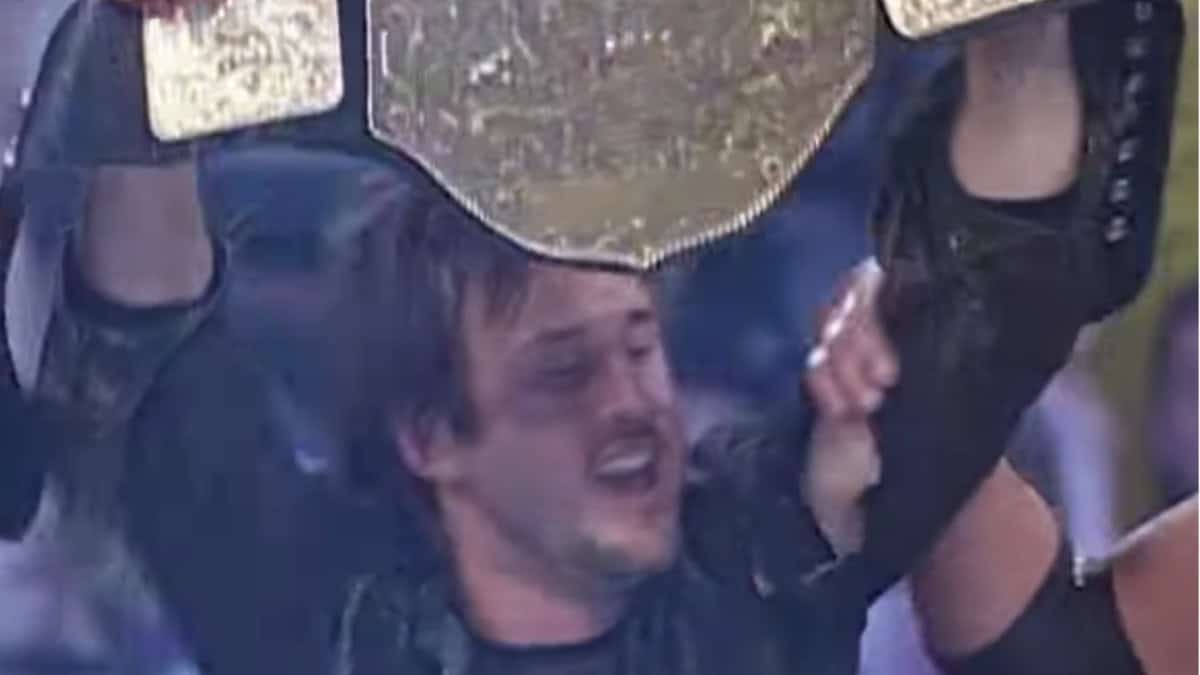
The crowd in the Oncenter War Memorial Arena was confused. There was no riot, no massive pop, just a murmur of disbelief. In the ring, Diamond Dallas Page acted shocked but supportive. Arquette held the Big Gold Belt, looking small and out of place.
The Backstage Reaction
If the crowd was confused, the locker room was furious. To the wrestlers who had spent decades destroying their bodies to earn a spot on the card, putting the title on an actor was the ultimate insult. It told the roster that their work rate, their sacrifices, and their matches meant nothing compared to a movie tie-in.
Ric Flair, the man most associated with that specific title belt, has largely refrained from burying Arquette personally but has criticized the booking decision as a mockery of the business. Other wrestlers were more vocal, viewing it as the moment WCW officially ceased to be a wrestling company and became a circus.
Interestingly, the person who hated the idea the most was David Arquette himself.
In later interviews, and confirmed by DDP and Vince Russo, Arquette argued against winning the title. He was a lifelong wrestling fan. He respected the business. He told Russo, “I can’t win the title. The fans will hate it. It’s disrespectful.”
Russo reportedly told him to get over it, insisting that it was just a prop and that the publicity was worth the heat. Arquette, an actor hired to play a role, did as he was told.
The Reign of the Paper Champion
Arquette held the title for 12 days. During his reign, WCW attempted to present him as a courageous underdog who knew he was out of his depth but had “heart.”
He successfully defended the title once on Nitro against Tank Abbott, a legitimate UFC fighter. The match was a farce, designed to protect Arquette while keeping the belt on him until the pay-per-view.
The reign concluded at Slamboree on May 7, 2000. The main event was a “Triple Cage” match—a structure reminiscent of the scene from the movie Ready to Rumble—featuring David Arquette defending against Diamond Dallas Page and Jeff Jarrett.
The finish saw a “swerve.” Arquette turned on his friend DDP, hitting him with a guitar. This allowed Jeff Jarrett to win the match and the title. Arquette turned heel, explaining in a promo the next night that he did it to help Jarrett because “partners help partners.” It was a nonsensical end to a nonsensical reign.
The Financial Gesture
While the wrestling world vilified Arquette, there was a private side to the story that went largely unreported at the time. David Arquette felt immense guilt about his involvement in the angle. He knew he didn’t deserve the money he was being paid by WCW.
Upon receiving his paycheck for his WCW appearances, Arquette donated the entire amount. He split the money between the families of Owen Hart (who had died in a WWE ring the previous year), Brian Pillman (who had died of a heart condition), and Darren Drozdov (who had been paralyzed in a WWE ring).
He also gave money to the family of Bobby Duncum Jr., a WCW wrestler who had recently passed away.
Arquette did this quietly. He did not issue a press release. It was an act of contrition from a fan who found himself in the middle of a corporate disaster and wanted to pay respect to the men who actually lived the life.
The Fallout: Did it Work?
From a business standpoint, the stunt was a catastrophic failure.
- Ratings: The ratings for Nitro and Thunder did not spike. The mainstream media coverage was largely mocking, treating wrestling as a joke rather than a must-see spectacle.
- The Movie: Ready to Rumble was a box office flop. It grossed only $12 million against a $24 million budget. The wrestling audience, insulted by the product on TV, did not turn out to see the movie.
- The Brand: The prestige of the WCW World Heavyweight Championship was shattered. Once a title is held by a comedy actor, it becomes difficult to convince the audience to take it seriously when it is held by a serious athlete. It signaled to the fanbase that nothing mattered.
The Redemption Arc
For nearly 20 years, David Arquette was persona non grata among wrestling fans. He was the answer to a trivia question and the punchline to a bad joke.
However, in 2018, Arquette decided he wanted to clear his name. At the age of 47, he began training to become a legitimate professional wrestler. He worked the independent circuit, wrestling in backyard brawls and deathmatches.
His journey was documented in the film You Cannot Kill David Arquette. He suffered broken ribs, a severe neck cut in a match against Nick Gage that nearly killed him, and legitimate beatings. He did it to earn the respect he felt he had stolen in 2000.
The wrestling community eventually embraced him. They saw a man who genuinely loved the business and was willing to bleed for their forgiveness.
Conclusion
The night David Arquette won the WCW World Heavyweight Championship remains a cautionary tale about the dangers of prioritizing short-term publicity over long-term credibility. It was a decision made by a television writer (Russo) and a movie studio (Warner Bros.) who fundamentally misunderstood the emotional investment fans have in a championship belt.
While Arquette eventually redeemed himself through blood and sweat decades later, the moment in 2000 stands as the definitive “Jump the Shark” moment for WCW—a stunt so preposterous that it helped convince millions of fans to change the channel and never come back.

