


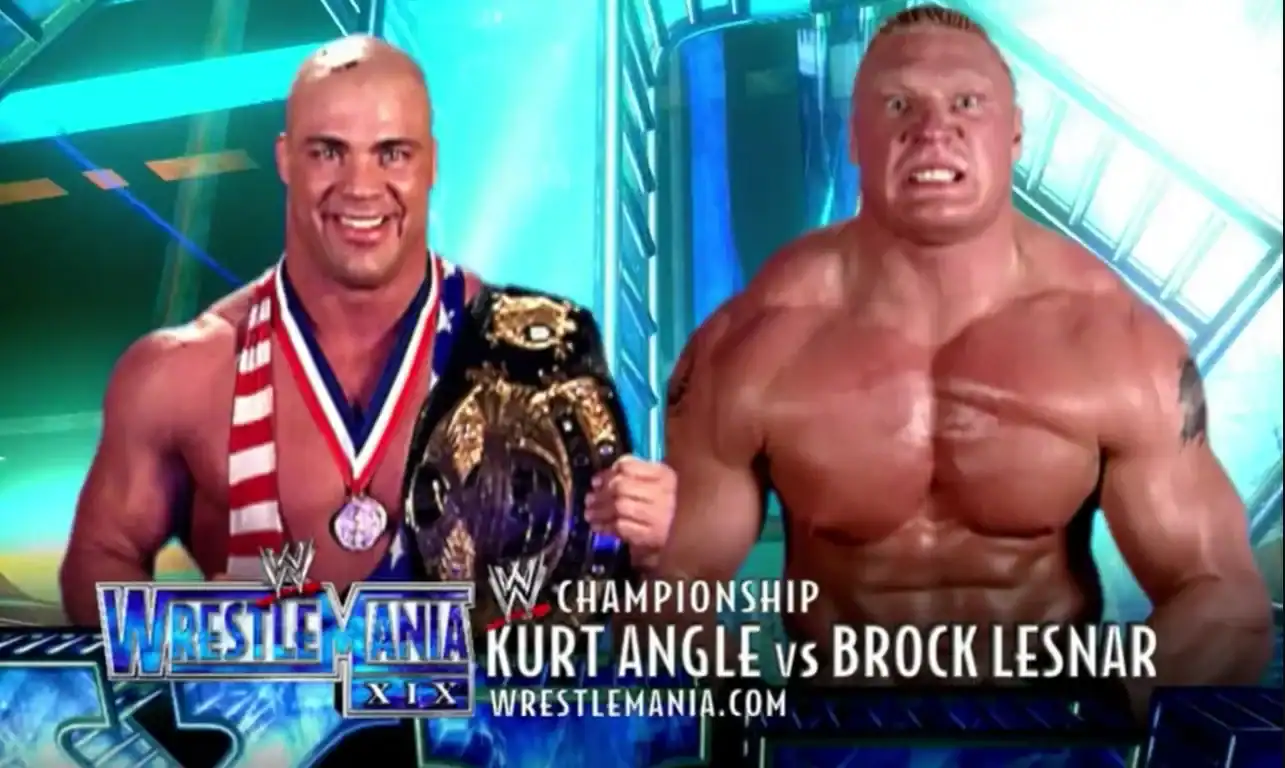
On March 30, 2003, World Wrestling Entertainment (WWE) presented WrestleMania XIX from Safeco Field in Seattle, Washington. The main event featured a contest for the WWE Championship between the defending champion, Kurt Angle, and the challenger, Brock Lesnar.
The Medical Crisis of Kurt Angle
While the public focus remained on the scripted rivalry, the logistical reality of the match was dictated by Kurt Angle’s severe medical condition. In the months leading up to WrestleMania, Angle experienced progressive numbness and weakness in his arms.
Medical evaluations revealed that Angle was suffering from severe degeneration in his cervical spine. Specifically, he had four broken vertebrae and significant bone spur growth that was compressing his spinal cord. Dr. Hae-Dong Jho, a neurosurgeon based in Pittsburgh, examined Angle and recommended immediate surgery. The severity of the injury was such that one erratic bump could have resulted in permanent paralysis.
This diagnosis created a crisis for WWE management. Vince McMahon, the WWE Chairman, considered stripping Angle of the title and canceling the main event. Various contingency plans were discussed, including a scenario where Brock Lesnar would defeat an alternate opponent or where Angle would drop the title in a squash match lasting only a few seconds on SmackDown prior to the pay-per-view.
Angle refused to vacate the title without a match. Driven by professional pride and a desire to deliver the promised main event, Angle elected to postpone aggressive surgery until after WrestleMania. He agreed to a minimally invasive procedure scheduled for the day immediately following the event. This agreement meant that Angle entered the ring at WrestleMania XIX with a fragile neck, placing a high burden of safety on Brock Lesnar.
The conclusion of the match hinged on the “Shooting Star Press.” This aerial maneuver involves a wrestler standing on the top turnbuckle, jumping outward while performing a backflip, and landing torso-to-torso on the opponent. It requires significant rotation speed and height.
Historically, this move was performed by cruiserweights. Brock Lesnar, however, was a physical anomaly. During his time in Ohio Valley Wrestling (OVW), WWE’s developmental territory, Lesnar successfully performed the Shooting Star Press regularly. At 295 pounds, Lesnar’s ability to execute the move was a spectacle that generated significant buzz among industry insiders.
Despite his past success with the move, Lesnar had not performed it on television since his main roster debut in 2002. WWE agents had instructed him to wrestle a “power” style, keeping him grounded to emphasize his size and strength. The Shooting Star Press was kept in reserve for a special occasion.
The Decision to Execute the Move
The decision to utilize the Shooting Star Press as the finish of the match was a collaborative choice between Kurt Angle and Brock Lesnar. Angle has stated on multiple occasions that he was the proponent of the idea.
Speaking on The Kurt Angle Show podcast, Angle detailed the conversation: “I thought he could do it. I’ve seen him do it before. I wanted him to do it because I wanted to give the fans a WrestleMania moment that they would remember forever.”
Lesnar was initially hesitant. He had not practiced the move in a live environment for over a year. Additionally, his body weight had increased since his days in OVW. However, the pressure to deliver a definitive “WrestleMania Moment” influenced the decision. The two agreed that Lesnar would hit the move to pin Angle, providing a visual spectacle to close the show.
The Match Progression
The match itself lasted 21 minutes and 8 seconds. By the time the match reached its climax, Lesnar was physically exhausted. His legs, which provide the explosive power necessary for the backflip rotation, were fatigued from twenty minutes of lifting Angle and moving around the ring.
The Environmental Factors
Two specific environmental variables at Safeco Field contributed to the botch.
First, the ropes. The wrestling ring ropes are wrapped in tape. Over the course of a four-hour event, the heat from the arena lights and the perspiration from dozens of performers can make the ropes slippery. When a wrestler attempts a springboard or a top-rope maneuver, traction is essential. Lesnar later noted that his footing felt unstable as he ascended the turnbuckles.
Second, the positioning. Kurt Angle lay in the ring, positioning himself for the move. However, the distance between Angle and the corner was substantial. Angle was positioned slightly past the center of the ring. This required Lesnar not only to rotate vertically but to propel nearly 300 pounds of mass horizontally across a significant distance.
The Incident: Mechanical Failure
At the conclusion of the match, Lesnar kicked Angle in the midsection and climbed to the top turnbuckle. He paused briefly to steady himself, taking a deep breath.
Lesnar launched into the air. He achieved the necessary height, clearing the initial vertical threshold. However, as he reached the apex of the jump, the rotation stalled. He failed to tuck his knees sufficiently to complete the rotation required to land flat on his stomach.
Instead of landing on his torso, Lesnar came down at an angle. His head drove directly into the canvas and into Kurt Angle’s left side.
Immediate Reaction in the Ring
Kurt Angle, who was observing Lesnar from the canvas, recognized immediately that the move had failed. He saw Lesnar’s eyes glaze over. “He was out,” Angle stated in the documentary The Mania of WrestleMania. “I remember asking him if he was okay, and he wasn’t responding. He was just looking through me.”
The referee, Mike Chioda, checked on Lesnar. The protocol in such a situation is often to end the match immediately if the competitor is unresponsive. However, the match was the main event of the biggest show of the year, involving a title change. Lesnar managed to kick out at the count of two. The kick-out was purely reflexive.
The Improvised Finish
Angle and the referee communicated quickly. They needed to end the match immediately. Angle instructed Lesnar to perform the F-5, Lesnar’s standard finishing maneuver.
Lesnar struggled to his feet. He was visibly unsteady, stumbling as he moved toward Angle. He grabbed Angle around the waist. In a display of adrenaline and muscle memory, Lesnar lifted the 230-pound Angle onto his shoulders.
He delivered the F-5. It was executed without the usual snap or precision, but it was effective. Lesnar fell onto Angle for the cover. Mike Chioda counted the pinfall. Brock Lesnar was the new WWE Champion.
The Backstage Scene
As the copyright graphic appeared on the screen and the broadcast faded, the celebration in the ring was nonexistent. Lesnar lay on his back, clutching his head. Angle rolled out of the ring to allow medical personnel access.
Lesnar refused a stretcher. He insisted on walking to the locker room. With assistance, he made it up the ramp.
Once backstage, the adrenaline faded. Lesnar collapsed. He began vomiting, a primary symptom of severe head trauma. Vince McMahon and the executive team were deeply concerned. The initial fear was a broken neck or spinal cord damage.
Medical Diagnosis
Lesnar was transported by ambulance to a nearby hospital in Seattle. Kurt Angle, despite his own broken neck, traveled to the hospital to check on his opponent.
Doctors performed CT scans and MRIs on Lesnar’s head and neck. The results revealed a severe concussion. However, miraculously, there were no fractures in the vertebrae.
Doctors attributed Lesnar’s survival to his extreme muscular development. The sheer size of his trapezius and neck muscles acted as a natural brace, absorbing the impact and preventing the cervical spine from snapping under the pressure. Had a performer with a standard physique taken the same fall, the result likely would have been quadriplegia or death.
Kurt Angle’s Surgery
While Lesnar was being treated for the concussion, Kurt Angle prepared for his own medical procedure. The morning after WrestleMania XIX, Angle flew to Pittsburgh to undergo surgery with Dr. Jho.
The surgery was successful. Angle had bone spurs removed and his nerve pathways decompressed. He returned to WWE television months later. The bond between Lesnar and Angle was cemented by the match; they had protected each other through a bout where both were one bad move away from permanent disability.
Brock Lesnar’s Perspective
In the years following the event, Brock Lesnar has expressed regret regarding the decision to perform the Shooting Star Press. In his autobiography, Death Clutch: My Story of Determination, Domination, and Survival, Lesnar was candid about the error.
He placed the blame on his own ego and the pressure to entertain. “I wasn’t comfortable doing it,” Lesnar wrote. “But I didn’t want to say no. I wanted to be the guy who could do anything… I launched, I slipped, and I came up short. It’s that simple.”
Lesnar also noted that the concussion affected his memory of the event. He has stated that he does not remember the end of the match or the celebration afterward.
Legacy of the Match
Despite the botched finish, the main event of WrestleMania XIX is often cited by wrestling critics as one of the best matches in the event’s history. The technical wrestling displayed by Angle and Lesnar prior to the accident remains a high-water mark for the integration of amateur styles into professional wrestling.

