


Context and Background
Mick Foley entered the June 1998 event with concerns regarding his ability to match the performance of Shawn Michaels. Michaels was known for his agility and technical wrestling ability, traits Foley did not possess to the same degree. Foley’s style focused on brawling and physical durability. In his autobiography, Have a Nice Day, Foley stated that he felt pressure to deliver a memorable performance despite his physical limitations compared to Michaels.
The Planning and Lack of Rehearsal
The logistics of the match originated from a conversation between Foley and fellow wrestler Terry Funk. While viewing a tape of the previous Hell in a Cell match, Funk suggested that Foley start the match on top of the cage structure rather than inside it. Funk remarked, “Maybe you ought to start the match on top of the cell.”
Foley accepted the suggestion. However, he did not rehearse the climb or the movement on top of the structure prior to the live broadcast. In later interviews, Foley admitted to lying to WWF Chairman Vince McMahon regarding his preparation. Foley told McMahon he had climbed the cage earlier in the day and felt comfortable with the height. In reality, Foley had not ascended the structure.
The Undertaker also expressed reservations. During the planning stages, when Foley proposed being thrown off the roof, Calaway asked, “Mick, do you want to die?” Calaway eventually agreed to the spot after Foley insisted it was necessary to generate audience interest.
The Structural Difference
The Hell in a Cell structure used in 1998 differed significantly from modern versions. The cage stood approximately 16 feet high and was constructed of chain-link mesh secured with zip ties and wire. The roof was not designed to support the weight of two men totaling nearly 600 pounds. Unlike reinforced cages used in later years, the 1998 mesh sagged under weight and provided unstable footing.
The First Fall: 16 Feet to the Floor
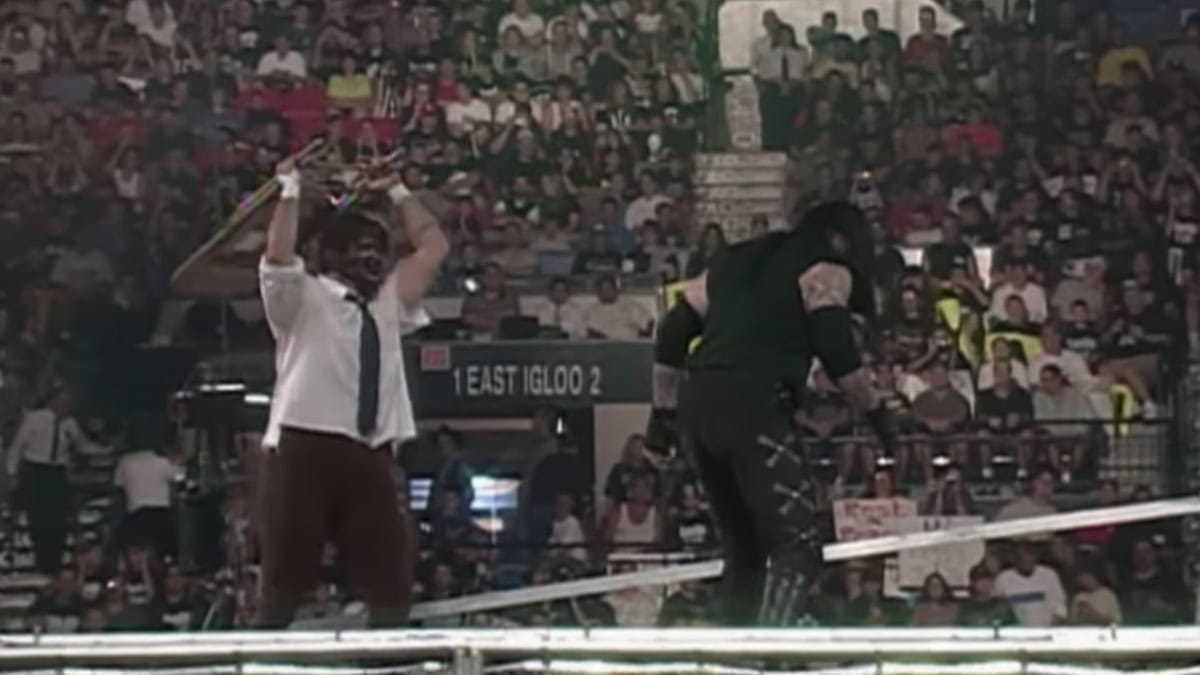
The match began with both competitors climbing to the roof of the cage. They engaged in a brawl on the mesh panels. The structure buckled under their movements. Approximately two minutes into the match, The Undertaker grabbed Foley near the edge of the structure.
The planned spot involved The Undertaker throwing Foley off the side of the cage. The Undertaker executed the move, tossing Foley 16 feet down toward the commentary position. Foley crashed through the Spanish announce table. The impact caused immediate concern among the production crew and ringside officials.
Commentator Jim Ross reacted live on the broadcast. His words, “Good God almighty! That killed him! As God as my witness, he is broken in half!” reflected the genuine shock of the moment rather than a scripted line. Ross later clarified that he believed he had just witnessed a fatal or paralyzing injury.
Medical personnel, referees, and Vince McMahon came to ringside. The match stopped temporarily. Officials placed Foley on a stretcher to transport him backstage. The production team prepared to move to the next segment, assuming the contest had concluded due to injury.
The Second Fall: Structural Failure
Despite suffering a dislocated shoulder from the initial fall, Foley removed himself from the stretcher and began climbing the cage for a second time. The Undertaker remained on the roof.
The two resumed fighting on the mesh. The next planned sequence called for The Undertaker to Chokeslam Foley onto a specific panel of the chain-link roof. The intention was for the panel to sag or give way slightly to create a visual scare, but for the structure to remain intact.
However, the plastic zip ties holding the panel together failed. When The Undertaker slammed Foley, the panel gave way completely. Foley fell through the roof, dropping roughly 13 feet to the canvas below.
This fall was unplanned. The impact was unmitigated, as Foley landed awkwardly on his back and neck. Additionally, a steel chair that had been resting on the roof fell through the hole and struck Foley in the face upon his landing.
The Undertaker later described this moment in his documentary The Last Ride. He stated that he looked down through the hole and assumed Foley was dead. Calaway broke character, standing still on the roof to wait for a signal from the referee or Foley. He noted that the visual of Foley motionless on the mat altered his perspective on the industry.
Medical Consequences of the Second Fall
The unplanned fall resulted in severe injuries. Foley sustained a concussion and was knocked unconscious. The impact of the chair dislocated his jaw and knocked out teeth. One of his teeth penetrated his lip and lodged in his nasal cavity.
Cameras captured close-up shots of Foley as he regained consciousness. The tooth was visible inside his nostril. Despite the severity of the situation, the match continued.
The Conclusion of the Match
Terry Funk entered the ring to check on Foley’s condition and buy time for Foley to recover. To maintain the narrative flow, The Undertaker chokeslammed Funk.
Foley eventually stood up. He later stated he has no memory of this portion of the match due to the concussion. Operating on instinct, he instructed The Undertaker to perform a Chokeslam onto a pile of thumbtacks, a stunt Foley had used in previous organizations.
The Undertaker poured thousands of thumbtacks onto the canvas. He then slammed Foley onto the tacks. The match concluded with The Undertaker performing his finishing move, the Tombstone Piledriver, and pinning Foley for the victory.
Immediate Aftermath and Interaction with Vince McMahon
Foley refused a stretcher after the match ended. He walked backstage with assistance from referees and officials. Upon entering the backstage area, he received medical attention for multiple injuries, including the concussion, dislocated jaw, dislocated shoulder, bruised kidney, and puncture wounds from the tacks.
Vince McMahon visited Foley in the medical area. According to Foley, McMahon expressed gratitude for his effort but established a new boundary. McMahon told him, “You have no idea how much I appreciate what you’ve just done for this company, but I never want to see anything like that again.”
Historical Significance and Criticism
The match produced immediate results for the WWF’s popularity but drew criticism regarding performer safety and the escalation of violence in professional wrestling.
Elevation of Mick Foley
The match altered the trajectory of Mick Foley’s career. The toughness displayed in Pittsburgh garnered respect from the audience and management, propelling him into the main event picture. Foley won the WWF Championship later that year.
The Undertaker’s Perspective
Mark Calaway has expressed mixed feelings about the match in various interviews. While acknowledging the match’s place in history, he has stated that it should not be replicated. He emphasized that the margin for error was non-existent and that the second fall could have easily resulted in paralysis or death.
Conclusion
The Hell in a Cell match at King of the Ring 1998 remains a pivotal event in professional wrestling history. It is defined by two specific falls: one planned but dangerous, and one unplanned and structurally catastrophic. The event served as a catalyst for Mick Foley’s rise to the top of the industry while simultaneously sparking a debate regarding the safety protocols and escalation of risk in televised wrestling. The images from the match are frequently used in WWE programming, though the participants and management maintain that the specific circumstances should never occur again.

