


The Death of the Competition
On March 23, 2001, the landscape of professional wrestling changed permanently. World Wrestling Federation Chairman Vince McMahon purchased the assets of World Championship Wrestling from AOL Time Warner. The purchase price was approximately $2.5 million for the trademarks, tape library, and select contracts—a staggering fire sale price for a company that had generated hundreds of millions of dollars in revenue just years prior. This acquisition signaled the end of the “Monday Night Wars,” a six-year ratings battle between WWF’s Raw and WCW’s Nitro.
The Contract Loophole
The primary reason the Invasion failed was not creative incompetence alone, but a calculated financial refusal by WWF management. When Vince McMahon bought WCW, he acquired the brand and the intellectual property, but he did not acquire the contracts of WCW’s top stars.
The parent company, AOL Time Warner, held the contracts for WCW’s highest-paid talent: Hulk Hogan, Kevin Nash, Scott Hall, Goldberg, Sting, and Lex Luger. These contracts were “guaranteed,” meaning the wrestlers were paid regardless of whether they performed or the company existed.
The WWF had the option to buy out these contracts or offer new deals to bring the talent in immediately. However, the costs were astronomical. Goldberg, for example, was earning upwards of $4.5 million per year.
Vince McMahon refused to pay these rates. He offered the WCW stars a choice: accept a buyout from AOL Time Warner for pennies on the dollar and sign a new, lower-paying deal with the WWF to work immediately, or stay home and collect their full guaranteed salary from AOL Time Warner to do nothing.
Logic prevailed. The biggest stars in the industry chose to stay home and get paid. “I had a guaranteed contract with AOL Time Warner,” Kevin Nash explained in a later interview. “I was making millions to sit at home. Why would I take a pay cut to go work 300 days a year?”
The B-Team Invasion
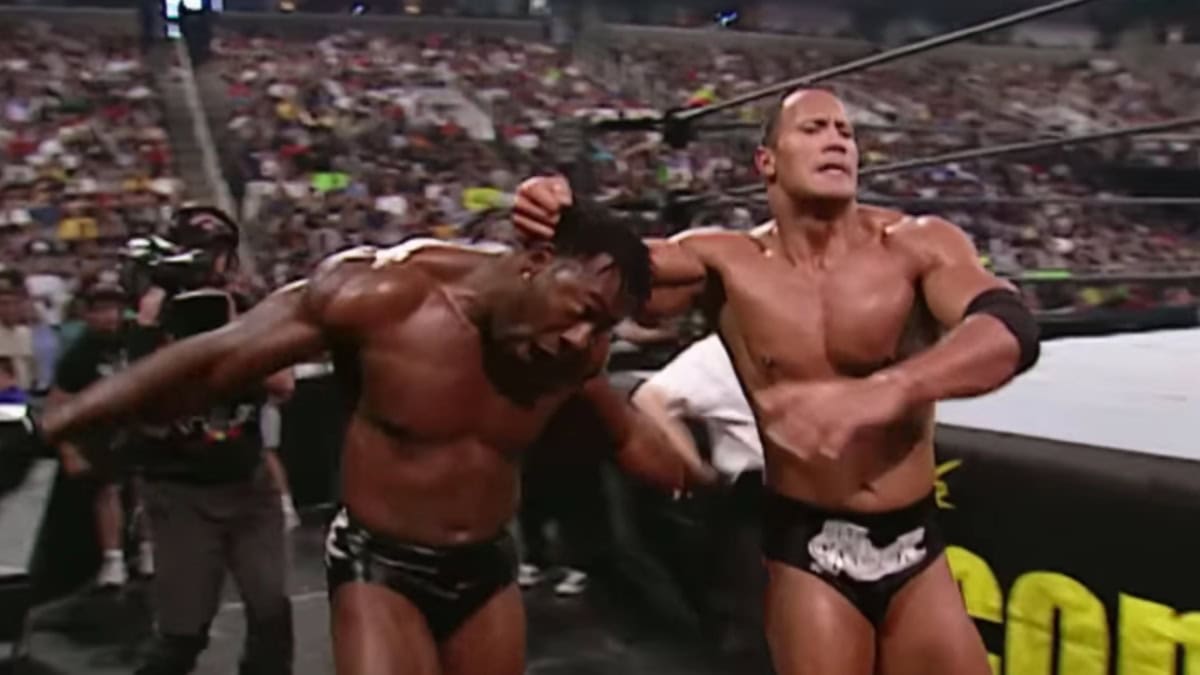
Because the top-tier talent refused the buyout, the “Invasion” force that arrived on WWF television consisted of mid-card talent and wrestlers who were hungry for an opportunity but lacked main-event status. The face of the WCW invasion became Booker T, Diamond Dallas Page (DDP), Lance Storm, and Buff Bagwell.
While Booker T and DDP were legitimate stars, they were not the NWO or Goldberg. To the casual audience, it looked like the WWF varsity team was fighting the WCW junior varsity squad.
Jim Ross, the WWF’s Head of Talent Relations at the time, noted the disparity. “We bought the brand, but we didn’t buy the soldiers,” Ross stated on his Grilling JR podcast. “It was like buying the New York Yankees but not getting Derek Jeter or Mariano Rivera.”
The Tacoma Incident
WWE initially planned to run WCW as a separate entity, potentially giving them their own timeslot or show. This idea died on July 2, 2001, during an episode of Raw in Tacoma, Washington.
Vince McMahon booked a WCW World Heavyweight Championship match between Booker T and Buff Bagwell to take place in the main event. It was intended to be a showcase of what the new WCW brand would look like.
The match was a disaster. The crowd in Tacoma had no emotional investment in the characters. The in-ring chemistry was poor, and the audience began chanting “Boring.”
Backstage, Vince McMahon viewed the reaction as an indictment of the WCW talent. He decided that night that WCW could not stand on its own. The “brand split” concept was scrapped in favor of integrating the WCW talent directly into WWF storylines as antagonists.
The Burial of DDP
The treatment of the WCW stars who did sign immediately further damaged the angle. Diamond Dallas Page (DDP) was one of the few main eventers who took a significant pay cut to join the Invasion, forfeiting hundreds of thousands of dollars to be part of the angle.
In WCW, DDP was known as “The People’s Champion,” a high-energy babyface. Upon arriving in the WWF, he was immediately repackaged as a stalker who was obsessed with The Undertaker’s wife, Sara.
The storyline stripped Page of his star power. He was physically dominated by The Undertaker in nearly every encounter. In one infamous segment, The Undertaker defeated DDP and his partner Kanyon essentially by himself.
This booking sent a clear message to the locker room and the fans: WWF stars were superior to WCW stars.
The Pivot to ECW and Steve Austin
Realizing that the WCW roster lacked the firepower to threaten the WWF main eventers (The Rock, Austin, Kurt Angle, Jericho, Kane, Undertaker), the creative team had to improvise.
On July 9, 2001, Paul Heyman and performers from Extreme Championship Wrestling (ECW) joined the Invasion to bolster the ranks. While this created a chaotic and exciting moment, it diluted the “WWF vs. WCW” premise.
Furthermore, the WWF was forced to turn their own biggest star, Stone Cold Steve Austin, against the company to lead the Alliance. The storyline became “WWF vs. The Alliance,” with Steve Austin leading the WCW/ECW faction.
The Financial Success and Failure
Despite the creative flaws, the initial interest in the angle was undeniable. The Invasion pay-per-view, held in July 2001, drew a massive buyrate—the highest non-WrestleMania buyrate in company history at the time.
However, the drop-off was steep. As fans realized they were not getting Sting or Goldberg, interest waned. By the time the angle concluded at Survivor Series in November 2001, ratings had begun a decline from which they would arguably never fully recover.
Backstage Politics: The Locker Room Divide
The failure of the Invasion was also driven by intense backstage tribalism. The WWF locker room, led by The Undertaker, was fiercely protective of their spots. They viewed the incoming WCW talent as the enemy who had tried to put them out of business for years.
There was little incentive for WWF stars to make the WCW talent look good. Hard-hitting matches and “receipts” (stiff physical strikes) were common. “It was a shark tank,” Booker T recalled. “You had to fight for everything you got. They weren’t going to just give it to you because you were a champion over there.”
The Aftermath: Too Little, Too Late
The tragedy of the Invasion is that the “Dream Matches” eventually happened, but they occurred years too late and often without the heat of the inter-promotional war.
- The NWO (Hogan, Hall, Nash): Arrived in February 2002, three months after the Invasion storyline ended.
- Goldberg: Arrived in March 2003, a year after the NWO failed.
- Sting: Arrived in 2014, over a decade later, for a single match against Triple H at WrestleMania 31.
Had Vince McMahon paid the contract buyouts in 2001, WrestleMania X8 could have featured The Rock vs. Hulk Hogan and Steve Austin vs Goldberg under the banner of a true Super Bowl of Wrestling.

