


History is often written in broad, convenient strokes. When wrestling historians discuss the “Attitude Era,” the starting line is usually drawn at a specific, definitive moment: perhaps “Stone Cold” Steve Austin’s King of the Ring speech in June 1996, or the Montreal Screwjob in November 1997, or the debut of the “Scratch” logo. While these are the pillars of the era, the cultural shift within the World Wrestling Federation (WWF) was not a sudden flip of a light switch. It was a slow, deliberate burn—a series of experiments, calculated risks, and shocking moments that occurred well before the “Attitude” branding was officially slapped onto the product.
Between late 1995 and early 1997, while the company was ostensibly still in the neon-colored “New Generation” era of clowns and garbage men, subtle (and sometimes blatant) seeds of edginess were being planted. These moments tested the waters of censorship, violence, and sexual content, gradually conditioning the audience for the “Crash TV” style that would eventually dominate pop culture. From late-night nightclub shows to the first major table bump, the road to the Attitude Era was paved with forgotten controversies.
Here are 10 specific moments where the WWF planted the seeds of Attitude long before the era officially began.
10. Mankind’s Boiler Room Brawls (1996)
While The Undertaker was a supernatural character, Mankind (Mick Foley) brought a psychological darkness to the product that was genuinely unsettling. Debuting in 1996, Mankind was a masochistic, squealing deranged individual who lived in boiler rooms.
The “Boiler Room Brawl” at SummerSlam 1996 was a precursor to the hardcore matches of the Attitude Era. It took place backstage, amidst pipes and concrete, with no referee and no rules. It was gritty, ugly, and devoid of the pomp and circumstance of traditional wrestling. Mankind’s willingness to inflict legitimate pain on himself introduced a level of sadism to the WWF that helped transition the company away from the cartoonish villains of the past and toward the complex, disturbed characters of the late 90s.
9. The ECW Invasion (Mind Games 1996)
In September 1996, the WWF explicitly acknowledged the existence of Extreme Championship Wrestling (ECW). Paul Heyman, The Sandman, and Tommy Dreamer appeared at the Mind Games Pay-Per-View, sitting ringside and spitting beer on Savio Vega. Vince McMahon, on commentary, acknowledged them by name.
This was a radical departure from the isolationist policy of the WWF. By acknowledging ECW, the WWF was inviting the “hardcore” audience to sample their product. It was a tacit admission that the underground style of ECW was cool, and it foreshadowed the WWF eventually adopting ECW’s weapon-filled brawls and “edgy” aesthetic into their own main event scene.
8. Diesel’s “Tweener” Turn (Survivor Series 1995 Post-Match)
Long before Steve Austin made it cool to be a “tweener” (neither a pure hero nor a pure villain), Diesel did it in late 1995. After losing the WWF Championship to Bret Hart, Diesel destroyed him in the ring, attacked referees, and mocked the fans. In a subsequent promo, he uttered the famous line, “I’m back.”
He began wearing black gloves and acting with a disregard for the rules that felt distinct from the cowardly heels of the past. He high-fived Shawn Michaels (a babyface) while acting like a jerk to everyone else. This nuanced character work—a “cool dude” who did bad things—laid the psychological groundwork for the anti-heroes that would define the Attitude Era.
7. Bret Hart’s “Bullshit” Promo (Raw, March 1997)
The linguistic barrier was shattered on the March 17, 1997, episode of Raw. After losing a steel cage match to Sycho Sid due to interference, a frustrated Bret Hart grabbed the microphone. He shoved Vince McMahon down to the canvas—a shocking act of physical aggression against the boss—and delivered a tirade against the changes in the company.
The line that resonated most was, “Frustrated isn’t the goddamn word for it! This is bullshit!” Hearing the word “bullshit” uncensored on WWF television was a watershed moment. It signaled that the rules of the “New Generation” were officially dead. The hero of the family-friendly era was now cursing and assaulting the owner. It was a clear declaration that the company was moving in a direction where traditional values were being eroded in favor of raw emotion and reality.
6. The 1997 Slammy Awards (March 1997)
By March 1997, the shift was becoming undeniable. The 1997 Slammy Awards is often cited by connoisseurs of the era as a pivotal night. Unlike the prestigious, kayfabe-heavy ceremonies of the past, this event was loose and filled with “shoot” comments. The host, Todd Pettengill, and the presenters made frequent jokes about backstage politics and the rival WCW.
The standout moment came from Steve Austin. Despite being a heel, he was receiving massive cheers. When he accepted the award for the “Freedom of Speech” Slammy, he didn’t thank the fans. He insulted the entire concept of the show and used mild profanity. The atmosphere in the room was rowdy, with wrestlers breaking character to laugh at jokes or heckle each other. It felt like a frat party rather than an awards show, perfectly encapsulating the new “frat boy” energy that D-Generation X would capitalize on later that year.
5. Sunny and Elmo (Shotgun Saturday Night, 1997)
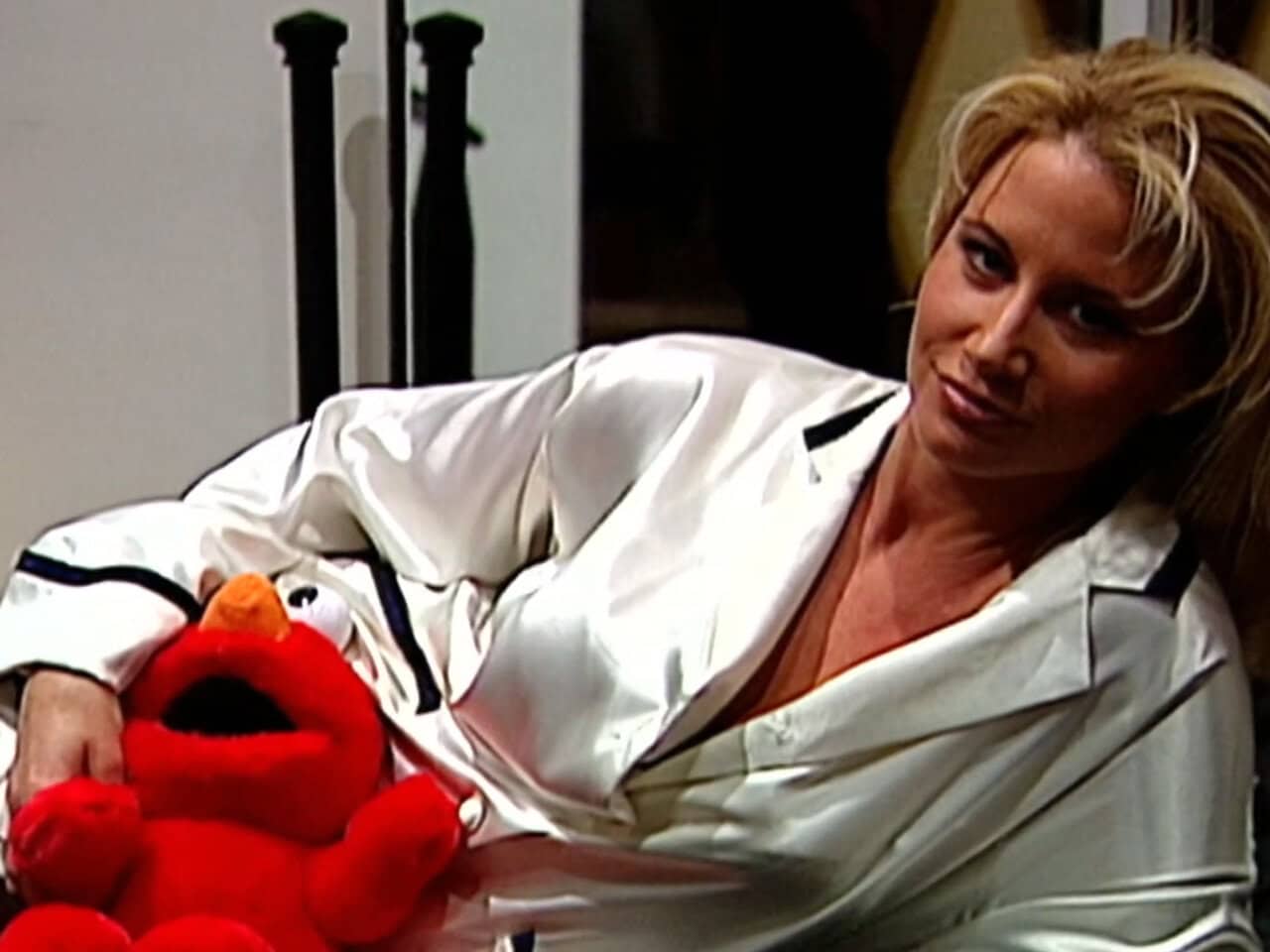
One specific moment from Shotgun Saturday Night stands out as a clear indicator that the target demographic had shifted. In a sketch designed to mock the “Tickle Me Elmo” toy craze, Sunny—the original Diva and the most downloaded woman on AOL at the time—appeared in a segment sitting on a bed with the Elmo doll.
The camera cut away to a silhouette or implied action, with Elmo’s voice box laughing hysterically as Sunny made suggestive noises, implying she was engaging in sexual acts with the toy. It was crude, juvenile, and decidedly not for children. This segment showcased that the WWF was willing to use its female talent in increasingly risqué scenarios to attract the 18-34 male demographic, a strategy that would eventually explode with the popularity of Sable later that year.
4. Shotgun Saturday Night: The Nightclub Experiment (January 1997)
Perhaps the most overlooked “seed” of the Attitude Era was a show called Shotgun Saturday Night, which debuted in January 1997. Airing in a late-night timeslot, the show was originally filmed in legitimate New York City nightclubs, such as the Mirage and the waiting area of Penn Station. The aesthetic was dark, gritty, and intentionally “underground,” designed to compete with the cooler vibe of the nWo in WCW.
Because of the late timeslot and the club setting, the content was significantly raunchier than Raw or Superstars. The ring ropes were yellow tape, the ring was smaller, and the commentary was looser. It was the testing ground for the “Crash TV” format: short matches, adult humor, and shock value. The show featured moments like The Headbangers throwing darker, edgier insults and a general atmosphere of debauchery that was completely absent from the bright lights of Saturday morning television.
3. Brian Pillman’s 9mm Glock (Raw, November 1996)
In late 1996, the line between fiction and reality was obliterated by Brian Pillman. Having cultivated a “Loose Cannon” persona in WCW and ECW, Pillman signed with the WWF and immediately brought a sense of danger to the programming. The most infamous incident occurred on the November 4, 1996, episode of Raw. Pillman, out with an ankle injury, was conducting an interview from his home in Walton, Kentucky, while his rival, “Stone Cold” Steve Austin, threatened to break in.
The segment played out like a home invasion thriller. When Austin arrived and broke through the door, the camera cut to Pillman, who produced a 9mm Glock pistol and pointed it at the intruder. The feed “cut to black” amidst screams, implying a shooting had occurred. When the feed returned, Pillman could be heard shouting, “I’m going to kill that son of a bitch!”—uncensored profanity that aired on the USA Network. This segment was a massive departure from wrestling norms. It wasn’t a match; it was a crime scene. The realization that Raw could be unpredictable and dangerous was a key tenet of the Attitude Era, and the “Pillman 9mm” incident was the proof of concept.
2. The Debut and Evolution of Goldust (1995-1996)
While Diesel and Hart were pushing physical boundaries, a character debuted in late 1995 that pushed social and sexual boundaries: Goldust. Dustin Rhodes was repackaged as an androgynous, movie-obsessed enigma who used mind games to unsettle his opponents. Dressed in a gold bodysuit and face paint, Goldust would grope his chest, stroke his opponents, and deliver promos laced with heavy sexual innuendo that flew in the face of the company’s family-friendly image.
The character’s feud with Razor Ramon leading into WrestleMania XII was built entirely on homophobia and sexual panic. Goldust would send Ramon love letters, gifts, and make advances that left the “Bad Guy” visibly shaken. For a company that had marketed itself to children for a decade, this was a jarring tonal shift. The subsequent “Hollywood Backlot Brawl” between Goldust and Roddy Piper at WrestleMania XII featured Goldust wearing women’s lingerie, a visual that was shocking for 1996 television. Goldust was the first true “Attitude” character, proving that controversy created cash long before the catchphrase existed.
1. Diesel Puts Bret Hart Through a Table (Survivor Series 1995)
If one were to pinpoint the exact moment the “cartoon” safety of the early 90s gave way to something more visceral, the conversation must begin at Survivor Series 1995. The main event featured WWF Champion Diesel defending against Bret “The Hitman” Hart in a No Disqualification match. At the time, “No DQ” in the WWF usually meant a bit of brawling on the outside or a chair shot to the back. It rarely meant legitimate destruction.
However, during this match, a spot occurred that shocked the audience in Landover, Maryland. Diesel, standing on the ring apron, shoved Bret Hart off the apron and through the Spanish announce table. Today, a table break is a standard transition spot in almost every major wrestling match. In November 1995, it was revolutionary. The table didn’t break cleanly; it collapsed under the force of Hart’s body, creating a visual of legitimate impact that looked nothing like the polished, safe product of the Hulkamania years. Vince McMahon was reportedly hesitant about the spot but allowed it to add a “gritty” feel to the rivalry. That single moment signaled a shift in the in-ring style: the heroes were no longer invincible superheroes; they were flesh and blood, capable of being broken.

