


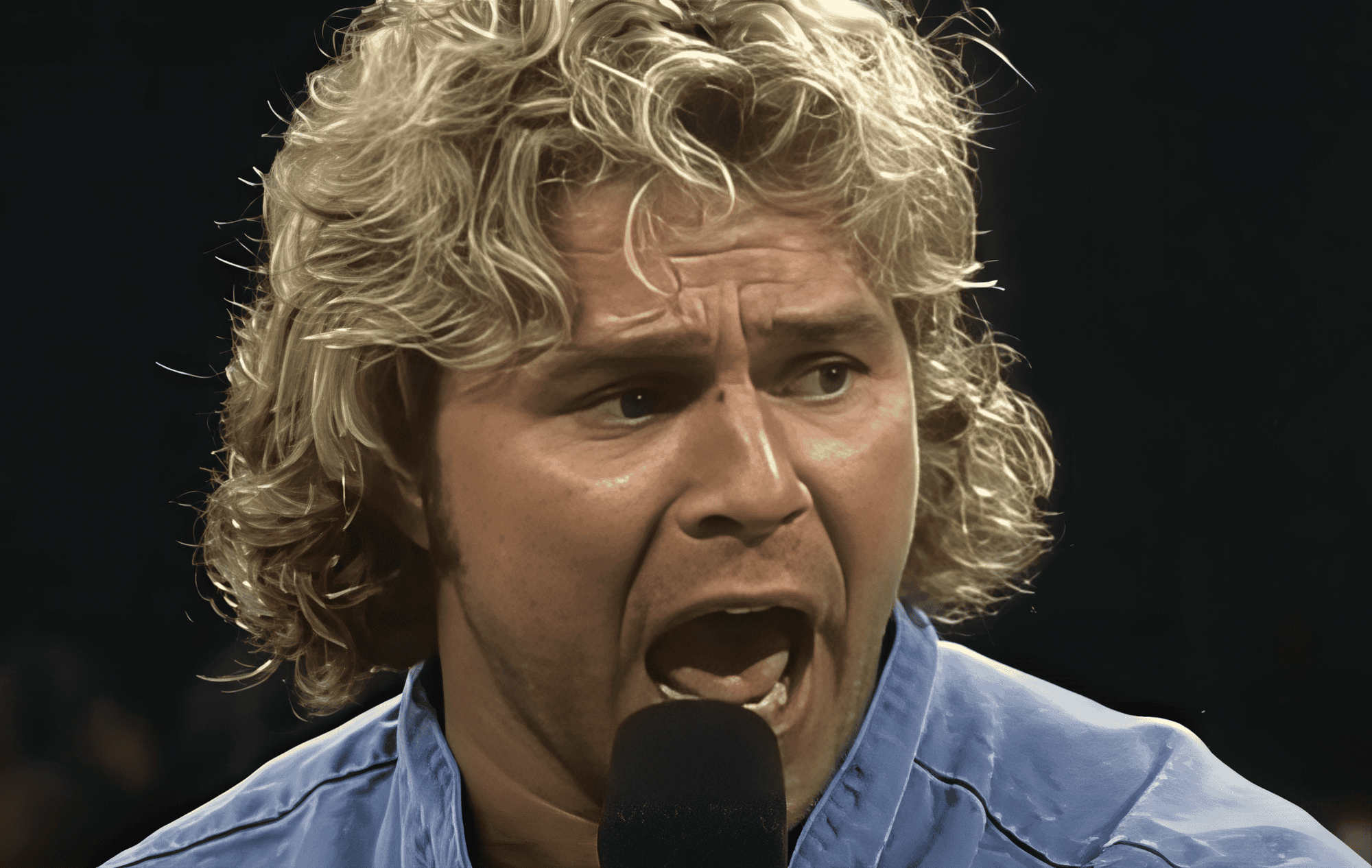
In the history of professional wrestling, there are “works” (scripted events), there are “shoots” (legitimate events), and then there is the chaotic gray area inhabited by Brian Pillman in 1996. Before the “Attitude Era” officially began, before Stone Cold Steve Austin stunned the boss, and before the NWO sprayed paint on the WCW title, Brian Pillman revolutionized the industry by creating the “Loose Cannon” persona.
The Birth of the Loose Cannon
To understand the impact of the Loose Cannon, one must look at the wrestling landscape of 1995. WCW was dominated by Hulk Hogan and the “Dungeon of Doom,” a cartoonish creative direction that clashed with the gritty reality of the developing Monday Night Wars. Brian Pillman, a former NFL player and a gifted high-flyer known as “Flyin’ Brian,” felt stifled. He had been a reliable hand for years, teaming with Steve Austin in the Hollywood Blonds and engaging in technical masterpieces with Jushin Thunder Liger, but he was trapped in the mid-card.
Pillman realized that to break through the glass ceiling, he needed to make himself unpredictable. He approached Eric Bischoff, the Executive Vice President of WCW, with a radical idea. Pillman proposed a character who was legitimately crazy—someone who would go off-script, break kayfabe (the illusion of wrestling), and make the dirt sheets (wrestling newsletters) believe he was a liability to the company.
Bischoff, looking for an edge against the WWF, agreed to the plan. The goal was to “work the boys”—to make the other wrestlers in the locker room believe Pillman had lost his mind, thereby making the deception authentic to the fans.
“I Respect You, Booker Man”
The first major detonation of the Loose Cannon persona occurred at SuperBrawl VI on February 11, 1996. Pillman was scheduled to wrestle Kevin Sullivan in an “I Quit” strap match. Sullivan, a veteran wrestler, was also the head booker of WCW—the man responsible for writing the storylines and deciding the winners.
The feud between the two had been personal and heated on-screen. However, as the match began, Pillman did the unthinkable. After less than a minute of brawling, Pillman grabbed the microphone. He looked directly at Sullivan and said, “I respect you, booker man.”
The use of the term “booker” on live pay-per-view was a cardinal sin in 1996. It exposed the business. It told the audience that the match was pre-determined and that Sullivan was the scriptwriter. Pillman then dropped the microphone and walked out of the ring, leaving a confused Sullivan and a stunned audience in his wake.
Backstage, the locker room was furious. Most of the wrestlers did not know it was a work orchestrated by Bischoff and Pillman. They believed Pillman had betrayed the business. This reaction was exactly what Pillman wanted. He had successfully worked his peers.
The Great Deception: The WCW Release
Following the SuperBrawl incident, Pillman and Bischoff took the angle to the next level. To make the “Loose Cannon” truly believable, Pillman argued that he needed to be fired. He suggested that if he were legitimately released from his WCW contract, he could go to Extreme Championship Wrestling (ECW) and the WWF, stir up controversy, and then return to WCW as the hottest free agent in the world.
Bischoff agreed to the plan. However, Pillman insisted that the firing had to look real to the legal experts and the dirt sheets. He convinced Bischoff to send him a legitimate notice of termination, complete with the necessary legal paperwork dissolving his contract.
Bischoff, trusting Pillman’s vision and their handshake agreement that he would return, signed the papers. Brian Pillman was officially a free agent.
It was a masterstroke of negotiation. Pillman had no intention of returning to WCW on his old terms. He used the legitimate release to spark a bidding war between WCW and the WWF. By the time Bischoff realized he had been outsmarted, Pillman was negotiating with Vince McMahon.
The ECW Pitstop and the Humvee Accident
Before joining the WWF, Pillman made a brief but memorable stop in ECW. Paul Heyman, the master of “shoot” style promotion, gave Pillman a live microphone and free reign.
At CyberSlam 1996, Pillman delivered a promo that is still studied by wrestling psychology students. He insulted the “smart mark” audience, threatened to urinate in the ring (and actually attempted to do so before being stopped by Shane Douglas and Todd Gordon), and attacked a fan with a fork. He was terrifying, erratic, and utterly captivating.
However, tragedy struck on April 15, 1996. While driving his Humvee in Kentucky, Pillman fell asleep at the wheel. The vehicle flipped, and Pillman was ejected. He suffered horrific injuries, including a shattered ankle that fused his foot in a walking position.
The accident ended his days as a high-flying athlete. He spent a week in a coma. When he awoke, his physical ability was diminished, but his mind was sharper than ever. He knew that to survive in the business with a broken body, he had to rely entirely on the “Loose Cannon” character.
Signing with the WWF
Despite the injury, Vince McMahon saw the value in Pillman. The WWF was in the midst of a transition. The cartoon era was dying, and the company needed edge. McMahon signed Pillman to a guaranteed contract—a rarity for the WWF at the time—while he was still recovering from the accident.
Pillman’s arrival in the WWF was heralded by a press conference where he seemed unstable and dangerous. He eventually aligned with his old partner, Stone Cold Steve Austin, before turning on him to ignite a bitter feud.
November 4, 1996: “Pillman’s Got a Gun”
The feud between Austin and Pillman culminated in the most controversial segment in the history of Monday Night Raw. The storyline was that Austin was coming to Pillman’s home in Walton, Kentucky, to finish the job he started by crushing Pillman’s ankle (in storyline).
Pillman was conducting a satellite interview from his living room, his leg in a cast. He was surrounded by his real-life wife, Melanie, and some friends for protection. As the show progressed, Kevin Kelly (the interviewer) noted the tension. Pillman, sitting in a chair, produced a 9mm Glock pistol. He stated, “When Austin 3:16 meets Pillman 9mm, I’m going to blast his ass straight to hell.”
The production team cut away, but the threat was clear. Later in the broadcast, Steve Austin arrived at the house. He fought through Pillman’s friends outside and broke through the front door.
The camera inside the house shook violently. The feed cut to static and then to a black screen. Amidst the chaos, screams were heard. Kevin Kelly shouted, “He’s got a gun!”
Crucially, just before the feed cut, Pillman was heard shouting, “Get out of the way! I’m going to kill that son of a bitch!” The word “bitch” was not censored. This was the first time the profanity had been aired on WWF television, adding to the raw, unedited feel of the segment.
The Fallout and the Network
The segment aired live. The reaction was immediate panic. Fans called the police, believing they had just witnessed a homicide on live television. The lines between entertainment and reality had been obliterated.
The USA Network, the broadcaster of Raw, was furious. They had not been warned about the gun. In 1996, gun violence on television was a highly sensitive subject. The network executives threatened to cancel Raw if the WWF did not apologize and retract the segment immediately.
The following week, Vince McMahon appeared on Raw to issue a formal apology on behalf of the WWF. He stated that the gun was not loaded and that the safety of all performers was paramount. He also had to navigate immense pressure from advertisers and the network standards and practices department.
Despite the backlash, the segment was a ratings success. It generated the “water cooler” talk that the WWF desperately needed to compete with WCW’s Nitro. It proved that the audience had an appetite for danger and edgier content.
Legacy of the Loose Cannon
Brian Pillman passed away on October 5, 1997, from a heart condition, undiagnosed at the time but likely exacerbated by his lifestyle and injuries. He was only 35 years old.
His career was tragically short, but his impact was monumental. The “Loose Cannon” persona provided the blueprint for the Attitude Era. It showed that characters could be morally ambiguous, dangerous, and real.
The deception of Eric Bischoff changed the way contracts were handled in the industry. The “Pillman’s Got a Gun” segment shifted the tone of Raw from a wrestling show to an episodic drama where anything could happen.
Most importantly, Brian Pillman proved that in a world of predetermined outcomes, the most valuable currency is believability. By making the world question his sanity, he secured his legacy as one of the most brilliant minds in the history of the sport. He was the first modern wrestler to realize that the show didn’t end when the bell rang; it ended when the audience stopped believing.

