


In the summer of 1993, the World Wrestling Federation (WWF) faced a crisis. Hulk Hogan, the defining star of the 1980s wrestling boom and the company’s primary revenue driver, departed the organization following the King of the Ring pay-per-view in June. Hogan’s departure occurred amidst a Federal investigation into steroid distribution within the company, creating a public relations minefield for Chairman Vince McMahon.
The Launch: The USS Intrepid
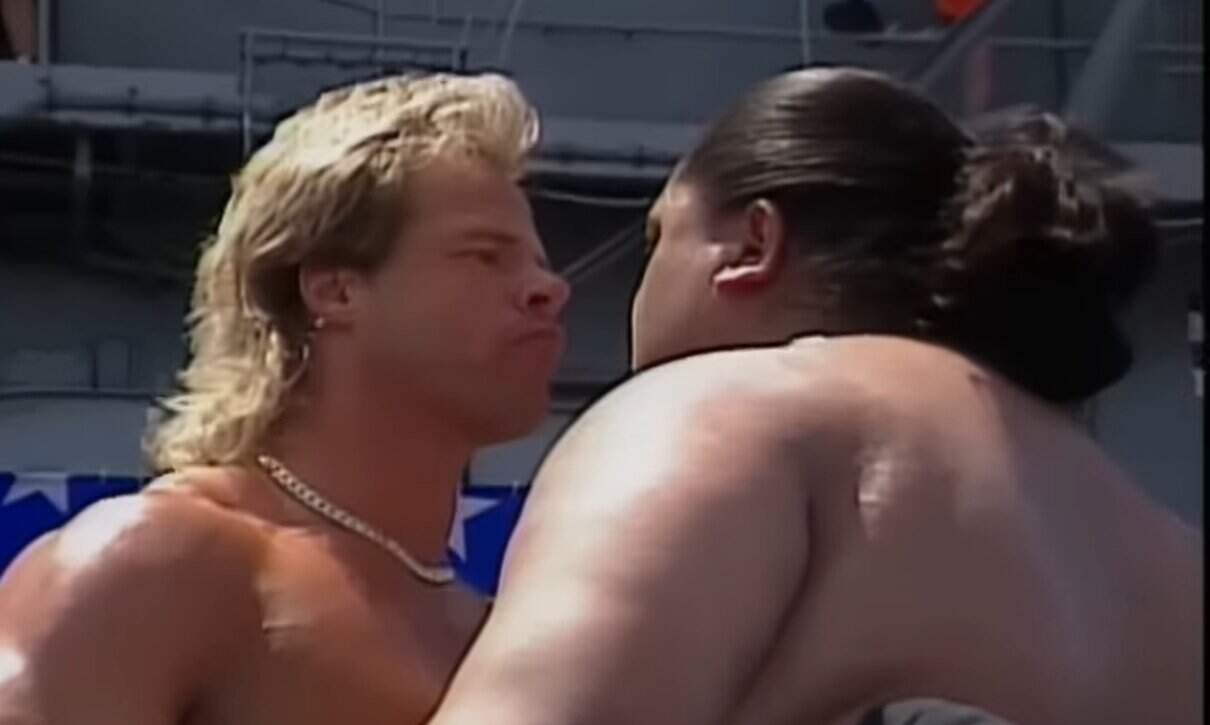
The transformation began on July 4, 1993. The WWF held an event called the “Stars and Stripes Challenge” on the deck of the USS Intrepid aircraft carrier in New York City. The storyline centered on Yokozuna, the massive WWF Champion who was portrayed as an anti-American sumo wrestler. Yokozuna’s manager, Mr. Fuji, issued a challenge to any American athlete to body slam the 500-pound champion.
Throughout the morning, various athletes attempted and failed to lift Yokozuna, including NFL players and other wrestlers. Finally, a helicopter arrived. Lex Luger stepped out, wearing a patriotic shirt. He had shed his “Narcissist” persona entirely.
In front of a cheering crowd, Luger successfully bodyslammed Yokozuna. The crowd erupted. The moment was designed to be the 1993 equivalent of Hogan slamming Andre the Giant. It officially positioned Luger as the new American hero and the number one contender for the WWF Championship.
The Campaign: The “Call to Action” Bus Tour
To capitalize on the momentum from the Intrepid, the WWF launched the “Call to Action” campaign. The centerpiece of this campaign was a tour bus painted in red, white, and blue, featuring images of Lex Luger flexing in American flag trunks. This vehicle was dubbed “The Lex Express.”
The strategy was to have Luger travel across the United States for weeks leading up to SummerSlam, greeting fans, visiting children’s hospitals, appearing on local morning news shows, and shaking hands. The goal was to build a grassroots connection with the audience, forcing the organic popularity that Hogan had enjoyed a decade prior.
However, the reality of the tour was grueling. Luger was required to be “on” 24 hours a day. Reports from the time suggest that the rigorous schedule wore on Luger, who struggled to maintain the high-energy, babyface persona required for endless meet-and-greets.
The Disconnect: Personality vs. Presentation
A fundamental issue with the Lex Express tour was the disconnect between Lex Luger’s real-life personality and the character he was playing. Backstage, Luger was known for being somewhat aloof and reserved.
Bruce Prichard, a key WWF executive during this era, discussed the challenges of the tour on his podcast Something to Wrestle. “Lex was not a ‘press the flesh’ guy,” Prichard stated. “He wasn’t the guy who wanted to go out and shake hands and kiss babies. It was a job to him. And when you are on a bus for weeks at a time, having to be that guy 24/7, it wears on you. The fans can sense when it’s not genuine.”
The campaign felt manufactured to many observers. The WWF was explicitly telling the audience, “This is your new hero,” rather than allowing the audience to choose him. While children largely accepted the character, the older demographic and the “smart” fans viewed Luger as a corporate replacement for Hogan.
The Destination: SummerSlam 1993
The tour concluded at SummerSlam on August 30, 1993, at The Palace of Auburn Hills in Michigan. The main event was set: Lex Luger vs. Yokozuna for the WWF Championship.
The build-up suggested a coronation. The bus tour, the Intrepid slam, and the patriotic marketing all pointed toward a decisive victory for Luger. The expectation was that he would defeat the foreign villain, win the title, and lead the company into the next era.
The Incident: The Count-Out Celebration
The finish of the main event remains one of the most baffling booking decisions in WWF history.
Towards the end of the match, Luger struck Yokozuna with his forearm, which contained a metal plate (a part of his previous storyline). The blow knocked Yokozuna out of the ring. The champion was rendered unconscious on the floor.
Luger remained in the ring. The referee began his count. Yokozuna failed to return to the ring before the count of ten. The referee called for the bell.
Lex Luger was declared the winner by count-out. However, per WWF rules, titles do not change hands on a count-out. Yokozuna remained the champion.
Despite failing to win the championship—the entire objective of the summer-long campaign—Luger celebrated as if he had achieved the ultimate victory. Red, white, and blue balloons fell from the ceiling. Confetti filled the arena. Other babyface wrestlers, including the Steiner Brothers and Tatanka, entered the ring to hoist Luger on their shoulders.
Luger waved the American flag, smiling triumphantly, while the ring announcer explicitly stated, “Winner of the bout, Lex Luger… however, still World Wrestling Federation Champion, Yokozuna.”
The Locker Room Reaction
The confusion extended to the audience and the locker room. Fans in the arena cheered the visual spectacle of the balloons but were perplexed by the result. The hero had failed to accomplish his goal, yet the company was treating it as a massive success.
Backstage, the celebration was viewed with skepticism. Bret Hart, who had been the champion prior to Yokozuna and was essentially moved aside for the Luger push, commented on the strangeness of the situation in his autobiography, Hitman. “It was the phoniest celebration in wrestling history,” Hart wrote. “Lex was marching around the ring like he had just saved the world, but he didn’t even win the belt. It made him look stupid.”
Why Vince McMahon Pulled the Trigger Back
Decades later, industry insiders have analyzed why Vince McMahon chose not to put the title on Luger that night. Several theories exist:
- The Bar Incident: A rumor circulated that Luger had been talking loosely in a bar prior to SummerSlam, telling people he was going to win the title. McMahon, known for hating spoilers, allegedly changed the finish to spite him.
- Lack of Connection: McMahon may have realized during the bus tour that Luger was not connecting with the fans on the level necessary to carry the company. The merchandise sales and live event attendance were not meeting the projections set by the Hogan era.
- The WrestleMania Plan: McMahon decided to wait until WrestleMania X to crown the champion, believing the chase would generate more interest.
Regardless of the reason, the decision to have a “victory celebration” for a count-out win severely damaged Luger’s credibility. A hero who celebrates a technicality is rarely embraced as a conqueror.
The Decline of the Push
Following SummerSlam, the momentum of the Lex Express evaporated. The bus was parked. The novelty of the patriotic gimmick wore off.
Luger continued to feud with Yokozuna, leading to the Royal Rumble in 1994. In another confusing booking decision, Luger and Bret Hart co-won the Royal Rumble match, tumbling over the top rope simultaneously. This set up a scenario where both men would challenge Yokozuna at WrestleMania X.
The audience response during the build to WrestleMania X was telling. Bret Hart received the thunderous, organic applause of the people. Lex Luger received polite, but tepid, cheers.
At WrestleMania X, the experiment officially ended. Luger faced Yokozuna first and lost by disqualification due to a push from the special guest referee, Mr. Perfect. Later that night, Bret Hart defeated Yokozuna to win the WWF Championship. The “New Hulk Hogan” project was abandoned, and the “New Generation” led by Bret Hart and Shawn Michaels began.
Financial and Cultural Impact
The Lex Express tour was a significant financial investment. The cost of operating the bus, the logistical support for the cross-country tour, and the promotional materials represented a major expenditure during a “down” year for the company.
The failure of the campaign highlighted the changing culture of the 1990s. The simplistic patriotism that worked in 1985 was losing its effectiveness in 1993. Fans were becoming more cynical. They preferred the technical excellence of Bret Hart or the anti-authority rebellion that would soon be popularized by Stone Cold Steve Austin.
Luger’s Perspective
Lex Luger has reflected on the Lex Express era in his book, Wrestling with the Devil. He acknowledged the hard work involved but admitted that the character constraints were difficult. “I was trying to be something I wasn’t,” Luger wrote. “Vince had a vision of the red, white, and blue hero, but you can’t force the fans to love you. You can’t manufacture that magic.”

