


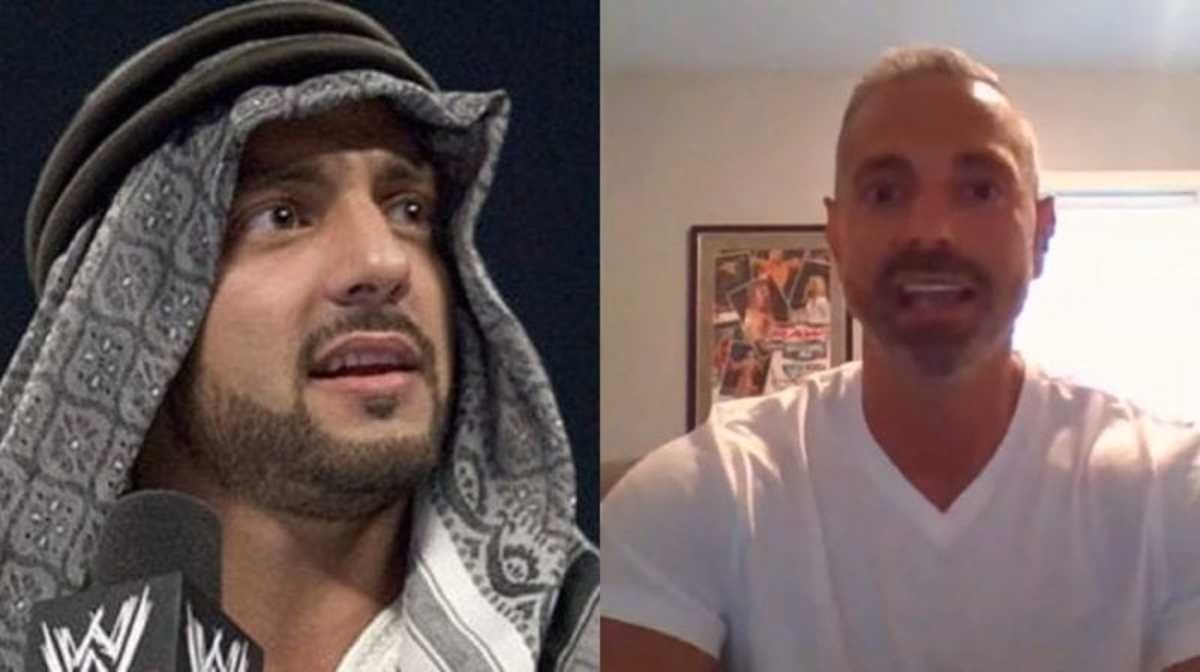
In the scripted world of professional wrestling, “heat” is the currency of success. Promoters and performers constantly seek to elicit strong emotional reactions from the audience, walking a fine line between entertainment and genuine provocation. However, on July 7, 2005, World Wrestling Entertainment (WWE) did not just cross that line; they obliterated it.
The fallout was immediate and catastrophic. It resulted in the permanent banishment of a top-tier character, a public relations nightmare for the UPN network, and the premature retirement of Mark Copani, a talented 23-year-old performer who found himself at the center of a geopolitical firestorm he had no hand in creating.
The Concept: Nuance vs. Xenophobia
To understand the severity of the incident, one must analyze the trajectory of the character. Muhammad Hassan debuted in late 2004, portrayed by Mark Copani, an Italian-American wrestler from Syracuse, New York. The character was originally conceived with a layer of sophisticated nuance rarely seen in wrestling.
Hassan was not presented as a foreign invader. He was an Arab-American who was born and raised in the United States. His grievances were rooted in the post-9/11 reality. He complained about being “randomly selected” for airport security screenings, being judged by his neighbors, and being treated like a second-class citizen due to his ethnicity.
In his early vignettes, Hassan made valid points about prejudice and civil liberties. He was a “heel” (villain) only because he interrupted the heroes and lectured the crowd with an arrogant tone. For months, the character generated immense heat because he held a mirror up to the American audience’s own xenophobia. He was a hate-sink that exposed the uglier side of patriotism.
However, wrestling booking often lacks subtlety. As Hassan moved up the card, the nuance was stripped away. To make him a viable threat to top stars like Hulk Hogan, Shawn Michaels, and Batista, the writers began to lean into the very stereotypes the character initially decried. By the summer of 2005, Hassan was no longer an aggrieved citizen; he was a caricature of an extremist.
The Taping: July 5, 2005
The fatal pivot occurred during a taping of SmackDown on Tuesday, July 5, 2005, in Sacramento, California. The show was taped to air on Thursday, July 7.
Muhammad Hassan was embroiled in a feud with The Undertaker, one of the company’s most protected legends. The storyline was building toward a match at The Great American Bash, where Hassan was scheduled to defeat The Undertaker and become the youngest World Heavyweight Champion in history.
To build heat for the match, the creative team devised a segment intended to display Hassan’s power. After a match between The Undertaker and Hassan’s manager, Daivari, Hassan knelt on the ramp in prayer.
As he prayed, five men dressed in black ski masks and camouflage cargo pants ran out. They were not dressed as wrestlers; they were dressed in the visual shorthand of a terrorist cell. They attacked The Undertaker, beating him down with clubs.
The imagery became even more disturbing. The masked men produced a strand of piano wire—a tool often associated with garroting and executions in spy thrillers and mob movies—and used it to choke the Undertaker into unconsciousness. They then lifted Daivari, the “martyr” of the match, above their heads and carried him away like a fallen hero.
In the arena, the segment was uncomfortable. It was violent and drew upon imagery that was deeply feared in the Western world. However, it was just a television show. No one in the building knew that in less than 48 hours, the context of the world would change.
The London Bombings: July 7, 2005
On the morning of Thursday, July 7, 2005, four suicide bombers struck central London. Three bombs detonated in the London Underground, and a fourth detonated on a double-decker bus in Tavistock Square.
The 7/7 attacks killed 52 people and injured more than 700 others. It was the worst terrorist atrocity in Britain since the bombing of Pan Am Flight 103 over Lockerbie. The world was in a state of shock and mourning. Every news channel on the planet was broadcasting images of the wreckage and discussing the threat of radical extremism.
The Broadcast Decision
That same evening, SmackDown was scheduled to air on UPN in the United States and on Sky Sports in the United Kingdom.
WWE officials were aware of the attacks. In the United Kingdom, the broadcast was edited to remove the Hassan segment entirely, as airing it would have been unconscionable. However, in the United States and Canada, a different decision was made.
The episode aired with the segment largely intact. WWE added a scrolling advisory message (a “crawl”) at the bottom of the screen during the segment, stating: “Parental Advisory: The following segment contains scenes that may be disturbing to some viewers. Viewer discretion is advised.”
The decision to air the segment was a miscalculation of massive proportions. While the segment had been taped two days prior to the attacks, the optics were horrific. To a viewer flipping channels between news coverage of the London carnage and SmackDown, it appeared as though WWE was capitalizing on the tragedy or, at best, was displaying a callous disregard for the victims.
The Backlash
The reaction was immediate and vitriolic. Mainstream media outlets, including CNN, The New York Times, and Variety, picked up the story. They juxtaposed the images of the fictional masked men choking The Undertaker with the real images of the London destruction.
Critics accused WWE of insensitivity and exploitation. The Council on American-Islamic Relations (CAIR) had already been critical of the Hassan character, arguing that it reinforced negative stereotypes. This incident provided them with irrefutable ammunition.
The pressure mounted not on WWE directly, but on the network. UPN (United Paramount Network) was the broadcaster of SmackDown. The executives at UPN were reportedly furious. They felt blindsided. They had not been fully warned about the content of the tape before the attacks, and the decision to air it—even with a warning—placed the network in the crosshairs of advertisers and regulators.
The Ban
In the days following the broadcast, UPN issued an ultimatum to Vince McMahon: The Muhammad Hassan character was no longer allowed on their network.
This was an unprecedented move. Networks rarely dictate creative direction to this degree, especially regarding a top character. Vince McMahon reportedly tried to fight for the character, arguing that Hassan was a heat-seeking villain and that the controversy would eventually drive ratings. He pointed out the irony of the “freedom of speech” arguments that Hassan’s character often made.
UPN stood firm. They told WWE that if Hassan appeared on their screen again, there would be severe consequences for the broadcast rights deal. With SmackDown being a primary revenue stream, McMahon had no choice but to capitulate.
The Great American Bash 2005
The Great American Bash pay-per-view took place on July 24, 2005, in Buffalo, New York. The original plan—for Hassan to defeat The Undertaker and become the World Heavyweight Champion—was scrapped.
Instead, the match became a televised execution of the character. The Undertaker defeated Hassan decisively. After the match, the “Last Ride” powerbomb was utilized as a narrative device to write Hassan off television permanently.
The Undertaker chokeslammed Hassan. Then, in a spot reserved for writing characters out of the script, he powerbombed Hassan through the open stage floor (a hole cut specifically for the stunt) onto the concrete floor below.
The symbolism was clear. Muhammad Hassan was sent “to hell,” or at least, out of the WWE Universe. When the show ended, Mark Copani was taken to the hospital (in storyline) and was never seen on WWE television again.
The Aftermath for Mark Copani
The real tragedy of the Muhammad Hassan controversy is the impact it had on the man behind the gimmick. Mark Copani was a young, talented prospect who had done everything the company asked of him. He had portrayed a difficult character with conviction and improved rapidly in the ring.
Following the Great American Bash, Copani was sent back to developmental territory Ohio Valley Wrestling (OVW). The idea was to repackage him, perhaps under a mask or with a different name, once the heat died down.
However, the heat never died down. The stigma of the character was so potent that it tainted the performer. Copani eventually realized that he would never be given a fair shake in the industry again. The character of Muhammad Hassan was an albatross around his neck.
In September 2005, just months after being poised to win the world title, Mark Copani was released from his WWE contract. He essentially retired from professional wrestling at the age of 24.
Copani returned to school, earned a degree, and became an educator. He eventually became a high school principal in New York state. In rare interviews, he has spoken about the experience with a mix of pragmatism and regret, acknowledging that he was a victim of circumstance and bad timing.
Historical Significance
The Muhammad Hassan controversy fundamentally changed how WWE approached sensitive geopolitical storylines. While they continued to use “evil foreigner” tropes (such as Rusev or Jinder Mahal), they became noticeably more cautious about invoking imagery related to terrorism or religious extremism.
It also highlighted the dangers of “hot-shotting” reality. WWE wanted to be edgy; they wanted to tap into the fear and anger of post-9/11 America. They succeeded, but they failed to account for the fact that in a world dealing with active terrorism, the line between “heat” and “hate” is razor-thin.
The visual of the masked men and the piano wire remains one of the most regrettable moments in the company’s history. It is a segment that is often edited out of replays and network collections. It stands as a monument to the day reality crashed into the fantasy world of wrestling, reminding everyone that while the fights may be scripted, the consequences can be very real.

