


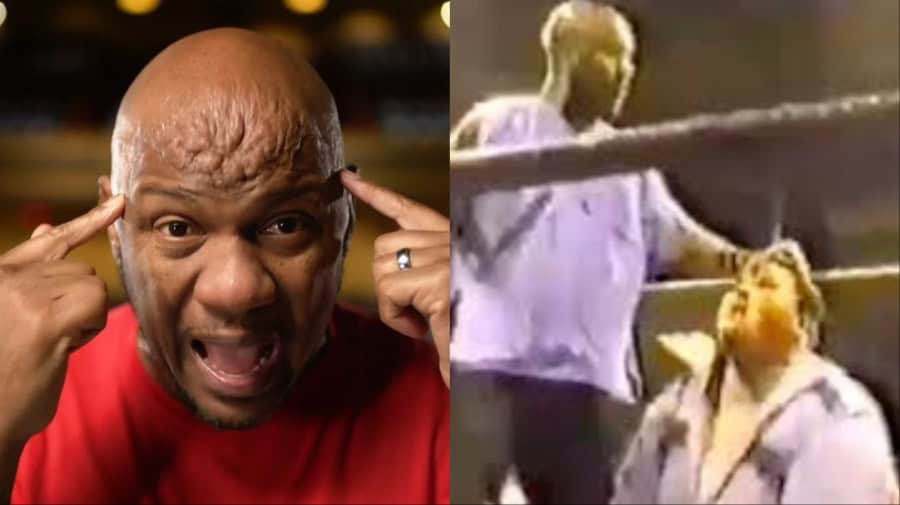
Introduction: The Night the Line Was Crossed
On the night of November 23, 1996, the air inside the Wonderland Greyhound Park in Revere, Massachusetts, was thick with the signature energy of an Extreme Championship Wrestling (ECW) house show. It was a potent mix of fervent loyalty, anti-establishment fervor, and a palpable thirst for violence that set ECW apart from its mainstream competitors. The fans who gathered there expected to see the boundaries of professional wrestling pushed to their breaking point. They would get more than they bargained for. That night, the line between performance and reality was not merely blurred; it was obliterated by a surgical scalpel, resulting in an incident that would become one of the most infamous and cautionary tales in the history of professional wrestling.
The controversy, forever known as the “Mass Transit incident,” was the result of a tragic confluence of three distinct, volatile forces. The first was Erich Kulas, a morbidly obese, 17-year-old aspiring wrestler whose ambition dangerously outstripped his talent and understanding of the business he so desperately wanted to join. The second was Jerome “New Jack” Young, a performer whose violent, unpredictable “gangsta” persona was notoriously and deliberately fused with his real-life volatility. The third was ECW itself, a rebellious promotion teetering on the verge of national exposure, whose entire brand identity was built on a foundation of extremity, realism, and a defiant disregard for convention.
The events that unfolded were not simply an accident, nor were they solely the result of a single malicious act. The Mass Transit incident was a systemic failure, born from a web of deception, professional negligence, and a subculture that celebrated extremity without adequate safeguards. It exposed the dark, unregulated underbelly of the wrestling industry, threatened to destroy ECW at the very moment of its potential triumph, and left a permanent, bloody scar on the lives of everyone involved.
Section I: The Cauldron of Extreme – Context and Characters
To understand how the Mass Transit incident could happen, one must first understand the unique ecosystem of Extreme Championship Wrestling in 1996. As the definitive “number three” promotion in the United States, ECW was an insurgent force locked in a seemingly impossible war against the corporate giants of the World Wrestling Federation (WWF) and World Championship Wrestling (WCW). Under the creative vision of owner and booker Paul Heyman, ECW had cultivated a fiercely loyal, cult-like following by offering a product that was the antithesis of the polished, family-friendly spectacle of its rivals. Its identity was forged in “hardcore” wrestling—a brutal, bloody style with few rules, where violence and the use of weapons were not just permitted but celebrated.
This penchant for controversial, boundary-pushing content was on full display just one month before the Mass Transit incident. At the High Incident event in October 1996, ECW presented an angle where the wrestler The Sandman was “crucified” on a wooden cross, complete with a crown of barbed wire. The segment was so shocking that it silenced the promotion’s notoriously rowdy fanbase and caused Olympic gold medalist Kurt Angle, who was in attendance considering a contract with ECW, to walk out of the arena in disgust. This context is crucial: ECW was a company that thrived on shock value, a philosophy that permeated its culture from the top down.
The Key Participants
The tragedy was set in motion by a cast of characters whose individual flaws and motivations would prove to be a catastrophic combination.
Erich Kulas (“Mass Transit”): At the center of the storm was Erich Kulas, a 17-year-old from the Boston area. Weighing over 300 pounds, Kulas was an aspiring wrestler who saw an opportunity and seized it through deceit. He convinced Paul Heyman that he was 21 years old and, critically, that he had been professionally trained by the legendary wrestler and trainer Killer Kowalski. This lie, which was vouched for by his own father, Steve Kulas, was the foundational falsehood upon which the entire incident was built. Despite having no formal training—his only known in-ring experience was a comedy skit involving midget wrestlers—Kulas carried himself with a misplaced confidence. Testimony from other wrestlers present that night would later paint a picture of a young man who was “extremely arrogant and demanding” backstage, a severe and dangerous breach of the unwritten rules of respect in a wrestling locker room.
Jerome “New Jack” Young: As one half of the ECW Tag Team Champions “The Gangstas,” along with his partner Mustapha Saed, New Jack was one of the most legitimately feared and controversial figures in the industry. His gimmick was an extension of a volatile reality. He was known for bringing a garbage can full of assorted weapons to the ring for every match and for having his theme music, “Natural Born Killaz” by Ice Cube and Dr. Dre, play continuously throughout his bouts, creating an atmosphere of chaotic menace. His reputation for real-life violence and backstage substance use was well-documented, making him the worst possible veteran for an arrogant, untrained rookie to disrespect and provoke.
Paul Heyman: The creative genius behind ECW, Heyman was a man under immense pressure in late 1996. He was on the cusp of securing ECW’s first-ever national pay-per-view (PPV) broadcast, an event to be called Barely Legal. This deal was the key to the company’s survival and growth, and its potential collapse was a constant source of anxiety. When his scheduled wrestler Axl Rotten was a last-minute no-show for the Revere event, Heyman was faced with a gap in his card. In this moment of desperation, he made a fateful decision. He took Kulas at his word, failing to perform the basic due diligence of asking for identification to verify his age or credentials. This lapse in judgment was a symptom of the often-chaotic, “honor-based” culture of 1990s independent wrestling, where a wrestler’s word was often taken as bond.
D-Von Dudley: An ECW mainstay, D-Von Dudley was scheduled to be Kulas’s tag team partner for the night. His perspective, shared in later interviews, provides a crucial insider account of the escalating tension backstage. Dudley recalled knowing that things were about to “go south” when Kulas, in a stunning violation of locker room hierarchy, approached the veteran New Jack to “suggest some ideas” for their match. D-Von served as a key eyewitness to both the backstage hubris and the in-ring horror that followed.
The convergence of these individuals was not a matter of simple bad luck but a cascade of culpability. The sequence of events began with Axl Rotten’s legitimate family emergency, which created a vacuum and a sense of urgency for Heyman. Erich Kulas and his father exploited this urgency with a calculated series of lies about his age and professional training. This deception was reportedly endorsed by another wrestler, Tiny the Terrible, who allegedly felt slighted that Kulas was abandoning a pre-arranged match with him to take a higher-profile spot on the card, adding a layer of backstage politics and resentment to the mix. Consumed with the pressure of putting on a show, Heyman prioritized filling the spot over procedural caution. Finally, Kulas himself sealed his fate with his own arrogance, disrespecting a veteran known for his short fuse and propensity for violence. This chain of events demonstrates that the tragedy was not a single point of failure but a perfect storm, where every link in the chain of professional responsibility and personal judgment snapped.
Section II: The Incident – A Four-Minute Descent into Chaos
The match was booked as a standard ECW-style tag team encounter: The Gangstas (New Jack and Mustapha Saed) versus D-Von Dudley and his last-minute replacement, “Mass Transit”. Kulas made his way to the ring dressed in a bus driver’s uniform, a gimmick befitting his ring name. The plan, known in wrestling parlance as a “squash,” was simple: The Gangstas would isolate and dominate the rookie Kulas, building sympathy from the crowd and making D-Von Dudley look like a valiant hero when he eventually tried to make the save.
A pivotal and legally critical moment occurred backstage before the match. Kulas was informed that, in keeping with the hardcore style of the bout, he would be expected to bleed—a practice known as “getting color.” Having never performed the act of “blading” (using a small, concealed razor to make a discreet cut), Kulas explicitly asked the veteran New Jack to do it for him. This request, a plea from an inexperienced performer to a seasoned one, would later become the central pillar of New Jack’s legal defense.
The ensuing “match” descended into chaos almost immediately, a sequence of events captured in graphic detail by a fan-held camcorder from the wrestling merchandise company RF Video. The Gangstas stormed the ring and, as was their custom, began assaulting their opponents with a variety of legitimate, non-gimmicked objects pulled from a trash can, including crutches, an acoustic guitar, and a household toaster. As planned, D-Von and Mustapha brawled outside the ring and into the crowd, leaving the completely untrained Kulas alone and at the mercy of New Jack.
Then came the moment that would define the incident. New Jack took a surgical scalpel—not a traditional wrestler’s blade—and made an incision on Kulas’s forehead. The cut was far too deep. It severed two arteries in Kulas’s forehead, and blood immediately began to pour down his face in a torrent, far exceeding the typical effect of a controlled blade job. The fan-cam footage captures what happened next: New Jack leans down and quietly asks Kulas, “You all right?” Kulas, likely in shock and running on adrenaline, audibly replies, “Yeah, I’m fine”.
Despite the obviously severe bleeding, The Gangstas continued their assault with elbow drops and other strikes. It was at this point that panic erupted at ringside. Erich’s father, Steve Kulas, who had facilitated his son’s deception, began screaming at the timekeeper, “Ring the fucking bell! He’s 17!”. In that moment, the lie was exposed to everyone in the building. As medics and ECW staff rushed into the ring to attend to the profusely bleeding teenager, New Jack grabbed the house microphone. In what he would later claim was an attempt to maintain his villainous character and “garner heat,” he launched into a vile, racially charged tirade against the fallen Kulas and the Boston crowd: “I don’t care if the motherfucker dies! He’s white! I don’t like white people! I don’t like people from Boston! I’m the wrong ni**to fuck with!”.
The ring became a gruesome medical scene. Eyewitnesses described “puddles of the kid’s blood” on the mat. It took paramedics and EMTs nearly 30 minutes to stop the bleeding and stabilize Kulas for transport to a local hospital. The situation was so dire that fellow wrestler Tommy Dreamer had to run to the ring and give the paramedics his own shirt because they had run out of towels to soak up the blood. Kulas would ultimately require 50 stitches to close the wound.
This set off a frantic crusade by Paul Heyman to save his company. By his own admission in the documentary The Rise and Fall of ECW, he “begged and pleaded” with Request TV executives. His core argument was that ECW was not the perpetrator but a victim of Erich Kulas’s calculated deception. He managed to convince the provider that the company had been misled about Kulas’s age and professional qualifications. His impassioned defense worked. Barely Legal was reinstated and rescheduled for April 13, 1997, pulling ECW back from the brink of financial disaster.
While Heyman fought to save his business, a war over the public narrative was being waged in the media. The incident exploded into the national consciousness when the Kulas family gave an interview to the syndicated tabloid television program Inside Edition. The segment, which featured the graphic fan-cam footage, was devastating. It portrayed Erich Kulas as an innocent, unsuspecting victim who was brutally savaged by a predatory and villainous organization. The report highlighted that Heyman had not asked for any form of state identification, painting ECW as negligent and reckless. Crucially, this story aired before the full details of Kulas’s deception and his request to be bladed had been made public, cementing a powerful, one-sided, and deeply damaging narrative in the minds of the American public.
Within the insulated world of wrestling, the reaction was one of shock and revulsion. Contemporary reports from industry newsletters like the Pro Wrestling Torch captured the horror of those who witnessed it. One fan wrote, “This is the bloodiest thing I’ve ever seen in my whole life… The kid is lucky he isn’t dead”. Another eyewitness stated, “This was without a doubt the single worst thing I have ever seen in my 10 or so years as a wrestling fan”. Renowned wrestling historian Dave Meltzer was quoted as saying the incident “made me hate professional wrestling, that’s how horrible it was,” a sentiment that underscored the profound sense of violation felt even by those accustomed to wrestling’s simulated violence. The incident became a battle of competing narratives: the simple, emotionally resonant story of “Innocent Teen Mutilated by Violent Thugs” presented by the mainstream media versus the far more complex, nuanced, and messy truth of “We Were Deceived by a Liar” that ECW had to prove to survive.
Section IV: The Trials of New Jack – Wrestling in a Court of Law
Three years after the incident, the saga moved from the wrestling ring to a Massachusetts courtroom. In 1999, Jerome “New Jack” Young was put on trial, facing criminal charges of assault and battery with a dangerous weapon. The case effectively put the entire concept of professional wrestling’s staged reality and the unwritten rules of “kayfabe” on trial.
The prosecution’s case appeared straightforward. They had the shocking video footage from the RF Video fan cam, which showed New Jack cutting Kulas and the horrific aftermath. They argued that Young’s actions, particularly the use of a surgical scalpel and the sheer violence of the attack, went far beyond the acceptable boundaries of a staged athletic performance, constituting a genuine criminal assault.
The defense, however, constructed a more nuanced argument rooted in the unique subculture of professional wrestling. Their entire case hinged on the legal concept of consent. Key wrestlers, including D-Von Dudley, took the stand and testified to two critical facts: that Kulas had been “extremely arrogant” backstage, and, most importantly, that he had explicitly asked New Jack to blade him because he did not know how to do it himself. New Jack’s infamous post-match promo was framed as nothing more than an in-character performance designed to generate “heat” from the Boston crowd—a standard practice for a villainous character. The defense also emphasized that Kulas and his father had deliberately deceived Paul Heyman and ECW about his age and professional training. According to the documentary series Dark Side of the Ring, Paul Heyman’s testimony included a claim that Kulas’s father had directed a racial slur at New Jack, a factor that may have influenced the jury’s perception of the events.
The central legal question was where consensual performance ends and criminal assault begins. The defense successfully argued that within the specific, agreed-upon context of a professional wrestling ring, actions that would be criminal on the street are part of the performance. Kulas’s request to be bladed was the key that unlocked this defense, as it demonstrated his consent to participate in the violent reality of the performance. Ultimately, the jury sided with the defense, and New Jack was acquitted of all criminal charges.
The Kulas family also pursued a civil lawsuit against New Jack, seeking monetary damages. However, following the logic of the criminal trial’s verdict—that Kulas had consented to the act—New Jack was found not liable in civil court as well. Years later, after Erich Kulas’s death in 2002, his parents attempted to sue New Jack one final time. They claimed that their son’s subsequent depression and severe eating disorder, which led to his need for gastric bypass surgery, were a direct result of the trauma inflicted by New Jack. This lawsuit was also unsuccessful, bringing the legal chapter of the tragedy to a close.
The aftermath of the Mass Transit incident left a trail of devastation and a complex legacy that reshaped aspects of the wrestling industry. The human cost was profound and lasting.
For Erich Kulas, the night of November 23, 1996, marked the beginning and end of his wrestling career. He never stepped into a ring again. He passed away on May 12, 2002, at the age of just 22, due to complications from gastric bypass surgery. The failed posthumous lawsuit attempting to link his death to the psychological trauma of the incident serves as a tragic postscript, underscoring the dark shadow the event cast over his short and troubled life. His family, deeply affected by the ordeal, declined to participate in the 2020 Dark Side of the Ring documentary about the incident.
For Jerome “New Jack” Young, the incident cemented his legacy as professional wrestling’s most infamous and controversial figure. He remained defiant and unremorseful about his actions to the very end. In his final tweet, posted just a day before his death from a heart attack in May 2021, he reiterated his long-held defense: Kulas had asked him to do it. While he was legally acquitted, his career prospects were undeniably affected. When ECW was eventually acquired by the WWF, New Jack was notably not among the talent brought over to the larger promotion, and he spent the remainder of his career on the independent circuit.
Paradoxically, the horror of the Mass Transit incident served as an unintentional but powerful catalyst for positive change within the industry. Prior to 1996, the independent wrestling scene often operated on a dangerously lax “honor system” regarding performer credentials. The severe consequences of this system—a near-fatal injury, a national media scandal, a cancelled PPV, and criminal charges—served as a terrifying wake-up call. Promoters, particularly on the independent circuit, were forced to professionalize their operations out of legal and financial self-preservation. This led directly to the implementation of stricter vetting processes to verify the age, identity, and training credentials of wrestlers before allowing them to compete. The suffering of Erich Kulas, while tragic, directly led to safeguards that have likely prevented similar incidents from occurring in the decades since. In a 2024 interview, D-Von Dudley confirmed the incident’s lasting cautionary power, stating it was a key reason he would not permit his own sons, who are also wrestlers, to enter the business before they turned 18.
Today, the incident has become a mythologized chapter in wrestling lore, a dark fable retold in countless podcasts, articles, and documentaries. Its most prominent modern examination came via the VICE TV series Dark Side of the Ring, which introduced the story’s grim details to a new generation of fans. The event also sparked a necessary, if unsettling, debate about the ethics and safety of the hardcore wrestling style. While the practice of blading has seen a significant decline in popularity—due in part to heightened health awareness, the risks of bloodborne pathogens, and other high-profile accidents like Eddie Guerrero’s in 2004—the Mass Transit incident remains the ultimate exhibit for the dangers of when “keeping it real” goes horribly wrong. The modern understanding of the long-term neurological dangers faced by wrestlers, such as Chronic Traumatic Encephalopathy (CTE), provides a grim contemporary context to the risks that were once celebrated as entertainment.
Conclusion: More Than a Wrestling Story
The Mass Transit incident transcends the niche world of professional wrestling. It is a complex and deeply human tragedy about the perilous intersection of unchecked ambition, the cascading consequences of deception, and the profound responsibility of gatekeepers in any field. It stands as a singular moment in time when the carefully constructed illusion of performance art was shattered, revealing the raw and bloody potential for real-world harm that lies just beneath the surface.
It was a story with no heroes and no true winners, only varying degrees of loss and culpability. A young man’s foolish dream, enabled by his father and a flawed system, collided with a volatile performer in a promotion that prided itself on courting danger. The result was a permanent, grim reminder that even in a world of predetermined outcomes, the potential for real consequence is ever-present. The legacy of the Mass Transit incident is one of profound, if unintentional, reform, but it is a legacy written in blood and scar tissue on the darkest pages of wrestling history.


