


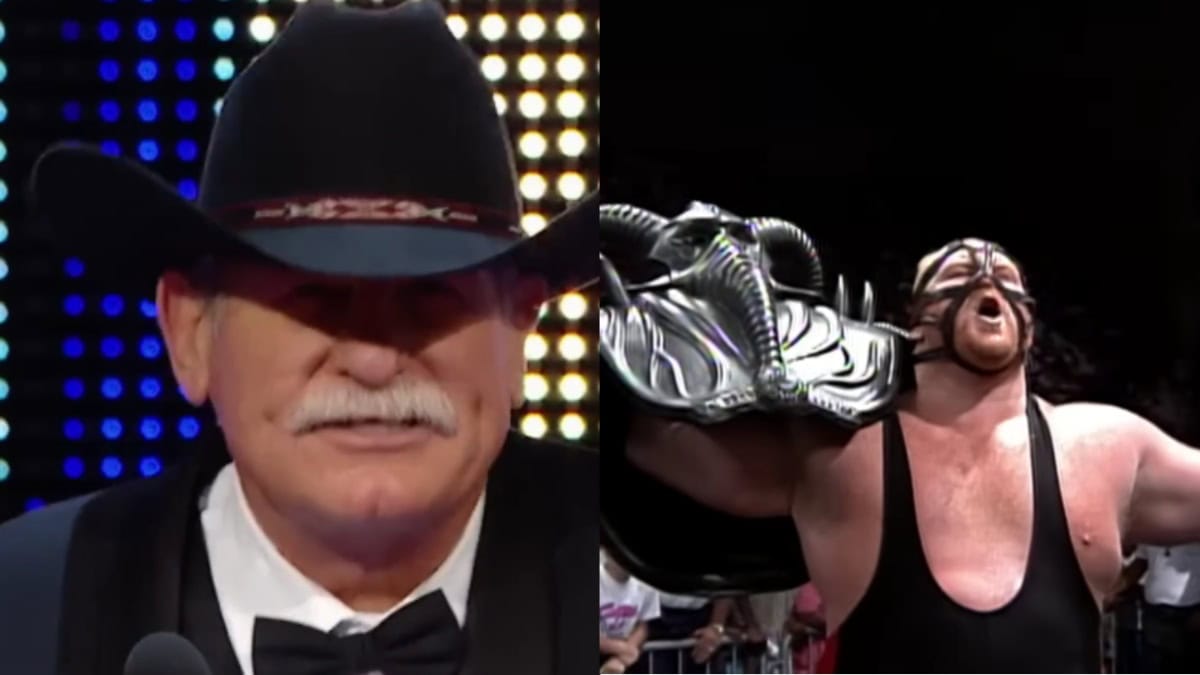
On February 10, 1990, New Japan Pro-Wrestling (NJPW) held an event titled “Super Fight in Tokyo Dome.” The card drew an attendance of approximately 60,000 spectators. It occurred during a period of high commercial success for professional wrestling in Japan. The event was notable for its cross-promotional nature, featuring talent from rival organizations.
Matches between top stars from rival promotions were rare in 1990 due to political concerns. Promoters Antonio Inoki (NJPW) and Giant Baba (AJPW) protected their athletes carefully. Neither organization wanted their “ace” foreigner to lose decisively. As a result, the match was booked to end in a double count-out, a finish where both competitors are disqualified for staying outside the ring too long. To satisfy the audience with a non-definitive ending, the match required a high level of physical intensity.
The Combatants and Physical Limitations
The match dynamics were influenced by the physical attributes and limitations of the two wrestlers.
Big Van Vader (Leon White)
Leon White was a former NFL offensive lineman. He stood 6’5” and weighed approximately 450 pounds. In NJPW, he performed under the name Big Van Vader, wearing a heavy, full-head mask that covered his entire face except for his eyes and mouth. This mask limited his peripheral vision.
Stan Hansen
Stan Hansen was established as the top foreign wrestler in AJPW. He was known for a wrestling style characterized by full-contact strikes. A significant factor in his style was his eyesight. Hansen suffered from severe myopia (nearsightedness). He performed without corrective lenses.
In his autobiography, The Last Outlaw, Hansen explained how his vision affected his in-ring work. He stated that he could not accurately judge the distance between himself and his opponent. Consequently, he swung his arms with full force to ensure he made contact, rather than risking a missed strike which would expose the staged nature of the contest. “I couldn’t see anything,” Hansen wrote. “I just swung. If I hit you, I hit you. If I didn’t, I missed. But usually, I hit you.”
The Pre-Match Nasal Fracture
The physical altercation escalated before the official start of the match. Stan Hansen entered the Tokyo Dome carrying a bull rope, a braided rope with a heavy steel cowbell attached to the end. Hansen swung the rope to clear space as he approached the ring.
As Hansen entered the ring, he swung the bull rope toward Vader. Due to his vision impairment and the distance, the steel cowbell struck Vader directly on the bridge of the nose.
The impact fractured Vader’s nose immediately. The injury caused significant bleeding inside Vader’s mask, which obstructed his breathing and vision before the referee signaled for the opening bell.
Vader addressed this specific moment in a later interview. “He broke my nose before the match even started,” Vader stated. “I was seeing stars, my nose was crushed, and I couldn’t breathe. And the bell hadn’t even rung yet.”
The match continued as a brawl. Approximately five minutes into the contest, the two men engaged in a grapple near the corner turnbuckles. During the exchange, Hansen attempted a “facial rake,” a maneuver where a wrestler drags a thumb across an opponent’s face.
Hansen’s thumb made contact with the inner corner of Vader’s right eye. The force of the thumb, combined with the leverage provided by the rigid eyehole of Vader’s mask, caused the eyeball to dislodge from the orbital socket.
The Manual Reduction
Vader retreated to the corner and removed his mask. This was a deviation from protocol, as masked wrestlers typically do not expose their faces. Vader determined that the mask was exacerbating the injury.
Upon removing the mask, Vader assessed the damage. He reported a loss of vision in the right eye and the sensation of the eyeball resting on his cheekbone. “I looked down and I could see the ring posts a little bit out of my right eye, but it was blurry and everything was out of whack,” Vader wrote in his autobiography. “I put my hand up and felt the eye on my cheek.”
Vader performed a manual reduction of the injury in the ring. He placed his thumb against the displaced eyeball and applied pressure to force it back through the eyelids and into the orbital socket. “I just pushed it back in,” Vader told Power Slam magazine. “I thought I lost the eye. I really did. But I wasn’t going to stop the match. Stan wouldn’t have stopped, so I wasn’t going to stop.”
Continuation of the Match
Following the reduction of the eye, the match continued for approximately 15 minutes. The wrestlers executed high-impact maneuvers, including lariats and suplexes.
The continuation of the match after such an injury is attributed to the “Fighting Spirit” culture prevalent in Japanese wrestling at the time. Stopping a match for an injury was viewed as a weakness, particularly in a high-profile inter-promotional bout.
Vader wrestled with a broken nose and significant orbital trauma. At one point, he executed a vertical suplex on Hansen. The match concluded with the planned double count-out finish, where both men brawled outside the ring and failed to return before the referee’s count of twenty.
Medical Aftermath
Vader received medical attention at a Japanese hospital immediately following the event. Surgeons inserted a metal plate beneath Vader’s right eye to support the orbital structure during the healing process. Vader underwent a recovery period before returning to the ring. He reported that his vision in the right eye remained altered permanently, with increased sensitivity to light.
Stan Hansen’s Account
Stan Hansen discussed the incident in his memoirs. He acknowledged causing the injury but framed it as an accident resulting from the intense style of wrestling required for the match. “Leon was a big, tough son of a gun,” Hansen wrote. “We beat the hell out of each other. That night was just a little more extreme than usual.”
Hansen noted that the incident increased his professional respect for Vader. In the context of 1990s Japanese wrestling, durability was a highly valued trait.
Industry Safety Standards
The incident is cited in discussions regarding the evolution of safety protocols in professional wrestling. In 1990, the decision to continue a match lay primarily with the performers. There was no independent medical official at ringside with the authority to stop the bout.
In modern professional wrestling (WWE, AEW, NJPW), protocols are different. Referees are trained to identify legitimate injuries. They use the “X” hand signal to communicate with backstage officials. A ringside physician has the authority to pause or end a match if a competitor sustains an injury.
Historical Significance
For Big Van Vader, the match against Stan Hansen established his legacy in Japan. He became the first foreigner to hold the IWGP Heavyweight Championship and is regarded as one of the most successful foreign talents in NJPW history. The story of the eye injury contributed to his aura of legitimacy when he later transitioned to World Championship Wrestling (WCW) in the United States.
The match remains a documented example of the physical risks associated with the “Strong Style” presentation of professional wrestling, highlighting the potential for severe injuries in scripted combat sports.

