


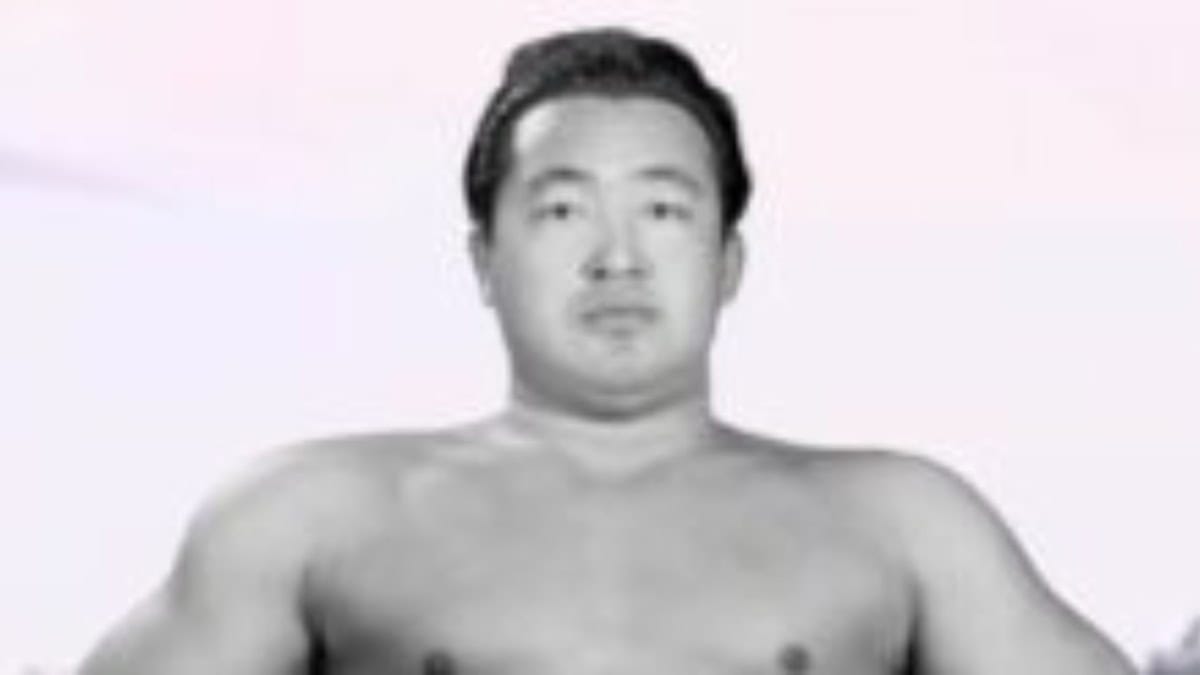
In the reconstruction era of post-World War II Japan, the nation was desperate for a symbol of strength. The cities were rebuilding from ash, the economy was fragile, and the national psyche had been bruised by defeat. Into this void stepped a man who seemed larger than life: Rikidozan.
However, on the night of December 8, 1963, the invincibility of the national hero was shattered. Inside a high-end nightclub in Tokyo’s Akasaka district, a minor altercation with a member of the Yakuza escalated into a fatal stabbing. The death of Rikidozan did not just end a life; it fractured the foundation of Japanese wrestling, leading to a power vacuum that birthed the modern era of the sport while exposing the dark, inextricable ties between the squared circle and organized crime.
The Hero and the Underworld
To understand the circumstances of his death, one must understand the dual life Rikidozan led. In the ring, he was a stoic warrior. Outside the ring, he was a volatile, wealthy celebrity who enjoyed the nightlife, heavy drinking, and the company of dangerous men.
In the 1950s and 60s, professional wrestling in Japan was heavily sponsored and supported by the Yakuza. The crime syndicates often handled ticket distribution, venue security, and local promotion. Rikidozan, as the head of the JWA, had to navigate this world. He was known to be friendly with various bosses, but his immense fame and physical power often gave him a sense of untouchability. He believed that his status as a national icon shielded him from the consequences that befell ordinary men.
By 1963, Rikidozan was at the peak of his powers. He was a business tycoon with interests in apartments, nightclubs, and boxing gyms. But his temper was legendary. When he drank, he became aggressive, and on the night of December 8, that aggression would cost him everything.
The New Latin Quarter
The incident took place at the New Latin Quarter, a luxurious nightclub in Tokyo known for its high-profile clientele and hostesses. Rikidozan was there drinking with friends.
According to witness accounts and police reports, the altercation began in the restroom or a corridor near the restroom. Rikidozan encountered Katsuji Murata, a high-ranking member of the Sumiyoshi-kai, one of the largest Yakuza syndicates in Japan.
The spark was trivial. Reports vary slightly, but the consensus is that Murata accidentally stepped on Rikidozan’s expensive shoe (or vice versa), or perhaps brushed against him without apologizing. In a normal setting, this would be a minor faux pas. However, Rikidozan, intoxicated and arrogant, demanded an apology.
Murata, a hardened gangster who lived by a code of honor that did not allow for submission to civilians—even famous ones—refused. The argument escalated. Rikidozan, relying on his size and strength, attacked Murata. He mounted the smaller man and began raining down punches, utilizing his raw power to pummel the gangster.
The Blade
Katsuji Murata was losing the physical fight, but he was armed. While pinned underneath the wrestling star, Murata drew a knife. It was described in various reports as a climbing knife or a short blade.
In a desperate act of self-defense and gangster retribution, Murata thrust the blade upward. He stabbed Rikidozan in the lower abdomen.
The blade pierced the abdominal wall. Rikidozan, filled with adrenaline and alcohol, reportedly did not realize the severity of the wound immediately. He continued to struggle until the fight was broken up. Murata fled the scene.
A chilling detail that has persisted in wrestling folklore—and was cited in some contemporary reports—is the condition of the blade. It is alleged that the knife had been soaked in urine or was otherwise contaminated, a Yakuza tactic designed to ensure that even a minor wound would result in a lethal infection. Whether this was a calculated assassination tactic or a grim coincidence of a dirty weapon, the result was the same: the wound was a ticking time bomb.
The Fatal Mistake
Rikidozan was rushed to the Sanno Hospital. The initial prognosis was serious but not fatal. The doctors performed surgery to repair the damage to his intestines. He was a man of immense physical vitality, and the expectation was that he would recover.
However, the “King of the Ring” proved to be his own worst enemy during his recovery. Rikidozan was not a patient man. He was accustomed to doing what he wanted, when he wanted.
Against the strict orders of his doctors, Rikidozan reportedly consumed large quantities of water and, according to some accounts, alcohol (specifically sake or sushi) shortly after the surgery. His body, still healing from the trauma of the stabbing and the operation, could not handle the intake.
The ingestion of fluids caused his intestines to bloat and the sutures to rupture. This led to peritonitis, a severe inflammation of the abdominal lining. The infection spread rapidly.
December 15, 1963
One week after the stabbing, on December 15, 1963, Rikidozan died. He was 39 years old.
The news sent a shockwave through Japan comparable to the assassination of John F. Kennedy in the United States just weeks prior. The national hero, the man who had restored Japanese pride, was dead at the hands of a gangster. The funeral was a massive state-like affair, attended by thousands of weeping fans, politicians, and celebrities.
Katsuji Murata was eventually arrested. He was charged with manslaughter (or bodily injury resulting in death) rather than murder, as the legal argument was that the stabbing occurred during a fight Rikidozan initiated. Murata served approximately seven years in prison. Upon his release, he rose through the ranks of the Yakuza, becoming a boss in his own right. In a strange twist of fate, Murata would later issue a public apology to Rikidozan’s family annually, visiting the grave to pay respects to the man he killed.
The Vacuum and the Split
Rikidozan’s death left the Japan Pro Wrestling Alliance (JWA) without a leader. He had ruled the organization with an iron fist, and he had not clearly designated a successor.
The struggle for control of the JWA began almost immediately. The two primary candidates were Rikidozan’s top students: Shohei “Giant” Baba and Kanji “Antonio” Inoki.
Baba was a former professional baseball pitcher, a towering 6-foot-10 giant who was beloved by the fans. Inoki was a fiery technician with a background in track and field and karate. They represented two different philosophies. Baba favored the American style of storytelling and spectacle (King’s Road). Inoki favored the “Strong Style,” emphasizing legitimate martial arts techniques and the appearance of a real fight.
The JWA executives initially tried to keep both men under one roof, but the tension was unsustainable. Furthermore, investigations into the JWA’s finances following Rikidozan’s death revealed massive corruption and embezzlement, further destabilizing the company.
The Birth of Modern Puroresu
By 1972, the JWA crumbled. From its ashes, two new promotions rose, defining the landscape of Japanese wrestling for the next fifty years.
Antonio Inoki was fired from the JWA for an alleged takeover plot. He went on to found New Japan Pro Wrestling (NJPW). He built the promotion on his “Strong Style” philosophy, bringing in martial artists and legitimate tough guys to prove that pro wrestling was the “king of sports.”
Giant Baba left the JWA shortly after to form All Japan Pro Wrestling (AJPW). He built his promotion on the NWA model, bringing in the top American champions like the Funks, Harley Race, and Ric Flair to put on classic heavyweight matches.
This split created a rivalry that fueled the golden age of Japanese wrestling. Had Rikidozan lived, it is likely the JWA would have remained a monopoly, and the stylistic evolution driven by the competition between Baba and Inoki might never have happened.
The Secret Identity
Rikidozan’s death also led to the gradual revelation of his greatest secret. During his life, he was celebrated as a Japanese hero. However, he was born in Korea.
In post-war Japan, discrimination against Koreans was rampant. Rikidozan concealed his heritage to be accepted by the public. After his death, the truth of his origins as Kim Sin-rak became public knowledge.
For the Korean community in Japan (Zainichi), Rikidozan became a complex symbol—a man who had to hide who he was to be loved, yet who secretly funded projects in Korea and served as a beacon of what a Korean could achieve. In North Korea specifically, he remains a national hero to this day, a fact that facilitated the “Collision in Korea” event decades later involving his student, Antonio Inoki.
Legacy of the Knife
The murder of Rikidozan remains the “Big Bang” moment of Japanese professional wrestling history. It ended the era of the singular, monolithic hero and ushered in the era of factions, promotions, and stylistic warfare.
The New Latin Quarter is long gone, having burned down in a fire in 1982, but the legacy of that night remains. It serves as a grim reminder of the close ties between the wrestling business and the Yakuza in the Showa era. It is a story of hubris, of a man who believed he was a god, only to find out the hard way that in the real world, a knife blade does not care about kayfabe.

