


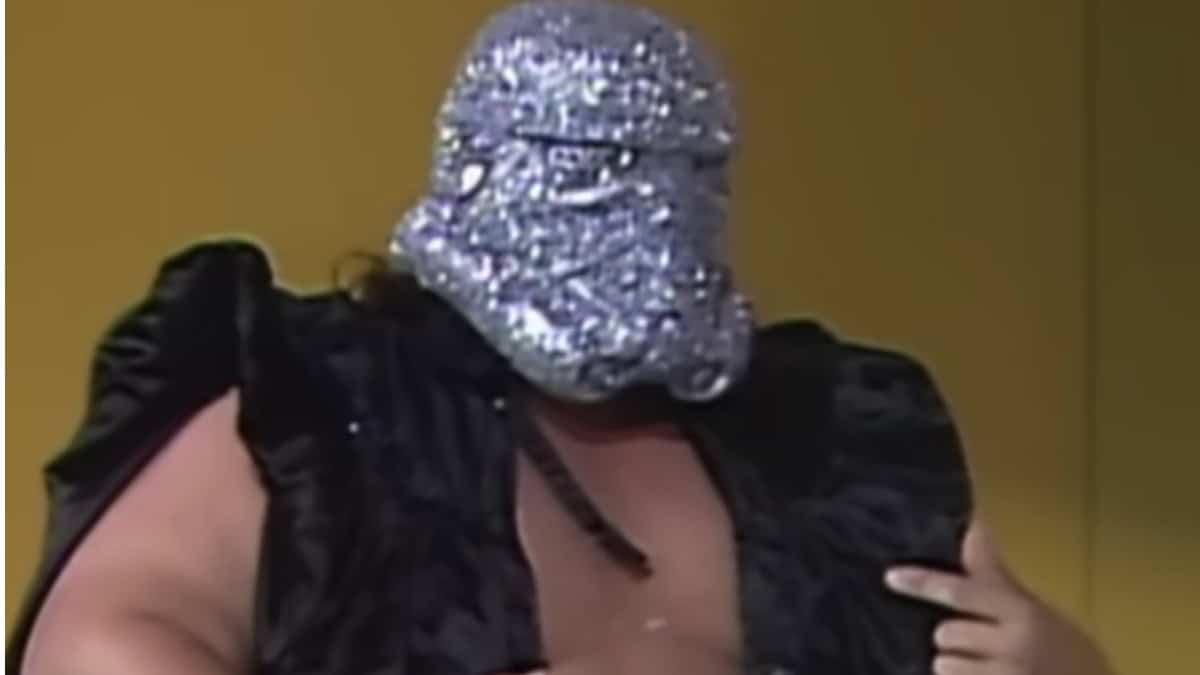
On August 18, 1993, World Championship Wrestling (WCW) broadcast Clash of the Champions XXIV live from the Ocean Center in Daytona Beach, Florida. The event was intended to be a serious showcase of the company’s main event talent, featuring a “Flair for the Gold” interview segment involving Ric Flair, Sting, and the villainous duo of Sid Vicious and Harlem Heat. The purpose of the segment was to introduce a mystery partner for the babyfaces—a monster so terrifying that he would strike fear into the hearts of the heels for the upcoming WarGames match.
The Context: A Monster is Needed
To understand the gravity of the failure, one must look at the players involved. The storyline centered on Sting and Davey Boy Smith feuding with Big Van Vader and Sid Vicious. These were the titans of the industry. The upcoming Fall Brawl pay-per-view featured the “WarGames” match, a violent, double-cage spectacle. The babyface team needed a fourth member to equalize the size and power of the villains.
Dusty Rhodes, the head booker of WCW, reached out to his brother-in-law, Fred Ottman. Ottman was a large, agile super-heavyweight who had previously found success in the World Wrestling Federation (WWF) as Tugboat and later Typhoon (one half of the Natural Disasters). He was a credible, experienced worker capable of moving well for a man of his size.
Ottman agreed to come to WCW. The concept for his character, however, was rushed. He was to be “The Shockmaster,” a mysterious force of nature. To keep his identity a secret until the reveal, management decided to cover his face.
The Costume and the Concept
The costume design for the Shockmaster has become iconic for all the wrong reasons. With limited time and perhaps limited creativity, the wardrobe department procured a standard Star Wars Stormtrooper helmet. To avoid copyright infringement, or simply to add “flair,” they covered the helmet in silver glitter.
To complete the look, Ottman wore a pair of jeans and a long, shaggy fur vest that looked like a floor rug. It was a bizarre, low-budget ensemble that clashed with the serious tone of the main event scene.
The plan for the reveal was theatrical. During the “Flair for the Gold” segment, Sting would announce their partner. Pyrotechnics would explode, and the Shockmaster would burst through a false wall on the set, creating a dramatic entrance. To add an aura of menace, the character would not speak with his own voice. Instead, Ole Anderson—the gruff, legendary voice of the Four Horsemen—would provide a distorted voiceover from backstage via a microphone.
The Construction of the Wall
The critical failure point of the segment lay in the carpentry. The set for “Flair for the Gold” was built with a false wall made of sheetrock (drywall).
However, the construction crew added a piece of framing that was not communicated to the talent. A 2×4 board was nailed across the bottom of the frame to stabilize the drywall. This board created a lip, several inches high, right at the threshold where Ottman was supposed to burst through.
Because Ottman was wearing the Stormtrooper helmet, his vision was severely restricted. The eye holes were covered with mesh, and the glitter further obscured his sightlines. He had no peripheral vision and could not see the floor directly in front of him.
Furthermore, there was no rehearsal. Ottman arrived at the building, was shown the spot, and was told to crash through the wall on cue. He was not informed about the 2×4 brace at the bottom.
The Fall: Live on TBS
The segment began with high tension. Ric Flair and Sting stood face-to-face with Sid Vicious and Harlem Heat (Booker T and Stevie Ray), accompanied by Col. Robert Parker. The insults flew. Sting took the microphone and declared, ” All I have to say is… to our partner… SHOCK THE WORLD!”
This was the cue. A small explosion detonated near the wall. Fred Ottman, adrenaline pumping, charged forward to break through the sheetrock.
His shins hit the unyielding 2×4 board at the base of the wall.
Momentum carried his upper body forward while his feet stayed planted. The Shockmaster tripped. He did not just stumble; he fell flat on his face, crashing through the upper part of the drywall and landing chest-first on the carpeted floor of the set.
The impact caused the glittered Stormtrooper helmet to fly off his head, rolling across the floor. For a brief second, Fred Ottman’s face was visible to the world. He scrambled, panicking, and grabbed the helmet. He put it back on his head, attempting to salvage the character, but in his haste, he put it on sideways.
He attempted to stand up, pulling the fur vest around him, looking like a child playing dress-up who had just taken a tumble.
The Reaction: “Oh God”
The audio of the segment captured the genuine reactions of the men in the ring. As Ottman fell, a voice—widely attributed to Ric Flair—can be clearly heard on the broadcast exclaiming, “Oh, God.”
The camera cut to the wrestlers. Sid Vicious, known for his intense, psychotic character, was visibly struggling to maintain his composure. He clenched his jaw, holding back laughter. Booker T and Stevie Ray looked down at the floor, shaking their heads.
Ric Flair, the consummate professional, tried to act as if a monster had just entered the room, but his body language betrayed him. The tension of the WarGames build-up had evaporated instantly.
The Voiceover Disconnect
Compounding the disaster was Ole Anderson. Anderson was situated in a backstage area with a microphone connected to the arena’s PA system. However, he reportedly did not have a monitor, or he was not looking at it when the fall occurred.
Unaware that the Shockmaster was lying face-down on the carpet scrambling for his helmet, Anderson began the scripted promo. A distorted, gravelly voice boomed over the speakers, laughing maniacally.
“I have got to let you know…” the voice threatened, while the visual showed Ottman trying to stand up and adjust his crooked helmet.
The disconnect was surreal. The voice sounded like a demon; the visual looked like a blooper reel. The Shockmaster eventually stood up, pointed a finger at Sid Vicious (who was nearly crying from laughter), and the voiceover continued to threaten the heels.
Sid Vicious, in a moment of improvisation, yelled, “Get him out of here!” It was the only thing that made sense.
Backstage Aftermath
When the segment ended and they went to commercial, the backstage area was a mix of hysteria and horror.
In an interview with WWE.com years later, Fred Ottman recalled the immediate aftermath. He described walking back through the curtain, devastatingly embarrassed. He pulled the helmet off and threw it.
“I was thinking my career was over. I’m sitting there, and I’ve got glitter in my eyes, and I’m just thinking, ‘What have I done?'”
However, he wasn’t met with anger. He was met with tears of laughter. The wrestlers, the production crew, and even the executives were doubled over. Dusty Rhodes, who had booked the segment, was reportedly laughing so hard he couldn’t speak. It was a disaster, but it was so catastrophic that it looped back around to being entertaining.
The Uncle Fred Pivot
WCW management realized immediately that the “monster” push was dead. The Shockmaster could not be taken seriously as a threat to Vader.
Rather than firing Ottman or pretending it never happened, WCW leaned into the botch. They repackaged the Shockmaster as a clumsy, bumbling character—a lovable oaf who was essentially “Uncle Fred.” He was portrayed as a blue-collar guy who worked construction (a nod to the wall) and wore a hard hat.
The “Super Shockmaster” character became a comedy act. While it kept Ottman employed, it was a far cry from the main event run that was originally planned. He did participate in the WarGames match, but he was the least serious element of the cage fight.
Historical Legacy
The Shockmaster debut has endured as the ultimate symbol of WCW’s production ineptitude. It is frequently featured on “Best of” blooper DVDs and WWE Network countdown shows.
However, it also speaks to the likability of Fred Ottman. In the years since, Ottman has embraced the moment. He sells Shockmaster action figures (complete with the falling action) and signs autographs on 8×10 photos of the fall. He realized that while he didn’t become the World Champion, he achieved a different kind of immortality.
The incident is a reminder that in professional wrestling, the line between “legendary” and “laughable” is often just a 2×4 board nailed to the floor. It remains the funniest moment in the history of the sport, a perfect storm of bad wardrobe, bad carpentry, and bad luck.


