


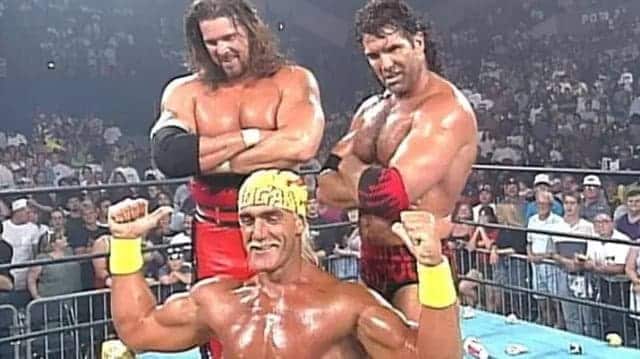
The Origin of the nWo: How the Trio of Hogan, Hall, and Nash Changed Wrestling Forever
The formation of the New World Order (nWo) in World Championship Wrestling (WCW) during the summer of 1996 stands as the single most definitive turning point in the modern history of professional wrestling. It was the moment that catalyzed the “Monday Night Wars,” shifting the industry from a traditional, family-friendly model of clear-cut heroes and villains to a reality-based product that blurred the lines between scripted entertainment and legitimate conflict. While the on-screen storyline of a hostile takeover captivated millions of viewers, the true story behind the group’s formation is a complex web of real-life contract disputes, backstage maneuvering, legal threats, and a high-stakes creative gamble that nearly fell apart before it even began.
The Curtain Call and the Exodus from the World Wrestling Federation
To fully understand the magnitude of the nWo’s formation, one must first examine the volatile state of the World Wrestling Federation (WWF) in early 1996. Scott Hall, known as Razor Ramon, and Kevin Nash, performing as Diesel, were two of the company’s top stars, yet both were increasingly frustrated with the financial structure of the promotion. At the time, the WWF operated on a system where talent compensation was heavily reliant on house show draws and merchandise sales, with very few guaranteed downsides. With the wrestling business in a slump and the company facing financial hardships due to various scandals, payoffs were shrinking. In contrast, WCW, backed by the deep pockets of Ted Turner and managed by Eric Bischoff, was beginning to offer guaranteed contracts—a revolutionary concept in the wrestling business that ensured talent was paid a set amount regardless of ticket sales or injuries.
Hall and Nash made the decision to leave the WWF for WCW, seeking financial stability. Their exit was marked by the infamous “Curtain Call” incident at Madison Square Garden on May 19, 1996. In a severe breach of “kayfabe” (the illusion that wrestling is real), Hall and Nash, who were villains, embraced their real-life friends Shawn Michaels and Triple H, who were on-screen heroes, in the center of the ring following a steel cage match. This act of breaking character infuriated WWF management, specifically Vince McMahon, and shocked traditionalists. However, it signaled a massive cultural shift in the industry: the fans were becoming “smart” to the inner workings of the business. Hall and Nash carried this outlaw reputation with them as they headed south to Atlanta, providing a layer of reality to their upcoming debut that could not be scripted.
The Inspiration: Japan and the UWF Invasion
The creative genesis of the nWo did not originate in the United States, but rather in Japan. WCW Executive Vice President Eric Bischoff frequently visited New Japan Pro-Wrestling (NJPW) to scout talent and observe production techniques. During one of these trips, he witnessed an angle involving the Union of Wrestling Forces International (UWFi) “invading” New Japan. The storyline presented the UWFi wrestlers not as typical villains, but as legitimate athletes from a rival organization looking to dismantle the home promotion. Bischoff was captivated by the realism and the “us versus them” tribalism it created among the fans.
Speaking on his podcast, 83 Weeks, Bischoff detailed how he adapted this concept for an American audience: “I wanted to create the impression that the WWF was invading WCW. I wanted it to feel real, gritty, and unlike anything we had done before.” The signing of Hall and Nash provided the perfect vessels for this concept, as they were fresh off WWF television and recognized globally as WWF superstars.
The Invasion Begins: “You Want a War?”
The on-screen narrative commenced on the May 27, 1996, episode of WCW Monday Nitro, the first two-hour broadcast of the show. During a match between The Mauler and Steve Doll, Scott Hall emerged from the crowd, dressed in denim street clothes rather than wrestling gear. He interrupted the broadcast, demanded the microphone, and delivered a monologue that broke the “fourth wall,” implying an invasion from the rival WWF without explicitly naming them.
Hall’s promo set the tone for the angle, and the specific verbiage was designed to sound unscripted. Addressing the camera and the announcers, Hall stated: “You people, you know who I am. But you don’t know why I’m here. Where is Billionaire Ted? Where is The Nacho Man? That punk can’t even get in the building. Me? I go wherever I want, whenever I want. And where, oh where, is Scheme Gene? Cause I’ve got a scoop for you. When that Ken Doll lookalike, when that weatherman wannabe comes out here later tonight, I have a challenge for him, for Billionaire Ted, for the Nacho Man, and for anybody else in uh… WCW. You want a war? You’re gonna get one.”
This segment was so convincing that the WWF filed a lawsuit against WCW, alleging that the company was misleading fans into believing Hall—and later Nash—were still WWF employees acting on behalf of the WWF to sabotage WCW. The lawsuit forced WCW to eventually state on air that Hall and Nash were not WWF employees, but the buzz had already been created. Kevin Nash debuted shortly after, and the duo, dubbed “The Outsiders,” began terrorizing the roster. They powerbombed Eric Bischoff through a table at The Great American Bash, a shocking moment of violence against an executive that heightened the realism. The storyline hinged on the identity of a “Third Man” who would join them to battle WCW’s defenders at the upcoming pay-per-view.
The Backstage Dilemma: Hogan or Sting?
While the audience speculated on the identity of the Third Man—with rumors swirling around Bret Hart, Lex Luger, or another WWF defector—the situation backstage was fraught with anxiety. Eric Bischoff’s primary choice for the role was Hulk Hogan. Hogan, the biggest babyface (hero) in the history of the industry, had seen his popularity wane in 1995 and 1996 as fans grew tired of his repetitive “red and yellow” character. Bischoff believed a heel turn would revitalize Hogan and the company. However, Hogan was hesitant. He feared that turning into a villain would destroy the “Hulkamania” brand he had spent 15 years building, potentially alienating the children and families who bought his merchandise.
Because of Hogan’s hesitation, Bischoff prepared a contingency plan: Sting. Sting was the face of the WCW franchise, and having him turn on his own company to join the invaders would have been a massive shock, albeit a different dynamic than Hogan. Speaking on 83 Weeks, Bischoff detailed the precarious nature of the situation: “If Hulk doesn’t show up, Sting is the third man. That was the backup plan. Up until the moment Hulk actually walked out of the dressing room, I wasn’t 100% sure he was going to do it.”
Hogan was filming the movie Santa with Muscles in California in the weeks leading up to the event. Bischoff flew out to meet him, pitching the idea one last time. Hogan eventually agreed, reportedly telling Bischoff, “I think it’s time.” However, even on the night of the event, Hogan did not arrive at the building until late in the show to avoid being spotted, adding to the nervousness of the production team.
Bash at the Beach 1996: The Turn
The climax occurred at Bash at the Beach on July 7, 1996, in Daytona Beach, Florida. The main event featured The Outsiders (Hall and Nash) against the WCW team of Sting, Lex Luger, and “Macho Man” Randy Savage. The match was designed to look like a legitimate chaotic situation. Early in the bout, Lex Luger was taken out on a stretcher due to a storyline injury, leaving Sting and Savage to face Hall and Nash in a two-on-three disadvantage (as the third man had not yet appeared).
As the match neared its conclusion, Hulk Hogan walked down the aisle. The crowd, conditioned for a decade to see Hogan as the ultimate savior, erupted in cheers, assuming he was there to replace Luger and save Savage from a beating. On commentary, Bobby “The Brain” Heenan, who had spent his career hating Hogan, asked, “But whose side is he on?”—a line he was later criticized for as it potentially spoiled the surprise, though Heenan maintained he was simply staying in character.
Hogan entered the ring, scared off The Outsiders, and stood over a fallen Randy Savage. Then, in the move that silenced the arena, Hogan bounced off the ropes and delivered his signature atomic leg drop to Savage. He did it a second time, then high-fived Hall and Nash. The crowd’s confusion turned to instant, vitriolic rage. Tony Schiavone, on commentary, delivered the defining line: “Hulk Hogan, you can go to hell! We have seen the end of Hulkamania. For Bobby ‘The Brain’ Heenan, for Dusty Rhodes, for Mean Gene Okerlund, I don’t give a damn. As far as I’m concerned, I’m out of here!”
The Promo That Changed History
As the match ended in a no-contest, the ring began to fill with debris. This was not a staged effect; the audience was legitimately throwing trash, drinks, and batteries into the ring. Mean Gene Okerlund entered the ring to interview Hogan, navigating through the flying garbage. Hogan’s subsequent interview is widely regarded as one of the most important promos in wrestling history. He didn’t just attack the fans; he attacked the very concept of his past character.
“Hulk Hogan, you can call this the New World Order of wrestling, brother,” Hogan shouted over the boos. “These two men came here from a great big organization up north and everybody was wondering who the third man was. Well, who knows more about that organization than me, brother?”
When Okerlund challenged him on his actions, Hogan retorted with a line that blurred reality and fiction, referencing his real-life contract status and creative control: “I’ve been the world heavyweight champion more times than anyone. And that’s because of the heart and soul and the blood and sweat that I’ve given. And the reception I got when I came out here, you fans can stick it, brother. Because if it wasn’t for Hulk Hogan, you people wouldn’t be here. If it wasn’t for Hulk Hogan, Eric Bischoff would be still selling meat from a truck in Minneapolis. And if it wasn’t for Hulk Hogan, all these ‘Johnny-come-latelies’ that you see out here wrestling wouldn’t be here. I was selling out the world, brother, while they were bumming gas to put in their car to get to high school. So the way it is now, brother, with Hulk Hogan and the New World Organization of wrestling, brother, me and the new blood by my side, whatcha gonna do when the New World Organization runs wild on you?”
The heat in the Ocean Center was palpable. Kevin Nash later recalled the intensity of the moment during an episode of Steve Austin’s Broken Skull Sessions. Nash explained the genuine danger they felt in the ring: “We didn’t know if we were going to get out of there alive. They were throwing D-cell batteries. That’s not a work. That hurts.” The trio required a heavy police escort to exit the building and return to their hotel.
The “Favored Nations” Clause and Business Impact
The formation of the nWo was not just a creative success; it was a financial landmark. The contracts given to Hogan, Hall, and Nash contained a specific stipulation known as a “Favored Nations” clause. This clause guaranteed that if any one of the three received a pay raise or a better deal, the other two would automatically receive a matching increase. This ensured that the founding members of the nWo remained the highest-paid talents in the company, creating a powerful political bloc that held immense sway over the direction of the company.
The success of the group was immediate. The nWo introduced the concept of “cool heels.” Unlike previous villains who were cowardly or purely evil, the nWo was stylish, rebellious, and counter-cultural. They adopted a black-and-white aesthetic, filmed gritty, handheld vignettes that looked like unauthorized broadcasts, and spray-painted the WCW World Heavyweight Championship belt with “nWo.” Merchandise sales skyrocketed, with the black-and-white nWo t-shirt becoming the highest-selling wrestling shirt of the year, transcending the sport to become a pop culture fashion staple.
The Legacy of the nWo
The immediate impact of the nWo was WCW’s dominance. Following the formation of the group, WCW overtook the WWF in the television ratings war, beginning a winning streak that lasted for 83 consecutive weeks. The storyline forced the WWF to abandon its cartoonish presentation and adopt the “Attitude Era,” resulting in the biggest boom period the industry has ever seen.
In the 2021 documentary WWE Icons: Rob Van Dam, Eric Bischoff reflected on the nWo’s legacy, noting, “It changed the way wrestling was presented. It changed the way the audience consumed the product.” While the nWo eventually diluted its own brand by adding too many members—at one point including virtually half the roster, from Vincent to Scott Norton—the initial impact of the core trio remains untouched. The image of Hogan, Hall, and Nash standing in the ring as trash rained down around them at Bash at the Beach 1996 is the defining image of the 1990s wrestling boom. It proved that in the world of professional wrestling, the most effective stories are the ones that dare to mix the scripted world with the raw, unresolved conflicts of reality.

