


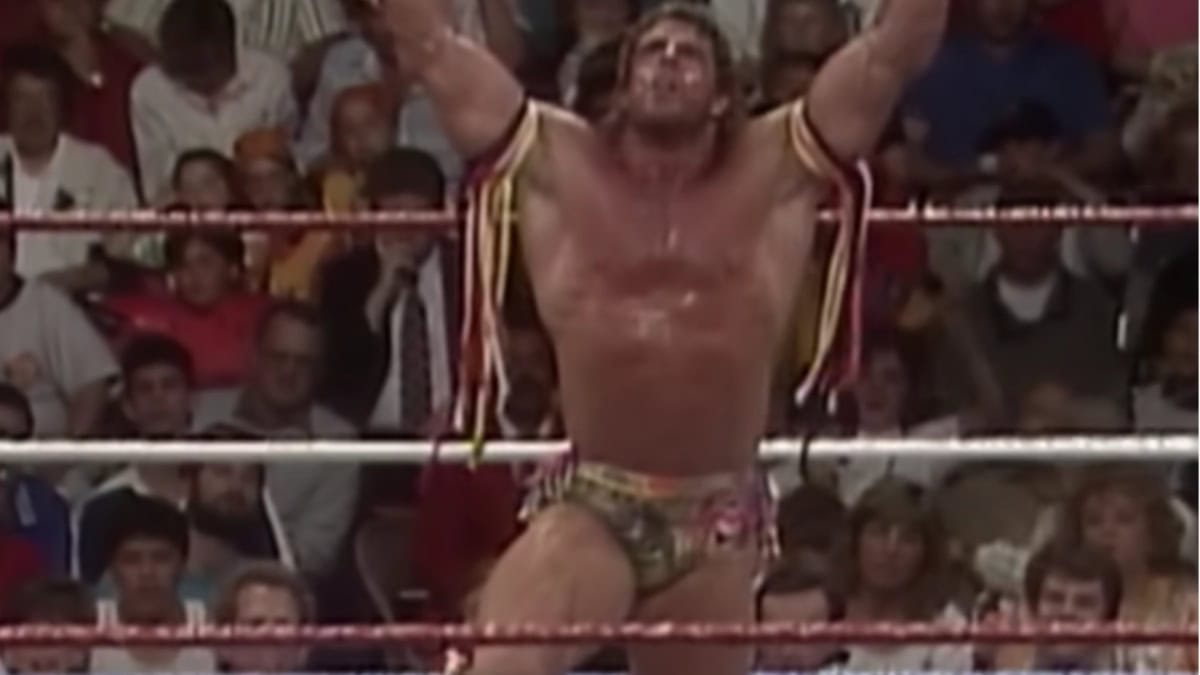
On August 26, 1991, Madison Square Garden was buzzing with the electric energy that only a “Big Four” World Wrestling Federation (WWF) pay-per-view could generate. The event was SummerSlam, billed as “The Match Made in Heaven, The Match Made in Hell.” While the “Heaven” portion featured the wedding of Randy Savage and Miss Elizabeth, the “Hell” portion was the main event: a handicap match pitting WWF Champion Hulk Hogan and The Ultimate Warrior against the Iraqi sympathizer trio of Sgt. Slaughter, Colonel Mustafa, and General Adnan.
The Context: A Crumbling Relationship
To understand the audacity of the demand, one must look at the year leading up to SummerSlam. In April 1990, at WrestleMania VI, The Ultimate Warrior defeated Hulk Hogan to become the WWF Champion. It was intended to be a passing of the torch, establishing Warrior as the face of the next generation.
However, the transition was not smooth. Warrior lacked Hogan’s polish and reliability. Business dipped during his reign, and by January 1991, he had lost the title to Sgt. Slaughter so that Hogan could win it back at WrestleMania VII.
Warrior felt slighted. He believed he was an equal draw to Hogan and deserved equal compensation. This resentment festered over the payouts for WrestleMania VII. According to Warrior, there was a significant disparity between his check and Hogan’s check for the event. He believed there was a discrepancy of approximately $500,000.
Throughout the summer of 1991, Warrior and McMahon exchanged a series of letters. Warrior demanded “parity” with Hogan on all fronts: pay-per-view bonuses, merchandise percentages, and even house show payoffs.
The Letter of Demands: July 10, 1991
The conflict escalated in July. Warrior sent a handwritten letter to Vince McMahon outlining his grievances and demands. The letter, which has since been made public in various documentaries, was disjointed but clear in its intent.
Warrior wrote, “I demand the same pay cuts as Hulk Hogan… I demand the same video cuts as Hulk Hogan.” He listed specific figures, requesting $550,000 for his WrestleMania VII payoff.
Crucially, the letter contained a threat. Warrior implied that if these terms were not met, he would not perform. He wrote, “I have been patient long enough… I will not be at the Meadowlands or any other arena until these terms are met.”
Vince McMahon, known for his negotiation tactics, initially tried to placate Warrior. He played the role of the father figure, assuring Warrior that they could work it out. However, as the date of SummerSlam approached, Warrior realized that “working it out” meant delaying the payment. He decided to use the only leverage he had: his presence at the biggest show of the summer.
The Day of the Show: The Ultimatum
On August 26, the day of SummerSlam, the WWF production trucks and talent arrived at Madison Square Garden. The card was stacked, and the arena was sold out.
According to accounts from Vince McMahon, Sgt. Slaughter, and backstage agent Bruce Prichard, Warrior refused to go to the ring unless the money was delivered. He demanded a lump sum payment to cover the perceived discrepancy in his WrestleMania payoff, as well as a guaranteed contract moving forward.
Vince McMahon was in an impossible position. If Warrior no-showed the main event, the company would face a riot. Madison Square Garden was the WWF’s home base; failing to deliver the advertised main event there would destroy consumer trust and potentially lead to lawsuits from broadcasters and the venue.
McMahon, swallowing his pride, agreed to the terms. He reportedly had a cashier’s check or a transfer arranged to meet the financial demand. He verbally agreed to the contract restructuring. He shook Warrior’s hand.
Warrior believed he had won. He suited up, painted his face, and prepared for the match.
The Match: Professionalism Under Duress
The match itself was a spectacle. Hulk Hogan and The Ultimate Warrior teamed up to face the “Triangle of Terror.” The crowd was electric, unaware of the backstage hostility.
Interestingly, the match is remembered for its strange psychology regarding Sid Justice, who served as the special guest referee. But the tension between Warrior and the office was invisible to the cameras. Warrior sprinted to the ring with his usual high-octane energy. He shook the ropes. He performed his signature moves.
However, keen observers noted that Warrior and Hogan did not interact much after the match. Once the pinfall was counted—Hogan pinning Sgt. Slaughter—the celebration began.
Hogan posed for the crowd. Warrior, rather than staying to celebrate with his partner and the fans, abruptly left the ring. He ran up the aisle to the backstage area. It looked like his character’s typical exit—always running—but in reality, he was running toward his termination.
The Firing: “You’re Fired”
As soon as The Ultimate Warrior passed through the curtain at Madison Square Garden, the trap was sprung.
Vince McMahon was waiting for him. But McMahon didn’t scream or shout. He simply handed Warrior a letter.
The letter, dated August 26, 1991, detailed the events of the day. It acknowledged that McMahon had agreed to the demands under duress solely to ensure the performance took place. It stated that because Warrior had threatened to breach his contract by no-showing, he was effectively holding the company ransom.
The letter concluded with a suspension, which was effectively a termination. Warrior was told to leave the building immediately. The locks on his gym bag had barely been opened before his career in the WWF was over.
The Aftermath: The Public Burial
The following weeks saw a public relations war. The WWF, usually protective of its internal workings, went on the offensive. On television, they announced that The Ultimate Warrior had been suspended for unprofessional conduct.
Behind the scenes, Vince McMahon was furious. He felt personally betrayed. He had taken James Hellwig, a bodybuilder with limited wrestling skills, and crafted him into an international icon. He had given him the clean victory over Hulk Hogan—a gift rarely bestowed. To be held up for money hours before a show was the ultimate sin in McMahon’s eyes.
Warrior retreated to his home in Arizona. He refused to return the money he had been paid (the legality of which was debated for years). He attempted to open a wrestling school and focused on his own ventures, but without the WWF machine, his relevance faded quickly.
The Return and the Second Fallout
Remarkably, the allure of money eventually brought the two sides back together. In 1992, with Hulk Hogan leaving the company amid the steroid scandal, McMahon needed a babyface star. He reached out to Warrior.
Warrior returned at WrestleMania VIII in 1992, saving Hulk Hogan from a beatdown by Sid Justice and Papa Shango. However, the reconciliation was short-lived. By November 1992, Warrior was gone again. The official reason given by the company was a failed drug test (for growth hormone) during the government crackdown on steroids. Warrior disputed this, claiming it was political.
Regardless of the reason, the trust was broken. The events of SummerSlam 1991 had permanently tainted the relationship. McMahon could never fully rely on Warrior again, and Warrior could never fully trust McMahon not to screw him.
The “Self-Destruction” DVD
The bitterness of the 1991 heist lingered for over a decade. In 2005, the WWE released a DVD titled The Self-Destruction of the Ultimate Warrior.
The documentary was a hit piece. It featured interviews with wrestlers, agents, and Vince McMahon himself, systematically dismantling Warrior’s legacy. They mocked his wrestling ability, his promos, and his sanity. A significant portion of the documentary focused on the SummerSlam hold-up, framing Warrior as greedy, unprofessional, and insane.
Warrior, who refused to participate in the project, sued WWE for defamation. The lawsuit was eventually settled, but the DVD cemented the narrative of the 1991 incident in the minds of a new generation of fans.
The Final Reconciliation
It would take another decade for the hatchet to be buried. In 2013, Triple H (Paul Levesque), now an executive, reached out to Warrior to broker a peace deal. The goal was to induct Warrior into the Hall of Fame.
In 2014, Warrior returned. He sat down with Vince McMahon. In a poignant scene captured for the WWE Network, the two men embraced. McMahon apologized for the DVD; Warrior apologized for the headaches. They agreed to leave the past in the past.
Warrior was inducted into the Hall of Fame on April 5, 2014. He appeared on Raw the following Monday, delivering a haunting speech about legacy and the spirit of the Warrior running forever.
On April 8, 2014, less than 24 hours after that appearance, The Ultimate Warrior collapsed and died of a massive heart attack outside a hotel in Arizona. He was 54 years old.
Historical Significance
The SummerSlam 1991 heist remains a pivotal moment in wrestling business history. It established the precedent that “card subject to change” was a very real threat. It also demonstrated the ruthlessness of Vince McMahon. He was willing to pay a ransom to save a show, but he was equally willing to destroy a career to save his dignity.
For the wrestlers, it was a lesson in leverage. Warrior had the ultimate leverage—the main event of a sold-out MSG show—and he used it. He got his money. But in doing so, he sacrificed his longevity.
The image of The Ultimate Warrior running to the back at Madison Square Garden is often replayed as a moment of triumph. But with historical context, it is the image of a man running away with the loot, unaware that the bridge behind him has already been set on fire.

