


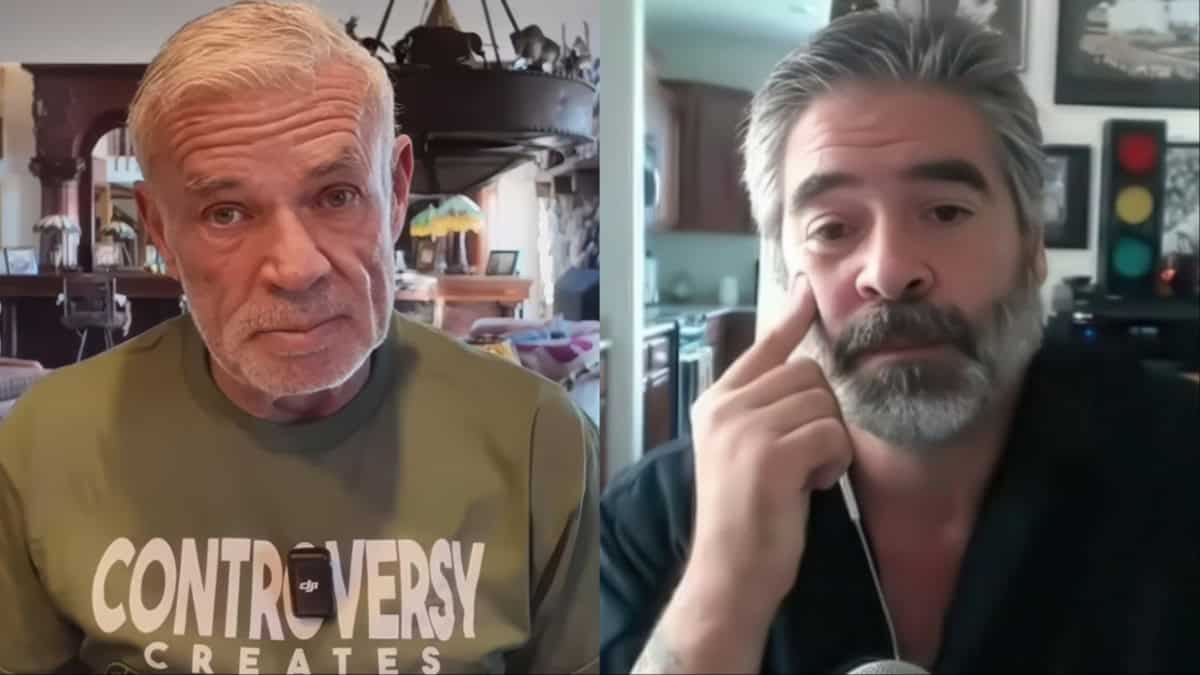
During a recent episode of the 83 Weeks podcast, Eric Bischoff offered an extended and detailed critique of his experience working with Vince Russo, focusing on what he described as fundamental flaws in Russo’s creative philosophy. The conversation with co-host Conrad Thompson was sparked by a review of a May 29, 2000, script for WCW Monday Nitro, which included a proposed storyline where David Flair would kidnap his stepmother, Beth. Bischoff used this as a jumping-off point to deconstruct his creative disagreements with Russo during their tumultuous time together in both WCW and later in TNA.
Bischoff began by explaining that Russo’s primary weakness was an inability to plan beyond the immediate television broadcast. “You could be in a room with Vince Russo, and he could be pitching you… and if you didn’t ask any questions and you just let him go, it would sound pretty good,” Bischoff said. However, he stated that the ideas would crumble under basic scrutiny. “But if you asked him one question, ‘Where do we go from here? What happens next week? What’s the arc look like?’ It was like you were asking him to solve… cure cancer. It would stump him. He never really understood episodic television, so he booked for that night’s show.”
This, Bischoff argued, led to a chaotic and unstructured creative output that lacked the necessary components of a compelling narrative. “Just because you come up and you book stuff every single week for the same two people over the course of six weeks, doesn’t mean you’re telling a story. You’re just booking matches,” he stated. Bischoff emphasized that true wrestling storytelling requires a clear structure and purpose.
“I used to say this about Russo all the time, ‘Everybody’s pitching angles, nobody’s pitching stories,'” Bischoff recalled. “A story has a beginning, a middle, and an end. A story has a character or characters that you are trying to get the audience to feel something for or against… it takes them on a journey.” He contrasted this with Russo’s method, which he felt was aimless. “It was just a bunch of stuff happening to fill time. No rhyme, no reason, and no story,” he said.
Bischoff also addressed what he considers to be Russo’s “biggest flaw,” which he asserted was an unwillingness to accept responsibility for creative failures while readily taking credit for any successes. “He wants to take credit for all of the good stuff… and he does, and he will, and he will embellish the truth to make sure he does,” Bischoff stated. “But when it turns out to be a flaming bag of dog poo… he’ll blame somebody else. He will lie, he will make stuff up.”
Using the proposed “kidnapping” angle as a specific example, Bischoff explained why he believes such concepts consistently fail in a wrestling context. He argued that they shatter the audience’s suspension of disbelief, a critical component of professional wrestling. “There’s an art to suspending disbelief,” he explained. “There’s certain premises that you can present to an audience that gives them permission, because it’s plausible, to get lost in the story. Kidnapping angles, I’ve seen them tried so many times in wrestling, and they never, ever, ever work.”
Bischoff noted that this creative approach was not limited to their time in WCW. He pointed out that the same patterns emerged when they were both involved with TNA Wrestling. He argued that Russo’s formula and creative philosophy have been tested in multiple environments—WWE, WCW, and TNA—and have never resulted in sustained financial success for any of those promotions.
“Show me where that formula and that approach has ever drawn a dime for anybody. For WWE, for TNA… it doesn’t draw money,” Bischoff stated emphatically. He suggested that Russo’s background as a magazine writer, as opposed to a television executive, was the root cause of their different perspectives on how to build a wrestling show and a wrestling company.
Bischoff framed their creative differences as a fundamental clash in professional responsibilities. “I was an executive with a budget, with a P&L, with advertisers… with a network… I had a lot of constituents that I had to be responsible to, and he didn’t. He was a writer for a magazine,” he said. This distinction, in Bischoff’s view, explains why his own focus was on long-term growth and brand stability, while Russo’s was on generating immediate, often controversial, moments for a single show.
In his final analysis, Bischoff summarized Russo’s creative output as lacking the foundational elements of successful wrestling television. The lack of narrative arcs, character development, and logical story progression, he argued, ultimately prevented the shows from connecting with the audience in a meaningful way that could translate to business growth. His assessment was a clear portrait of two creative minds with irreconcilable views on how to produce a professional wrestling program.
If you use any portion of the quotes from this article please credit AdFreeShows.com with a h/t to WrestlingNews.co for the transcription.

