


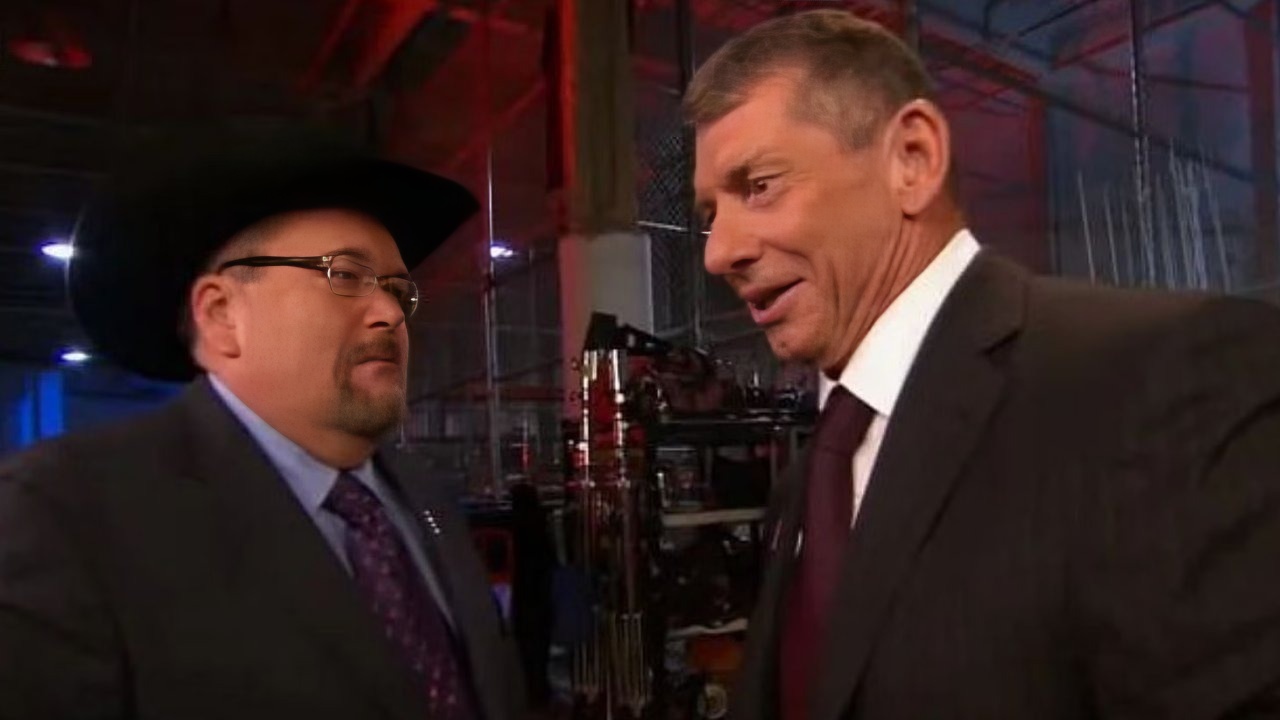
The leadership style of Vince McMahon has been a subject of scrutiny and fascination for decades, with various wrestlers recounting stories ranging from fatherly support to psychological manipulation. On the latest episode of Kliq This, Kevin Nash weighed in on recent allegations made by Matt Hardy regarding McMahon’s treatment of legendary commentator Jim Ross.
Sean Oliver, the host of the podcast, read a transcript from Matt Hardy’s podcast in which Hardy claimed that McMahon enjoyed putting people, particularly Jim Ross, in uncomfortable situations. Hardy described this behavior as a mechanism to test employees for weakness but admitted that it often crossed the line into abuse. Hardy stated, “I think he was abusive with it as well, and JR probably was one of the guys he was more abusive with.”
Kevin Nash, who worked closely with McMahon during his run as Diesel in the mid-90s and later upon his return with the nWo in 2002, did not dispute Hardy’s characterization. In fact, Nash validated the claims by referencing specific medical hardships that Ross endured, which became fodder for on-screen ridicule.
“Vince is not going to get a Humanitarian of the Year Award anytime soon,” Nash stated bluntly. “He gave JR a horrible time when JR had that Bell’s palsy.”
The Context of McMahon vs. Ross
Nash’s reference to Bell’s palsy alludes to several incidents in WWE history. Jim Ross, who has suffered multiple bouts of the condition which causes facial paralysis, was famously mocked on WWE television. In 2005, following surgery, a character named “Dr. Heinie” was introduced to perform a colonoscopy on a Jim Ross mannequin, a segment widely criticized for its mean-spirited nature. Furthermore, the character “Oklahoma” in WCW (written by former WWF writer Vince Russo) also mocked Ross’s condition, though the culture of mocking Ross was prevalent in the WWF/E environment as well.
Nash’s confirmation that McMahon gave Ross a “horrible time” reinforces the narrative that McMahon viewed illness or physical differences not with sympathy, but as vulnerabilities to be exploited for entertainment or dominance.
Nash’s Personal Experience: The Big Man Privilege
However, Nash made a clear distinction between his own experiences with McMahon and those of Jim Ross. Standing nearly seven feet tall and projected as a monster heel and later a top babyface, Nash’s relationship with the chairman was different. McMahon has historically favored larger athletes, often treating them with a level of deference or camaraderie not afforded to smaller talent or non-wrestlers.
“Not to me,” Nash explained regarding the bullying behavior. “But I’m saying is, it’s like everything. When I was five foot nine and in fourth grade… and weighed like 100 pounds, and I got my ass beat every fucking day. I saw fucking kids getting picked on all the time. One of them was me. As life goes on, then that just doesn’t happen anymore.”
Survival of the Fittest
The conversation then shifted to a broader philosophical discussion about the nature of the wrestling industry. Nash did not necessarily condone the abuse, but he framed it as an inevitability of the environment—a Darwinian struggle where only the toughest survive.
“I’ve lived the life of being picked on, and I’ve also watched it’s always going to be the strong survive,” Nash said. “And in essence, people know that the actual thing is the one that survives is the one that can adapt. So unlike them dinosaurs… adaptation is what you need to strive for.”
Nash’s comments suggest that in the high-pressure cooker of WWE, “testing” employees—even to the point of abuse—was part of the culture. Those who could adapt to McMahon’s eccentricities and cruelty survived; those who could not were chewed up by the machinery.
For Jim Ross, “adaptation” meant enduring public humiliation while remaining the voice of the company for two decades, proving his indispensability despite the treatment. For Nash, adaptation meant leveraging his size and wit to ensure he was never the target. While the industry has evolved significantly in 2026, Nash’s reflections serve as a stark reminder of the ruthless interpersonal politics that defined the company’s most boom-heavy periods.
If you use any portion of the quotes from this article please credit Kliq This TV with a h/t to WrestlingNews.co for the transcription.

