


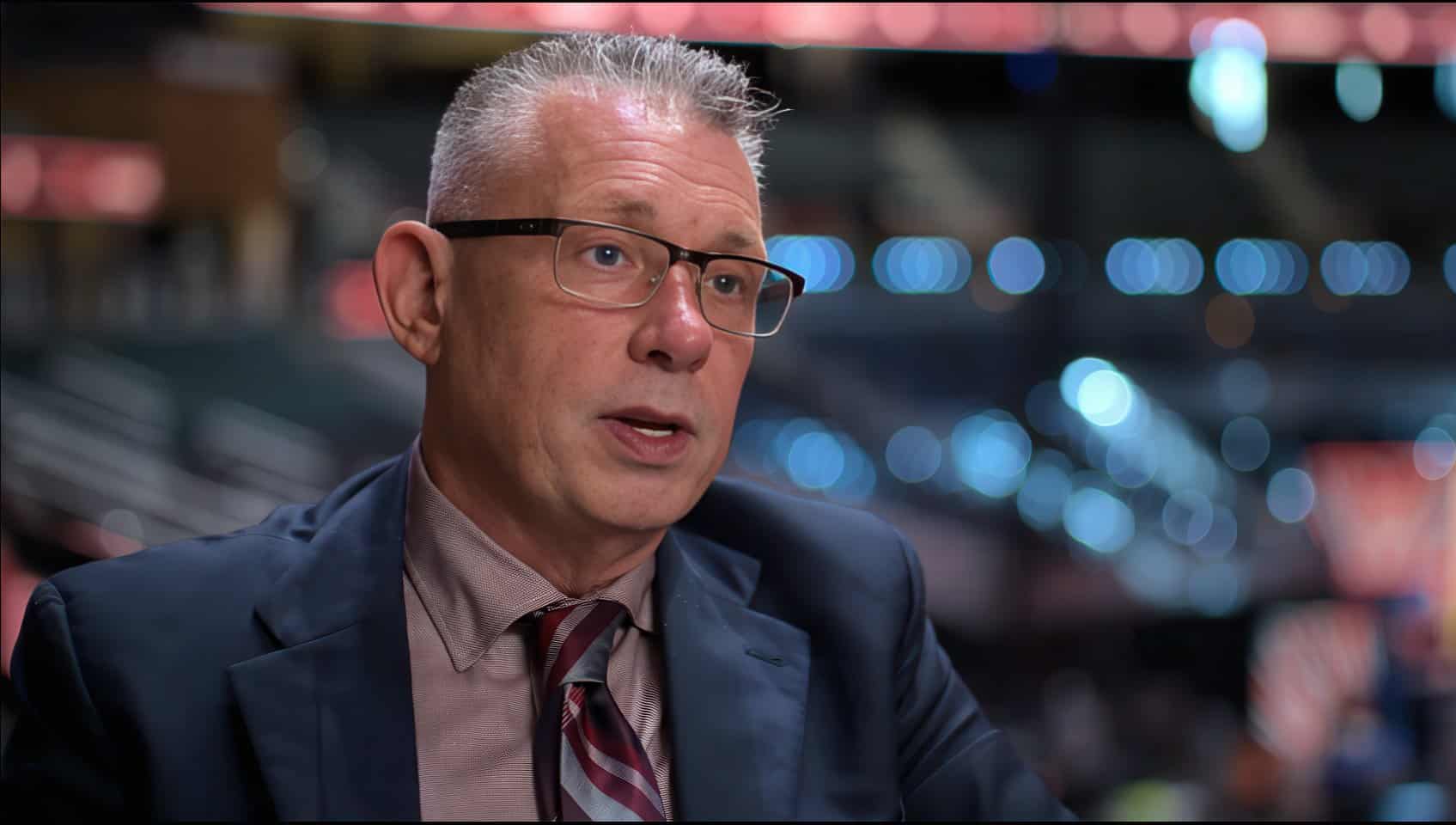
Michael Cole arrived in WWE as a network news reporter with no idea how wrestling worked. The company’s fix was to put him in a car with two of the most respected men in the locker room and let him figure it out.
Speaking on What’s Your Story? with Steph McMahon at Fanatics Fest, Cole said Kevin Dunn, who hired him, wanted him brought along properly.
“Kevin wanted to make sure that I was always protected, and that I learned the business the right way, and that I wasn’t just thrown out there having no idea what was going on,” Cole said. “So he put me on the road my first year in the company to go to most of the live events, and I ended up traveling with Ron Simmons and JBL.”
His duties were straightforward.
“My job was to drive the car, and I had to make sure that after every live event, that there was a case of beer, and that there was a bottle of whiskey, in this vehicle as you were driving from town to town,” Cole said. “We would get to the town, I’d make sure everybody got checked in. It was a learning experience.”
The payoff had nothing to do with the driving.
“All kidding aside, what it did to me is it immediately helped me become accepted by the boys and the girls in the locker room,” Cole said. “That was the real important part of it, because John was very respected, as was Ron at the time, and that really helped me become accepted as a part of this business.”
Cole said that path does not really exist anymore.
“That’s one of the things I’ve seen with a lot of people today, and a lot of our younger announcers that have come in, we don’t have that anymore, because there isn’t a lot of live events and there’s not a lot of driving between cities and shows,” Cole said. “It’s hard for a lot of these younger guys and girls to come in here from the outside world and become accepted into our world, because they don’t have what they used to have in the past. That’s what I’ve been trying to do, help a lot of these youngsters out as they start out.”
The lesson that stuck hardest came from JBL during his run as WWE Champion, and it was about a paycheck he turned down.
“He used to tell me that I’m a bad guy, I’m a heel. The company came to me and wanted me to sell JBL merchandise. I refused to do it,” Cole said, recounting JBL’s reasoning. “I don’t want people wearing my stuff in the crowd, despite the paycheck, because I’m a bad guy. People need to hate me. Why do I want people out there wearing my gear and supporting me if I’m a bad guy?”
Cole said that was the moment the business clicked for him.
“The light bulb sort of went on with me at that point and said, oh my, this is, you’ve got to buy into this,” Cole said. “You’ve got to buy into that character and you have to live it and you have to breathe it in order for this business to be believable, in order for the audience to buy into what we’re doing. I think the people that are successful here are the people that are able to do that. Those who don’t make it aren’t able to buy into their character 100 percent.”
The second lesson took far longer, and it was the one he kept getting sent back for.
“Early on in my career, JR, Vince, yourself, Hunter, a lot of people, I’d come to the back and I’d feel like I had a good show, and they’re like, damn it, Michael, where was it here? I didn’t feel the emotion here. You sound like a reporter,” Cole said. “Well, that’s what I am. I’m a reporter. No, you’re not. You’re a narrator. You’re a storyteller. You’re part of the story.”
What finally unlocked it, he said, was time spent with the people he was calling.
“I spent years with John Cena riding his bus each and every week, and got to become great friends with John. To be able to go out there and call that match, I wanted John to win. He was my friend,” Cole said. “That’s where the emotion of this process comes out, where you can really feel it come through your television screens, because I’m legitimately happy that John won a championship, or I’m legitimately upset that Brock Lesnar just beat the s*it out of him.”