


The Brawl for All: A Complete History of WWE’s Most Disastrous Tournament
The Origin: Ego and Escalation
The genesis of the Brawl for All lies in the backstage culture of the WWF in the late 90s. The locker room was filled with large, imposing men who often boasted about their legitimate fighting prowess. According to former head writer Vince Russo, who is credited (and blamed) for the concept, the idea was born from a specific grievance involving Bradshaw (John Layfield).
Speaking on various platforms, including the Dark Side of the Ring documentary series, Russo claimed that Bradshaw would frequently boast in the locker room that he could beat up anyone on the roster. Russo, tired of the posturing, pitched an idea to Vince McMahon: let them prove it. He proposed a tournament where the wrestlers would actually fight, with the winner receiving a substantial cash prize ($75,000) and a push on television.
Vince McMahon approved the concept. The rules were a hybrid of boxing and wrestling, designed to protect the talent while allowing for action. Rounds lasted one minute. Wrestlers wore boxing gloves. Points were awarded for clean punches (5 points) and takedowns (5 points). Knockouts ended the fight. However, the rule set was flawed from the outset; the heavy gloves made knockouts difficult for untrained strikers, and the scoring system encouraged awkward grappling rather than decisive action.
The “Chosen One”: Dr. Death
While the tournament was ostensibly an open competition, the WWF front office had a clear favorite. Jim Ross, the Head of Talent Relations, had recently re-signed “Dr. Death” Steve Williams. Williams was a legendary figure in Japan and a former All-American wrestler from the University of Oklahoma. He was renowned as one of the toughest men in the industry.
The long-term booking plan was for Williams to storm through the Brawl for All, showcasing his legitimate toughness to the American audience. This would establish him as a credible, dangerous threat to “Stone Cold” Steve Austin. A pay-per-view main event between Austin and Williams was penciled in for the months following the tournament, with millions of dollars in potential revenue on the table.
Because management believed Williams was unbeatable in a shoot environment, they heavily promoted him. However, they failed to account for the unpredictability of a real fight. They also failed to secure the participation of the actual fighters on the roster. Ken Shamrock and Dan Severn, both UFC veterans with legitimate fight records, declined to participate. Severn later stated he had “nothing to prove,” and Shamrock recognized the risk of injury far outweighed the reward.
The Casualties Mount
The tournament began on the June 29, 1998 episode of Raw is War. Almost immediately, the physical toll became apparent. Unlike professional wrestling, where participants work together to protect each other’s bodies, these matches involved full-contact striking and aggressive takedowns.
In the first round, the injuries began to pile up. Steve Blackman, a martial artist, won his fight against Marc Mero but sustained an injury during training that forced him to withdraw. The Godfather (Charles Wright) fought Dan Severn (who participated initially before withdrawing) and sustained injuries.
One of the most gruesome injuries occurred to Road Warrior Hawk. Fighting against Drogba (a frantic brawl), Hawk sustained a torn hamstring and other injuries that sidelined him. Savio Vega, a trusted veteran, aggravated an arm injury during his fight against Brakkus.
The audience reaction was also problematic. WWF fans were conditioned to expect non-stop action, high spots, and drama. The Brawl for All fights were often sloppy, consisting of two exhausted men hugging against the ropes (clinching) while the referee tried to separate them. The “boring” chants were audible during several bouts, a disaster for a segment taking up valuable television time during the Monday Night Wars.
The Shock in the Second Round
The turning point of the tournament—and the moment the office’s plans evaporated—occurred on July 27, 1998. The match featured the heavy favorite, Dr. Death Steve Williams, against a mid-card tag team specialist, Bart Gunn.
Bart Gunn (Mike Polchlopek) was one half of The Smoking Gunns. He was not viewed as a tough guy or a main eventer. However, unbeknownst to many, Gunn had a background in toughman fighting and possessed incredible knockout power in his left hand.
During the fight, Williams managed to secure a takedown, scoring points. However, in the process, he tore his hamstring completely off the bone. Despite the agony, Williams continued. When they stood back up, Gunn capitalized on the injured Williams. He threw a ferocious left hook that connected flush with Williams’ jaw.
Steve Williams, the man destined to main event against Steve Austin, collapsed. He was knocked out cold.
The backstage reaction was one of stunned silence. In seconds, a multi-million dollar storyline was destroyed. Williams’ aura of invincibility was shattered, and his injury would keep him out of action for months. When he eventually returned, the fans remembered him not as a monster, but as the guy who got knocked out by Bart Gunn. His WWF career never recovered.
Bart Gunn’s Unlikely Run
With Williams out, the tournament continued with Bart Gunn as the dark horse. He continued to display devastating power. In the semifinals, he faced The Godfather (who replaced a withdrawing fighter) and knocked him out.
The finals took place on August 24, 1998. Bart Gunn faced Bradshaw, the very man whose locker room boasting had allegedly inspired the tournament. It was a grudge match with real tension.
Gunn wasted no time. He caught Bradshaw with a massive left hand, knocking the future WWE Champion out violently. Bart Gunn was crowned the Brawl for All champion. He had won the prize money ($75,000) and seemingly earned a new level of respect. However, in the WWF, ruining the promoter’s plans often comes with a price.
The Punishment: WrestleMania XV
Having accidentally exposed their top prospect (Williams) and derailed creative plans, the WWF was left with a problem: What to do with Bart Gunn? He had proven he was a tough fighter, so going back to being a smiling babyface was impossible. However, management seemingly did not view him as a marketable star.
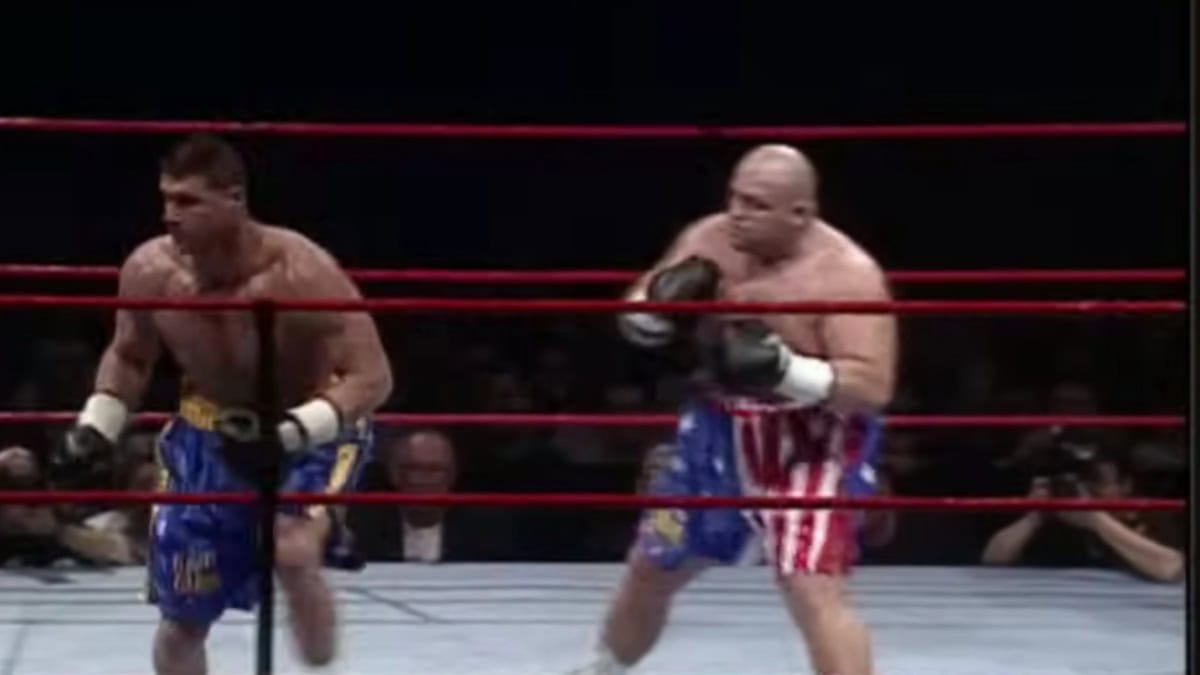
Instead of capitalizing on his knockout power by booking him as a dangerous wrestling character, the WWF booked him into a legitimate boxing match at WrestleMania XV against Eric “Butterbean” Esch.
Butterbean was a professional novelty boxer, known as the “King of the 4 Rounders.” He weighed 400 pounds and hit like a freight train. He was a seasoned striker who made a living knocking people out in legitimate contests. Pitting a wrestler with toughman experience against a professional heavyweight boxer was a mismatch of epic proportions.
Many insiders, including Bob Holly in his autobiography The Hardcore Truth, viewed this booking as a public execution. It was seen as punishment for Gunn knocking out Steve Williams.
The Execution
On March 28, 1999, in Philadelphia, Bart Gunn stepped into the ring with Butterbean. The fight lasted 35 seconds.
Butterbean cornered Gunn immediately. He threw a haymaker that rocked Gunn, followed by a straight right hand that sent Gunn flying into the ropes. Gunn, eyes glazed, tried to stand. Butterbean connected with a final, monstrous overhand right.
Bart Gunn hit the canvas stiff. It was a brutal, scary knockout. His head bounced off the mat. The experiment was over. Bart Gunn was carried out, humiliated on the grandest stage of them all. He was released from the WWF shortly thereafter.
The Aftermath and Legacy
The Brawl for All had zero positive outcomes for the WWF.
- Steve Williams: His career in the US was effectively ended. He returned to Japan but never achieved the stardom in the WWF that was planned for him.
- Bart Gunn: Despite winning, he was fired. He eventually found success in Japan, where his knockout of Williams earned him respect, but his WWF run was ruined.
- The Roster: Multiple wrestlers, including Savio Vega, Hawk, and Brakkus, sustained injuries that shortened their careers or sidelined them for extended periods.
- The Audience: Fans were subjected to weeks of bad television, culminating in a 35-second squash at WrestleMania.
JBL later admitted that the tournament was a mistake, noting that “nobody won.” In the Dark Side of the Ring episode covering the event, Jim Ross expressed his regret, calling it a failure of management to protect the talent from themselves.
The Brawl for All stands as a testament to the hubris of the Attitude Era. It proved that professional wrestling works precisely because it isn’t real. The control, the cooperation, and the protection of the opponent are what allow wrestlers to perform night after night. When those safeguards were removed in favor of a “shoot,” the result was not compelling television—it was broken bones, torn hamstrings, and the destruction of careers.

