


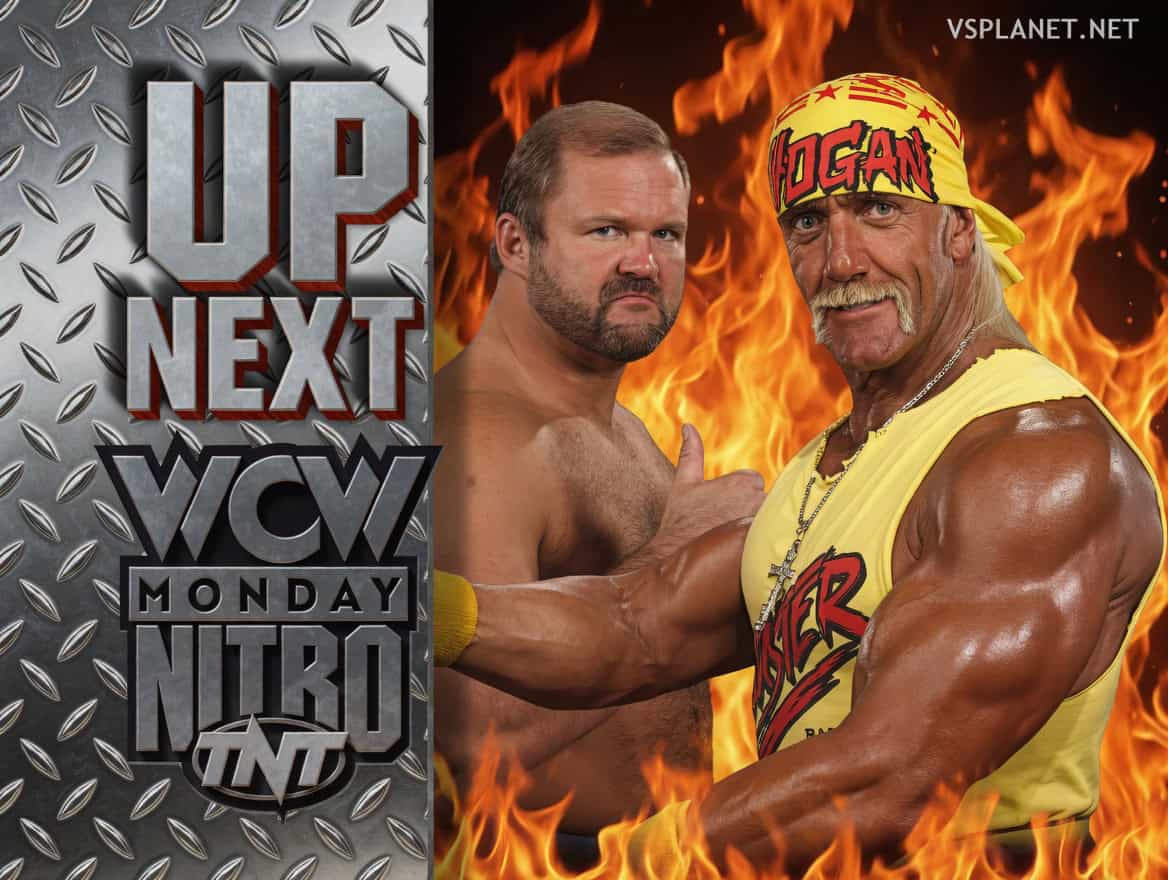
Arn Anderson watched all four episodes of Hulk Hogan: Real American on Netflix with his daughter Aaron the night before his April 2026 podcast. The documentary, which features Hogan’s final interview before his July 2025 death at age 71, hit Anderson harder than he expected.
“I gotta be honest with you, I tell you, I know, I don’t know if this affected anybody else in our business, but I always looked at him as being immortal. And he’s one of those guys that you saw as he got older, there were still traces of Hulk Hogan, you know, even though he wasn’t 300 pounds and he was beat up and bummed up and all that stuff. And it just, I know this is crazy, but it just, it introduced me to my own mortality. He can die. And just like that, you hear that he’s just gone. What’s in store, you know, for the rest of us?”
Anderson said the feeling has lingered. Speaking on his podcast, Straight Talk With The Boss, he framed it as a kind of cognitive dissonance.
“You just don’t feel like you’re just always in the back of your mind, think he’s always going to be there, and you hear about him making an appearance somewhere, and he’s, you know, it’s one of those things that I’ve really gone.”
“Wrestling Years Are Like Dog Years”
Anderson’s co-host Paul Bromwell pointed out that Hogan was 71, the same age Bromwell’s own father was when he died, and called that a young age. Anderson pushed back on the framing.
“Well, you look at wrestling years, it’s not, it’s like dog years. Unless you’ve spent the rear, if you’ve spent 25 years in this business, and you were back from the era where you’re 300, 330 days a year, wrestling twice on Saturday, twice on Sunday, the end of the day, when you got that 70 year old, you’re like 95.”
Asked about the leg drop and the cumulative damage to Hogan’s body, Anderson did not lean on the obvious answer that the move was uniquely dangerous.
“That’s not a big dangerous bump to be given or taken. But who’s to say what your body, you know, it affects different people different ways. And you know, apparently him having to have his hips and stuff replaced and knees and something didn’t sit well with him, that’s for sure.”
The Chiropractor’s Car-Wreck Math
Anderson recounted a conversation with his chiropractor, Pete Hunt of Charlotte, that has stayed with him as the clearest explanation he has heard of what wrestling does to a body over time.
“Pete Hunt here in Charlotte explained it to me one day. He said, no, Arn, and I don’t know what you call her, but when you get thrown down on your back, is the way he put it, it’s like being in a car wreck. Get rear ended, whiplash on your neck, getting rear ended. If you do that 10 times a match, you just been in 10 car wrecks. Man, that was so crystal clear, just that flash moment over time.”
The damage compounds beyond the ring, he said.
“And then getting in a rent a car with the air conditioner blowing, sitting in a seat that’s too little for you. It’s not conducive to being healthy.”
The Travel Was Worse Than The Bumps
Anderson said the post-match drive is the part fans never see and rarely consider when measuring physical wear on wrestlers.
“Well, getting jammed in a rent a car. And the reason I brought it up, after having that 30 minute match, and you don’t cool down properly, and you’re getting around a car, and you take off, and it’s too small. Even the biggest of cars, you know, I mean, Hogan’s six eight, you know, I’m six one, and most cars were terrible to ride in, potentially with the, you know, with the air conditioner blowing on you. And if ever, ever, forbid, if you’re driving, you’re not going to be that comfortable because you’re tensed up, having to drive, pay attention. All that. It’s tough.”
He said it is surprising how few road accidents the era produced given the conditions.
“Only ones on the road. So if you could keep it on the road, you Evan, Evan would sometimes wish an angel down, and you’d get an 18 wheeler in front of you and let him plow the way. You just had to drive slow, take your trip, there was four hours, it would sometimes take you.”
“There’s So Much More Than What People See”
Anderson summed up the mismatch between the perception of the wrestling life and what wrestlers actually live.
“There’s so much more to the business than what people see. People would like to think you got a genie, and you go from being your hotel room, and he blinks, you in the arena, and you’re in the, you know, you’re in the ring, and then you’re out of there, and you blink yourself to the next town, and that same Genie puts you in your bed. There’s a lot of travel involved, and a lot of things involved, eating lousy food late at night, wet weather. There’s always a bad deal, pulling out of an arena where you’ve had a sellout crowd, and all of a sudden it starts snowing and sleeting, and you got 300 mile trip to get to the next town and do the same thing. Very challenging.”
Hulk Hogan, real name Terry Bollea, died July 24, 2025, at age 71 of a heart attack at his Clearwater, Florida home. Hulk Hogan: Real American premiered on Netflix on April 22, 2026, as a four-part documentary directed by Bryan Storkel and includes Hogan’s final recorded interview alongside contributions from Donald Trump, Bret Hart, Jesse Ventura, Triple H, Linda Hogan, and others. Anderson, real name Martin Anthony Lunde, broke into wrestling in 1982 and was inducted into the WWE Hall of Fame in 2012 as a member of The Four Horsemen.
You can click below to watch the full episode.

