


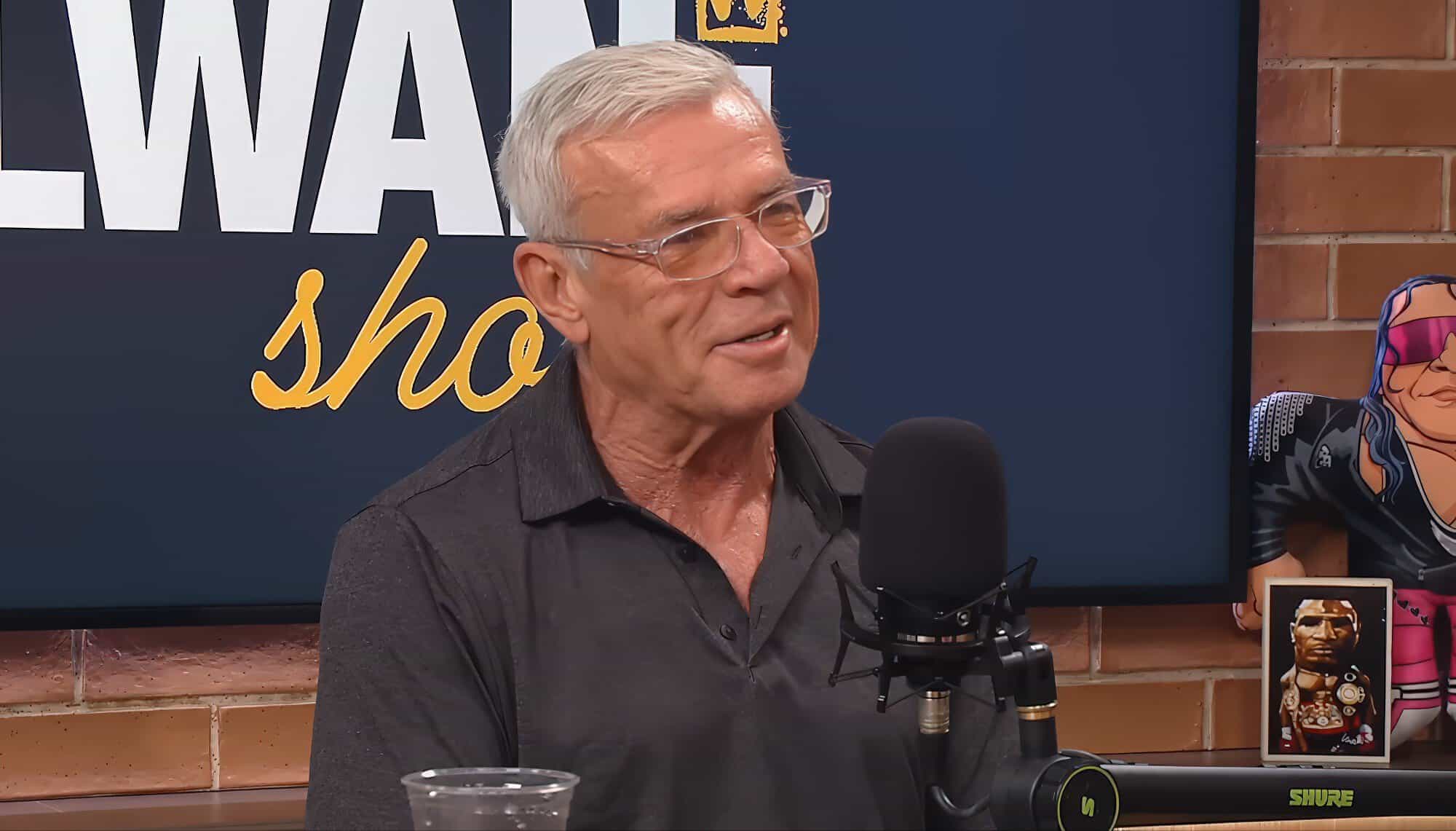
Eric Bischoff thinks a good gimmick and a bit of consistency no longer gets a wrestler anywhere near the top, that WWE going back to running house shows is the smartest investment the company could make, and that the two things are the same argument.
Bischoff was talking on 83 Weeks about why promos matter more now than they did in the era the show usually covers. He started with the television rather than the talent.
“The product has changed. Every aspect of the business has changed, but the presentation and the format. I use the word format. Some people think of that as just a rundown schedule, list of things to do on TV. To me, a format is like the recipe. It’s the special ingredients, the right balance of ingredients that make that schedule of things to happen actually matter.”
“I think the format for television has changed to the extent that it’s putting more pressure on the spoken word.”
He took a swipe at the audience he expects to disagree with him.
“None of the dirt cheap Dave Meltzer fan base will understand. Their head brains will be splattered all over walls across America when I say this, but in terms of what’s working and returning on investment, it’s clear that wrestling is going to a more sophisticated narrative. You’re going to have to get better at it to become a star.”
He put a figure on how much the bar has moved.
“It used to be if you just had a good gimmick and your promos and you were consistent, you were in that upper 10 percentile bracket. Now it takes a lot more than that, because the television audience has become so much more accustomed.”
He said the reason has nothing to do with wrestling.
“Social media, AI especially now, this is going to become even more challenging, because the level of performance that you’re surrounded by throughout your day is pretty good in the world of entertainment. So if wrestling is going to keep pace, the storytelling aspects of wrestling are going to continue to meet a growing expectation from the audience. Reliance upon the narrative word, and a much more sophisticated character development, is going to be a must.”
He said the old approach will not work.
“The days of just going out there and, oh, it kind of reminds me of Terry Funk back in ’74. Good f**ing luck. That s**t won’t fly.”
The show he hosts is built on the era he is dismissing as a template. He said the old promos were not the problem, and that the audience for them is gone. His answer has two parts. The first is the touring schedule.
WWE cut back its non-televised live events over the past few years and has been rebuilding the schedule this summer. Bischoff has spent the past year on the show arguing about what the cutback cost, and was asked whether the current strategy makes sense.
“I like to think it’s very strategic, and it’s smart. I’m glad to see it.”
He said the financial side is what people look at first.
“Obviously the financial part of it is the first thing everybody thinks about. But then there’s the talent side of it, and to a lesser extent, the creative side of it.”
He said reading a crowd cannot be taught anywhere else.
“Unless you get an opportunity to develop your instinct and develop the ability to read your audience in a way that helps direct your moves, your actions, your mannerisms. In other words, you’re using the audience. Hulk Hogan used to talk about it. Ric Flair would talk about it a lot. The Roddy Pipers of the world would talk about it. Jake Roberts would talk about it.”
“They just happen to be the people that are known for commanding control of the audience and telling their stories and selling their characters with the narrative, as opposed to just relying on physical stuff inside of the ring.”
He returned to that point twice.
“Where do you learn that if you don’t get the opportunity to practice it and to develop the skills and develop the instinct? Because you can’t take that s*** in a pill, you can’t read about it, you can’t watch a YouTube show and figure it out.”
“You’ve got to go out there with some great guidance, by the way, and coaching, but you need to go out there and find what works for you, and get comfortable with the voice of your character, as opposed to what you would normally do.”
The second half of the argument is about the audience rather than the roster.
“One of the things that has made professional wrestling such a bulletproof form of entertainment in our culture since the very beginning of television time is the fact that these stars, these characters, these people that the audience connects to because of what they see on television, well, guess what? They’re coming down the street next month.”
“You get a chance to go and see the people that you enjoy watching on TV for about six bucks, or whatever the price of a ticket was. The point is, you get a chance to make a personal connection.”
Bischoff said AEW has never really run house shows either, producing television and pay-per-views almost exclusively, and that the problem is industry wide rather than specific to one company. He said WWE should proceed even if the projections are unattractive.
WWE has been running an expanded live event schedule through the summer, including the Manchester show on August 13 that brought Randy Orton and Alexa Bliss back to the ring for the first time in months, and the Fairfax show at which CM Punk told Cody Rhodes he could have a rematch whenever he wanted.
The second part of his answer is coaching, which he was in the middle of setting up when he left WWE in 2019. A research company had been brought in before he arrived to audit WWE’s creative process, at the board’s instruction.
“Prior to my getting to WWE, there was a research company that came in to do essentially an audit of the entire creative process, amongst other things. Other divisions went through the same, and I’ve been through it before. I went through it twice at Turner, so it’s not an unusual thing at all, especially for publicly held companies to go through these.”
His own job was one of the recommendations that came out of it.
“As a part of this mandate by the board of this audit, the creative department, the television side, the broadcast side, production side, all were going through this audit when I got there. It had already started, and I think the job titles of executive director in my case of SmackDown and in Heyman’s case of Monday Night Raw were part of a suggestion by this audit group of ways to improve the operations at WWE.”
Bischoff and Paul Heyman were appointed to those roles in June 2019. Bischoff lasted until October.
Acting classes were another of the group’s suggestions, and he was careful to say Vince McMahon was not simply humoring the board.
“I think Vince was going along because it was a board thing. He needed to play nice in a sandbox at least for a while. One of the things that became a focus was acting classes, and Vince was quite committed to it. By the way, I don’t want to suggest that he was just going along because someone suggested we should try it. He was very, my impression for the short period of time that I dealt with him on it, was that he wanted to see if it would work. He wasn’t going through the motions.”
He got as far as scheduling.
“I actually began trying to initiate it and start setting it up schedule-wise and working with Michael Hayes on the live event schedule and the TV side to try to see when we could start scheduling. We had to coordinate with the talent schedule and the coaches. So I know the project was at least initiated to that point. I just don’t know where it went after I left.”
“I don’t know if it was an ongoing thing and just died out slowly, or for whatever reason they put a bullet in it.”
His pitch now is narrower than acting lessons. He wants a coach who specializes in short-form promo work, traveling with the live event loop.
“Find somebody who’s a really good acting coach that understands all of the elements and characteristics that make good actors, especially good young actors, learn quickly. And rather than trying to turn them into stage actors or film actors necessarily, learn what it takes to deliver great promos in short form narrative.”
“These guys aren’t going to go out there and run lines. Teach people how to go out there and kick the s*** out of a minute and 30 seconds. So when they wrap that up, the crowd is just as excited about listening to their promo as they are watching the finish in their match.”