


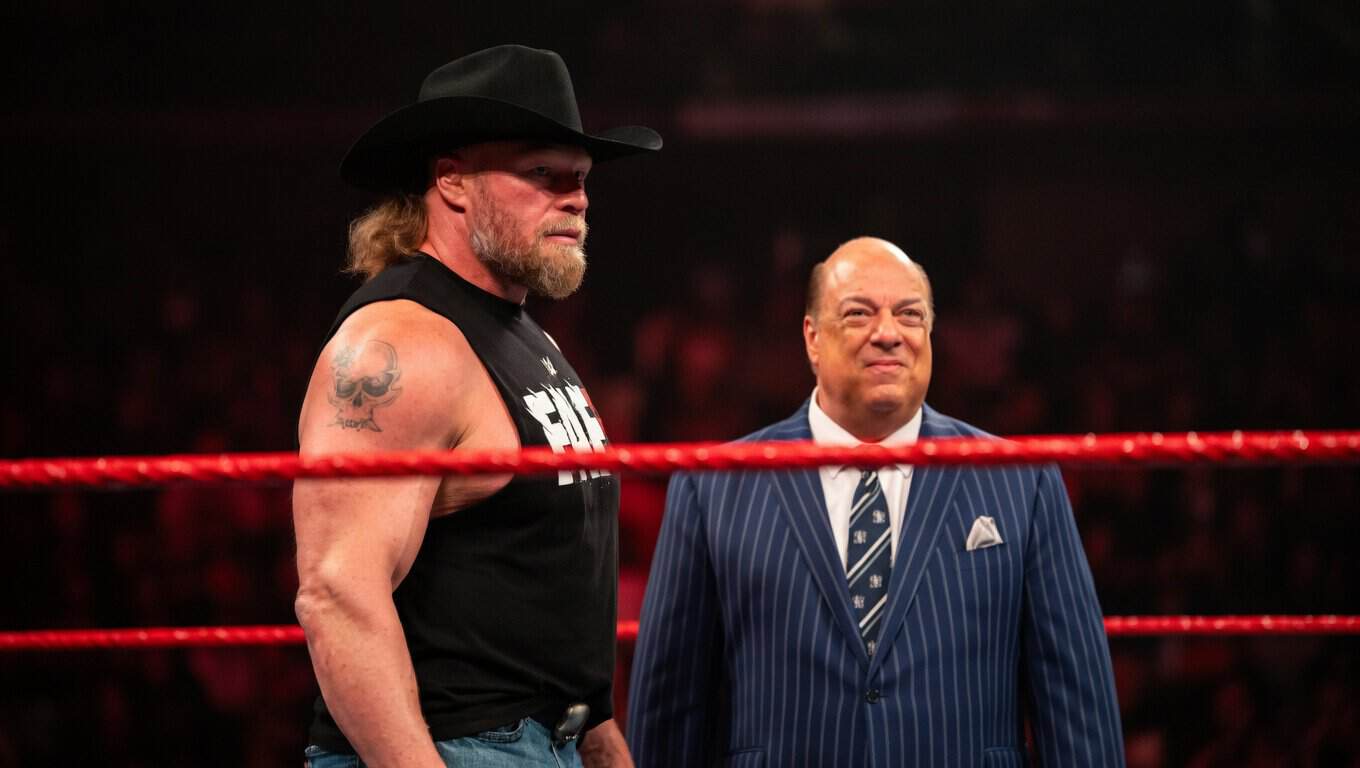
Paul Heyman thinks Brock Lesnar ending the streak is what his generation will remember, the way earlier ones remember Hulk Hogan slamming André the Giant.
Heyman was in the ring for it, as Lesnar’s advocate, when Lesnar beat The Undertaker at WrestleMania 30 in April 2014 to end an undefeated run stretching back to 1991. Speaking on The Undertaker’s podcast Six Feet Under, he described what happened in the building as it became clear the count was going to three.
“You feel the rumble in the crowd, like, oh my God, this is really, we’re witnessing something that we thought we’d never get to witness.”
He said what an audience takes away from a match is narrower than the match itself.
“That tells a lot about our industry, in that it’s not about everything. It’s about the moment that people remember. The finish that people remember, the moment that people remember, the emotion. They don’t have to really remember the match itself.”
“If this is what you’re building towards, if that moment is what you’re building towards, and you deliver it, that’s the memory. That’s what people take home with them.”
He put it alongside two earlier ones.
“As much as Hogan and André from WrestleMania III is the WrestleMania moment of the early days, or Steve Austin and Mike Tyson being the Attitude Era’s moment, to me, this generation, that’s the moment.”
He said the reaction to it has not gone away.
“Twelve years later, it’s still a sore spot because of that.”
The match took place on April 6, 2014, at the Mercedes-Benz Superdome in New Orleans. Roughly 75,000 people were in the building. Lesnar won with three F5s in a match that ran a little over 25 minutes. It was The Undertaker’s 22nd WrestleMania match, and he was 49. Lesnar was two years into his second WWE run, having returned the night after WrestleMania 28.
The two matches Heyman puts it beside are Hulk Hogan slamming André the Giant at WrestleMania III in 1987 at the Pontiac Silverdome, and Steve Austin against Mike Tyson at WrestleMania 14 in 1998. After the three-count, the camera cut to individual faces in the crowd rather than to the ring, and WWE has used those shots repeatedly since. The finish had not been widely reported in advance, and the streak had survived challenges from every main event act of the previous decade.
The streak stood at 21 wins going into the Lesnar match. It began at WrestleMania VII in 1991 with a win over Jimmy Snuka and took in matches against Shawn Michaels, Triple H, Randy Orton, Edge, Batista, and CM Punk, among others. Several of those were built on whether the number would survive rather than on a title or a grudge.
Not everybody has agreed with Heyman in the years since. The common hot take is that a streak can only be ended once, and that what WWE got for it was a part-time Lesnar. He squashed John Cena for the WWE World Heavyweight Championship at SummerSlam four months later, hitting sixteen suplexes in a match that ran under seventeen minutes, and held the title into the following spring, working a handful of dates a year.
The Undertaker suffered a concussion in the match and has said he has no memory of it. He talks about that at more length on the same episode. Taker returned the following year with a win over Bray Wyatt.
Lesnar confirmed his retirement this month after losing to Oba Femi inside Hell in a Cell at SummerSlam, which turned out to be his last match. Heyman managed him across his entire WWE career. The Undertaker retired in 2020 and now runs creative for AAA.