


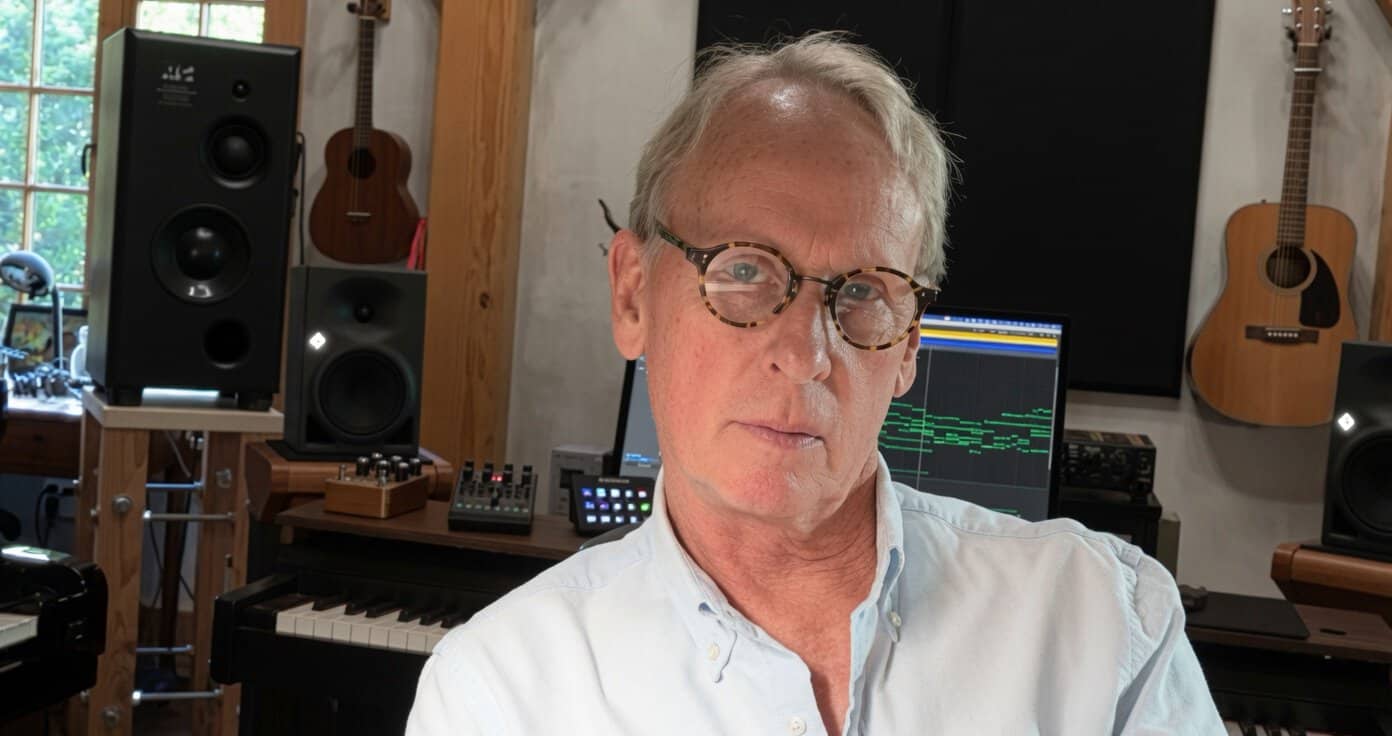
Longtime WWE composer Jim Johnston, who wrote the company’s entrance music from 1985 until his departure in 2017, sat down for a nearly two-hour interview on The False Face podcast with host Paul McNamee. Johnston pushed back on Steve Austin’s account of how the Stone Cold theme came together, confirmed Brock Lesnar’s theme was written for the XFL, and said neither WWE nor AEW is creating big stars anymore.
The full video interview is below.
The Stone Cold theme and Rage Against The Machine
Austin has said in past interviews, including on his own podcast, that he brought Rage Against the Machine’s “Evil Empire” album to Johnston and pointed to “Bulls on Parade” as the energy he wanted for his theme. When McNamee raised the story, Johnston answered, “I’m not sure that ever happened.”
Johnston said the theme predates any conversation with Austin:
“The creation of that theme happened way before I ever met Steve, because it started with his promos. There were a series of promos when they transitioned him from Ringmaster, and these two producers, friends of mine, David Sahadi and Chris Chambers, who did some unbelievably creative stuff, they had this idea for a series of things that they shot up in this really beat up, dark, destroyed warehouse in upstate Connecticut, and they were almost poetic. I remember one final line was Steve saying something like, ‘You want forgiveness? Go to church.'”
He continued, “At the time, I saw the vibe of the promos, and what I came up with, the first version of Steve’s theme, was a score for those promos. I did sort of orchestral type stuff for 90 percent of the promo, and each one of them had a tagline, and boom. It needed something that kind of kicked you in the ass, and that’s when I came up with it.”
Johnston said the glass break was already part of the music “in those promos.” He allowed that Austin may have gotten involved afterward: “Maybe he came to me later, either directly or indirectly, and said, this is the energy I want. But so maybe he didn’t like the first version or something.” When McNamee said, “Steve, if you’re watching this, let us know,” Johnston joked, “Yeah, Steve, you pain in the ass, trying to bury me.”
“There are no new Steve Austins”
Johnston was blunt about the state of entrance music today and connected it to star creation across both major companies:
“It just sounds like noise to me, and all the themes just sound generic. It used to be, whether it was my music or a Jimmy Hart theme or an outside band thing, you used to be able to be making dinner in the kitchen with the TV in the other room, and you’d know who was coming out. You could almost follow the program from the other room. Now, I just don’t think it’s like that at all. And for some reason, the powers that be have forgotten their roots or something, of how powerful music is in creating stars. And I further believe that’s why they’re not creating, either WWE or AEW. They’re not creating big stars anymore. There are no new Steve Austins. There are no Rocks around now. And it’s because everyone’s sort of in this layer of generic.”
He added, “I think that happens to a lot of corporations. They find what works. They’re making a lot of money. And, oh well, we must be doing it right. So don’t change anything.”
Johnston credited Vince McMahon on this front: “He was always trying to push the envelope forward. Sometimes he pushed it places that I certainly didn’t agree with. But at least the guy was embracing progress and change, and how can we make the product even better than it was yesterday. And that was a compatibility that he and I really had, because I always wanted to try different things and make the music better.”
Brock Lesnar’s theme was written for the XFL
McNamee noted that Lesnar’s theme was used as walkout music for the XFL’s Chicago Enforcers months before Lesnar debuted, and asked whether Johnston wrote it for the football league. “I wrote it for the XFL,” Johnston confirmed.
“The whole XFL thing was awkward at best,” he said. “I get what Vince was trying to do, and he had a much bigger impact on the world of professional football than he ever thought he was going to have, in that the vast majority of innovations that came to pass in XFL, in terms of camera coverage, the cameras flying above the stadium, and much more character development, learning much more about these people, that is the NFL playbook now. I wrote themes for all those teams, and it was a great effort, but it just never sort of clicked. And when Brock showed up, it isn’t like I suggested that. It’s just like suddenly that music showed up for Brock.”
“Sometimes the stars align,” Johnston added. “Maybe, going back to truth, that music finds its rightful home, because that is perfect for Brock.”
Johnston pointed to a famous precedent, asking McNamee who he thinks of when he hears “Real American.” “Not written for Hulk Hogan,” Johnston said. “It was for a tag team. I’ve forgotten the name of the tag team.” The Rick Derringer song was originally used in WWE for The U.S. Express, the team of Mike Rotunda and Barry Windham, before it became Hulk Hogan’s theme.
Refusing to watch the shows
Johnston said he was given “tidbits, and I truly mean tidbits, about the person’s vibe or character” and then left with free rein, sometimes with as little as 90 minutes of notice. “They would be writing the shows right up until the show went live, and sometimes after,” he said. “They didn’t even know what the final match of the night was going to be. Because of that, new people would be introduced suddenly. Someone may change from a babyface to a heel. Maybe two guys suddenly are a tag team because of a story change.”
He also described a running disagreement with WWE executive producer Kevin Dunn over whether he needed to follow the product:
“This was an eternal argument I had with my boss, who was the executive producer, Kevin Dunn. He was always, ‘Jim, you have to watch the programs,’ and I just resisted, probably first and foremost because I’m not a wrestling fan. I didn’t really want to watch the programs, but I think it was curiously one of the most valuable things, my separation from it. I don’t think John Williams needed to study aliens to come up with the score for E.T., or that he needed to study the oceans to come up with the theme for Jaws.”
“I always approached it as nothing but a movie score to these individual guys,” he continued. “Each of these guys is their own little film. They’re the Harrison Ford or Brad Pitt of that film, and I’ve got to do the main theme to that film that makes you think of that film when you hear it.”
That approach extended to the locker room. “I have had very little interaction with the talent,” Johnston said. “That was absolutely by choice, because it always ended badly. It’s extraordinary how few wrestlers really understand that part of the business. This is not about getting a piece of music that is similar to what you like to listen to in the car when you’re driving around. Steven Spielberg is not using music for movie scores that he happens to listen to when he’s having a glass of wine with his wife on Friday night.”
“If I had to deal with talent, I would inevitably hear either two lanes,” he added. “One is, well, I love Metallica, so I’d like it to be kind of a Metallica vibe. Or it’s, I love Stone Cold’s music, I love that whole attitude. And of course, the first thing I want to say is, well, there’s only one problem with that: you’re not Steve Austin. Part of that magic is Steve. He dances with that music perfectly.”
Pushing back on hip hop themes for Black wrestlers
Asked about ethnic sounds in entrance themes, Johnston said some choices made sense as WWE expanded internationally, but he objected to one pattern:
“I remember particularly pushing back on, if a black guy came in, it was hip hop. It was like, why is it hip hop? Not all black people like hip hop. Why can’t it be rock and roll? Why can’t it be opera? Why can’t it be whatever, wherever it wants to go? And I think there’s always a reasonable argument for saying that’s the best way to make this person stand out, is by having their music be not what you’re expecting it to be.”
Recording the D-Generation X theme with Chris Warren
Johnston said the D-Generation X theme, with its extended spoken intro, “broke all the rules. I couldn’t believe that I got that one through the door, because long intros as entrance themes” were considered off limits. He explained how the ad-libs with vocalist Chris Warren were captured:
“I had a microphone here, and I put Chris right across from me, and then I did like a 10 minute or 20 minute loop, and I just started saying things. I said, just say whatever I say, but in your ‘go f— yourself’ tone of voice. I was living out the dream of being a threatening wrestler or something. It’s like, you think you can tell us what to do? I had so much material to work with, and it was hard to narrow it down to the ones I used.”
Working with Motorhead and Lemmy
On Motorhead recording Triple H’s music, Johnston said the band covered three of his songs and recalled his first impression of Lemmy: “I was sort of nervous going in, particularly Lemmy had a pretty solid reputation, and when I was with him, he couldn’t possibly have been more of a gentleman. He wasn’t crazy. He wasn’t drunk out of his mind. He wasn’t acting weird. The band was very responsible and just wanted to do a good job. They did a great job.”
Johnston also said, “I remember making demos of the song and singing them with my best Lemmy.”
The Scotty 2 Hotty samples
McNamee played Johnston samples he had traced in Scotty 2 Hotty’s theme, one from the original 1954 Godzilla and one of actor Peter Cushing in the obscure French film Tender Dracula. Johnston said he had no idea of their origins because they came from commercial sample discs: “I never did the sampling thing where I sampled it off of someone’s record. The only time I used samples were, you buy sample CDs from a company, like buying sound effects. I have never lifted something off somebody else’s record.”
He said sampling other artists’ records was never an option: “As a corporation, that was legally way off the table, and it was just way off the table for me because I am not an admirer of that.”
The Undertaker, library music, and heel themes
On replacing The Undertaker’s original theme after roughly eight years, Johnston said, “It had been a long time, and I think Mark was ready to move to something a little different. Then later he moved to the motorcycle guy for a while, which I think never really worked out. It’s tough to do the same thing night after night. It’s the eternal problem of incredibly popular bands, where the crowd wants to hear the greatest hits and the band wants to play the new music.”
He also said the Gaelic phrase at the top of the Ministry of Darkness theme came from The Undertaker himself: “I was given that from him saying it. It was from some promo he did.”
On WWE’s use of library music for acts like The Hardy Boyz and The Dudley Boyz, Johnston said he understood the necessity given the volume of shows, but disliked being asked to recreate those pieces later: “I hated having to stay in the lane. I hated it. But sometimes those things were business decisions, when Vince realized that by using library music, we’re giving all that publishing income away. So there’s a business money factor in that decision as well. But I hated being told, can you do a ripoff of this piece of music?”
He named another early frustration: heel music. “That was a bone of contention for me early on, when heels first started getting themes. They didn’t get good music; they got gimmicky music, because to communicate their heel, you’re supposed to hate them. You can’t like anything about them. In movies, generally it is the bad guy who gets the most impressive theme.”
Johnston said he has never had writer’s block, describing his challenge as the opposite: “I’ll be working on something, and I’ll be at the piano, and suddenly while working on Paul’s theme, I do this little ditty and say, oh, that’s cool, I like that, and then I want to work on that. So distraction. I really have to work hard on having the discipline to focus on one thing and finish it.” He also confirmed he still has master recordings of his WWE work, “right down to the original, just the very first idea put into a little handheld tape recorder.”