


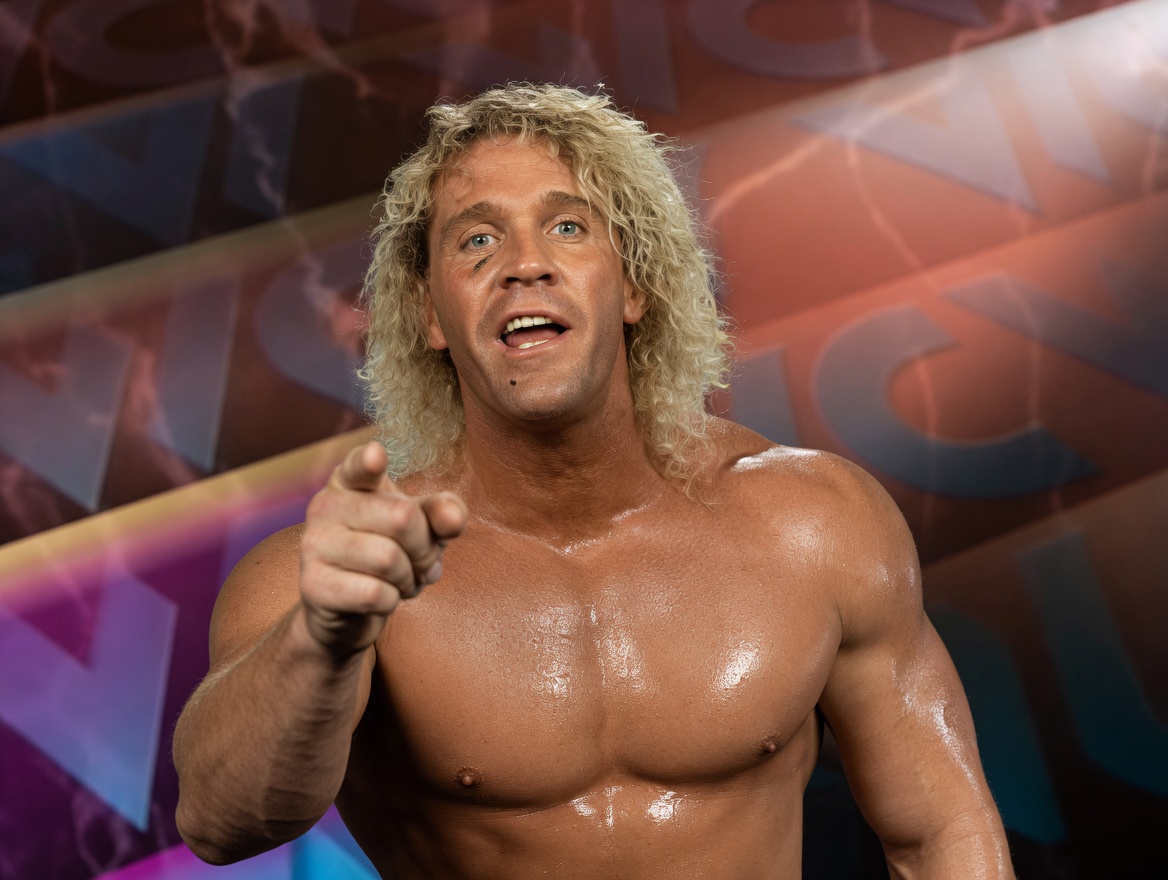
When the death of former WCW star Van Hammer at age 66 came up on Arn Anderson’s podcast, Anderson did not pretend the two of them had been close. He gave an honest assessment of a wrestler who arrived in WCW with massive expectations and a major contract and never settled into the business the way the company hoped he would.
“I wasn’t close to him. I worked in the same company as him. I’m so sorry that he passed away at an early age. I feel that way, but I think that he was brought into the business without having a full thought process, what he’s getting into, you know, he felt like the look was everything, and he had a great look. You know, he’s probably six, five, probably 270 pounds. Well, he looked the part. You know, he had that gimmick with the guitar and souped up jacket, and I just think that he was probably thrown out there like a lot of guys were in that time too soon.”
Mark Hildreth, known as Van Hammer in WCW, died on April 18, 2026. The cause was pending an autopsy at the time. Marc Mero broke the news of Hildreth’s death on social media on April 19. Mero and Hildreth had trained together under Boris Malenko in Tampa, Florida, and Hildreth had served as Mero’s opponent in his 1991 WCW tryout, with Dusty Rhodes signing both men off the single match.
Anderson’s reading of Hammer’s WCW arc on his podcast, Straight Talk With The Boss, lined up with what has been written elsewhere about the wrestler. Mick Foley wrote in his autobiography Have A Nice Day that Hammer had two things working against him: he was given a push well before he was ready, and he was given the gimmick of a heavy metal guitar player despite not being able to play.
A $156,000 Contract And A Push Before He Was Ready
Hammer arrived in WCW in 1991 with a reported $156,000 contract, a music video budget that ran into the tens of thousands, and an introduction at Clash of the Champions XVI in September 1991, where he squashed Terrance Taylor in 39 seconds. Standing six foot six and billed at 280 pounds, he had the physical presence WCW wanted to push as a marquee young wrestler. Dusty Rhodes openly compared him to Hulk Hogan and saw him as a future major star.
The problem, by most accounts including Mick Foley’s, was that the push came before Hammer had the in-ring foundation to handle it. Hammer was also known to bury himself with the locker room. According to Foley, statements like “I came here to save the company” did not sit well with wrestlers who had paid their dues for years and did not have their own $25,000 music video.
Anderson recounted on his podcast the moment Hammer first introduced himself to a group of WCW veterans, telling them he was “WCW’s Ultimate Warrior.” That story has been retold elsewhere as a textbook example of how a young hand should not enter a locker room.
Anderson Did Not Sugarcoat The Career
The structural problem Anderson identified was not unique to Hammer. The early-to-mid 1990s WCW had a pattern of finding tall, muscular young wrestlers and pushing them onto national television before they had built the in-ring vocabulary that would let the push stick. The look was everything. The work was secondary.
“He felt like the look was everything, and he had a great look. He looked the part. He had that gimmick with the guitar and souped up jacket. And I just think that he was probably thrown out there like a lot of guys were in that time too soon.”
Hammer’s WCW run included a stint with Raven’s Flock in the late 1990s, where the bleach-blond rocker character was traded for a brooding, miserable outsider gimmick that suited him better. He stayed with WCW through nearly the entire 1990s before the company folded in 2001, then transitioned to occasional independent appearances. His most notable later moment came in 2009 at MCW, when he came out of retirement for one night to defeat a younger wrestler who had cut a promo calling him washed up.
A Different Era Of Recruitment
The point Anderson kept circling back to is the recruitment and development culture of WCW in that era. The promotion signed wrestlers off looks alone and assumed the rest could be taught on national television in front of millions of viewers. Some of those wrestlers, like Lex Luger, made it work over time. Others, like Hammer, ended up in a position they were not prepared for, with a contract that put a target on their backs.
Anderson’s tribute to Hammer is one of the more honest assessments a longtime wrestler can give about a peer. He acknowledged the death, expressed sympathy that Hammer died at 66, and was upfront about not knowing him well. He framed the rest of his answer around what he saw of the booking around Hammer rather than the man himself. The implication is that the WCW system that put Hammer on TV is more responsible for the way his career played out than Hammer is.
Mark Ty Hildreth was born on November 1, 1959. Before wrestling, he served in the U.S. Navy. He trained under Boris Malenko in Tampa alongside Marc Mero and Dan Spivey. In 2020, Hildreth was arrested in Palm Beach County, Florida, and charged with DUI and felony hit-and-run after striking a five-year-old child on a bicycle while driving 58 miles per hour in a 35 mile per hour zone. Anderson, real name Martin Anthony Lunde, debuted in 1982 and was inducted into the WWE Hall of Fame in 2012 as a member of The Four Horsemen.
You can click below to watch the full episode.

